One of the greatest pleasures we derived from life afloat arose as the sea was effectively our back garden. In the Tropics it is nicely warm, typically 28-32°C with visibilities often in excess of 50m. We have both been water babies all our lives, starting scuba diving over fifty years ago. Di now has problems clearing her ears so is limited to snorkeling which is no problem as Dave only dons full scuba gear for excursions to significant depths at special locations, especially wreck sites. In fact, much of the most interesting marine life generally resides at depths of less than 10m. Our list of these memorable remote sites includes Tobago, Los Roques in Venezuela, Bonaire, the San Blas Islands of Panama, Galapagos, Tuamotos, Easter Island, Samoa, Wallis Island, Tonga, Fiji, Vanuatu, the Australian Great Barrier Reef, Flores in Indonesia and the magical Similan Islands off Thailand.
Firstly an apology, as this specialist section of our site has become overlarge as there were just so many images to choose from, 3663 in fact! After not inconsiderable effort, this has been reduced to a mere 204. In order of appearance there are five groupings :-
Introduction to people and equipment (10), Fish (32), Other marine creatures (102), Hard corals (30), Soft corals and anemones (17) and Wrecks (13).
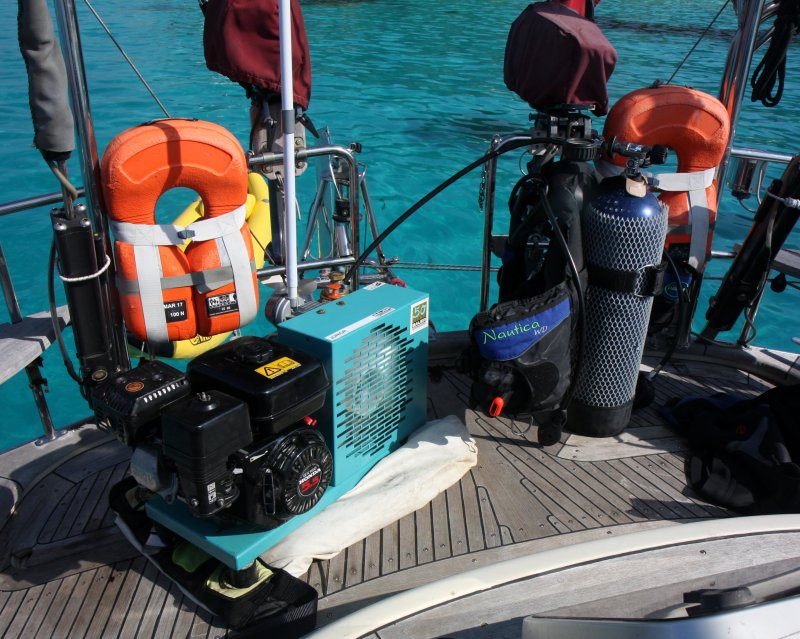
An essential bit of kit, our Bauer Junior compressor which meant Dave could dive extensively in these remote areas which were often where the best unspoiled marine environment was to be found.
We left on our voyage with a Reefmaster underwater camera in a stout, yellow, plastic case good to depths of 50m. Inside was a pretty basic 35mm wet film, automatic camera with a red compensated flash. (seawater colouring filters out lower-end of the visible spectrum rendering underwater scenes blue/green). Getting good results was hard work, as framing a shot underwater of what is usually a moving target presents quite a challenge, especially as the optimum distance to the subject should be between 1 to 2m. Initially the results were often discouraging with most fish either only partially within the frame or way off in the dim distance. However, as in most things, perseverance along with scanning followed by computer processing often improved the images no end but then there was the limitation of a maximum of only 36 pictures on each dive. This all changed when we acquired our first digital underwater camera with housing, in Singapore in 2004, using it for the first time on Di's birthday on the small uninhabited island of Kelisi in the Tongan chain.

Sadly, this took-in water in Indonesia in 2007 when part of a strap caught in the sealing ring. We moved on then to a Canon IXUS 860 camera (8Mp, 3.8x zoom, 3" display) with a 40m underwater housing which gave excellent results. Dave often took these housings to well in excess of their rated maximum depths without failure. The Canon went to over 50m several times whilst diving on the wreck of the President Coolidge, a US 2nd world war troopship in Vanuatu. They are designed such that under increasing pressure they seal even tighter. Their operating limit is eventually reached when the housing distorts to a point where the controls fail to move freely.
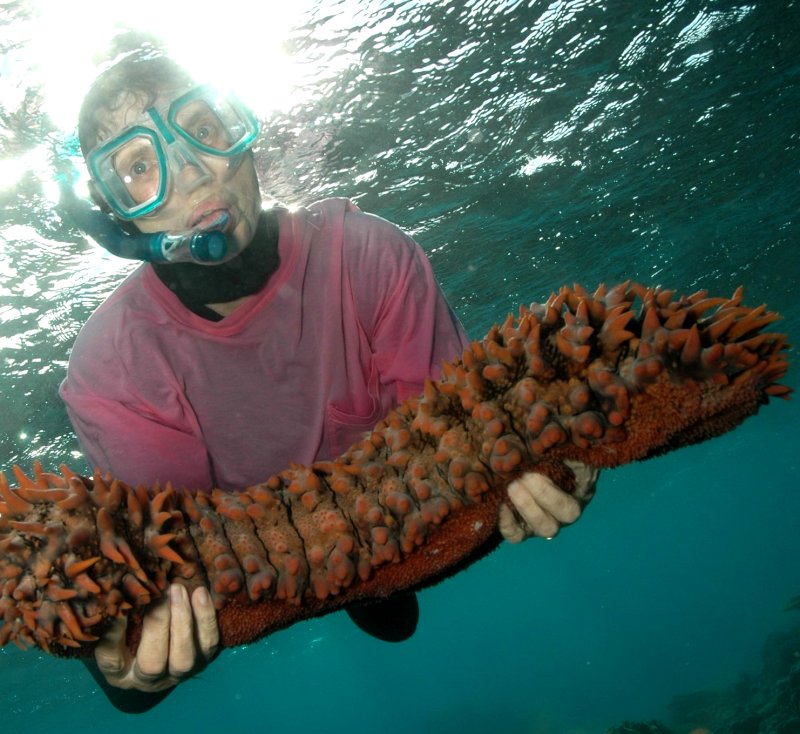
Now to a few images of ourselves and a few of our diving friends. Naturally, the admiral comes first, here carrying a holothurian (Thelenota ananas) on the Hasting section of in Australia's Great Barrier Reef near Cairns. Note that we are always wearing wet suits or thinner 'skins' to provide essential protection from the sun's UV rays on excursions that often extended to up to 4-5 hours. Here Di has an additional tee-shirt as she is hoping she will look less like a seal to any shark in the vicinity.
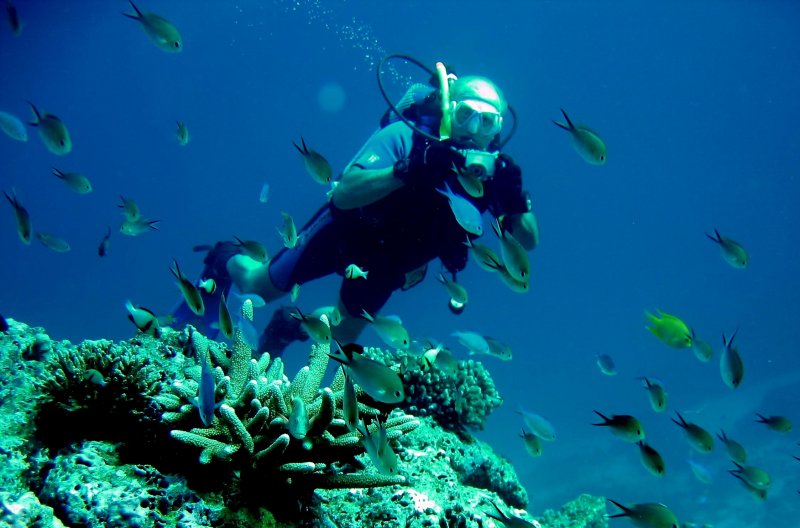
Dave, at depth, doesn't have to worry about the sun's rays or even keeping warm in most of the tropics, hence the shorty wetsuit. Here he is on a reef in the Similan Islands off Thailand's NW coast, close to Myanmar (Burma).
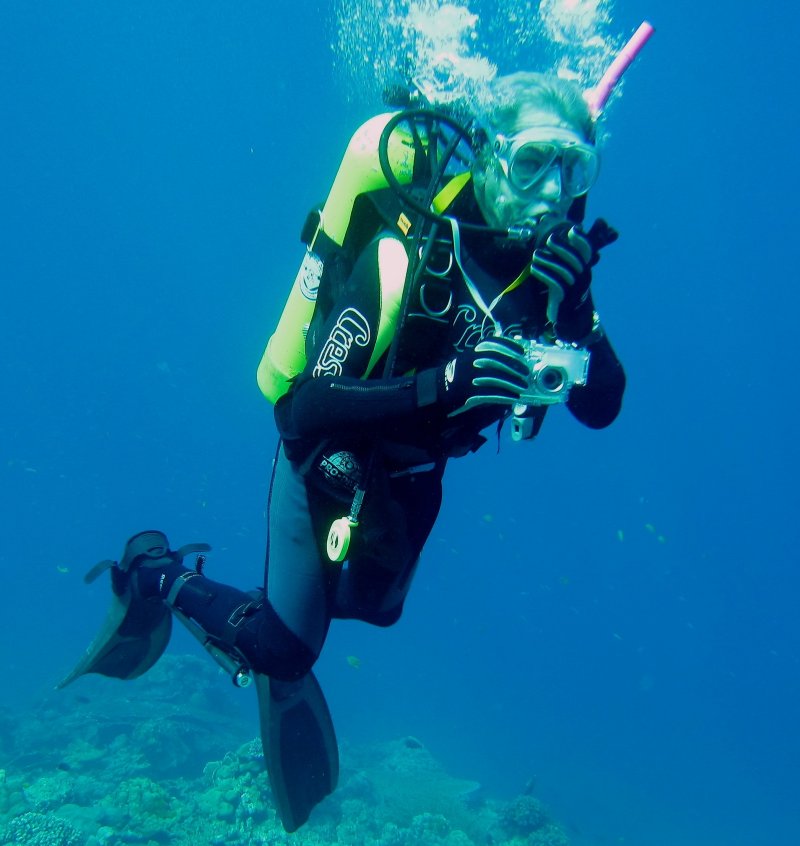
SCUBA diving is quite safe provided you are well trained and approach each dive cautiously after careful planning. Above all, you never dive alone and must have a buddy in whom you have ultimate trust. The unforeseen happens, wrecks are particularly dangerous, so to have immediate help and maybe share an air supply is essential. We met Alfred and Rosemary on Ironhorse way back in Trinidad in 2000. Not only did have an amazingly close friendship but he had a background in the Marines special forces so made an ideal dive partner.
We met Keith and Carol from Kirsten Jayne in Tahiti in 2002. They were Channel Islanders on their second circumnavigation, travelling at a similar rate to ourselves so we were often in dive sites together.

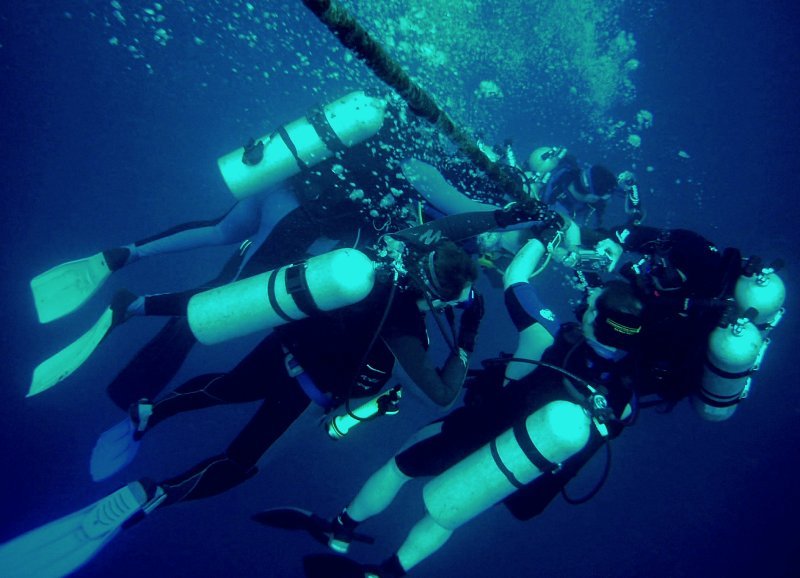
Quite a few cruisers dive and the sound of our compressor often brought them around for a refill or the chance to exchange intelligence on good sites. Here are a group of us decompressing around 12m down the buoyed line to the wreck of a Sandringham flying boat (civilian version of the wartime Sunderland) in a remote area of Villa harbour in Vanuatu. Divers need to do this to allow the dissolved nitrogen that gets into the blood under pressure to be released. If one came to the surface too quickly bubbles might form in the bloodstream, known as an Embolism or the Bends which causes muscle pain at best and death in extreme cases.
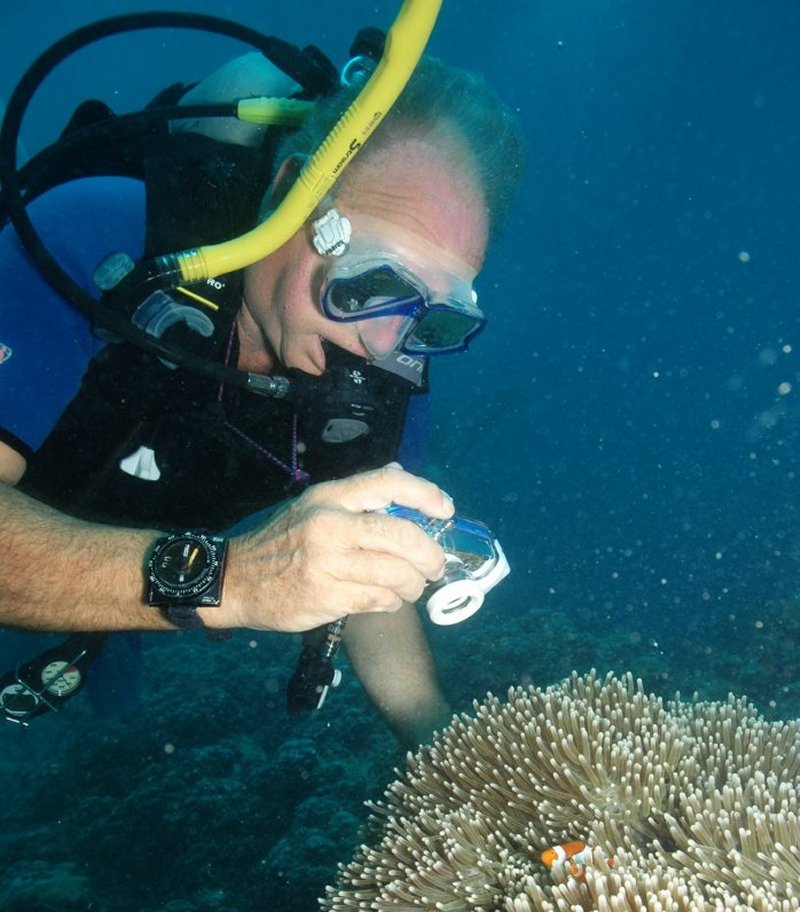
Here's Dave photographing an anemone fish within a sea of anemone on the Great Barrier Reef off Queensland, Australia.
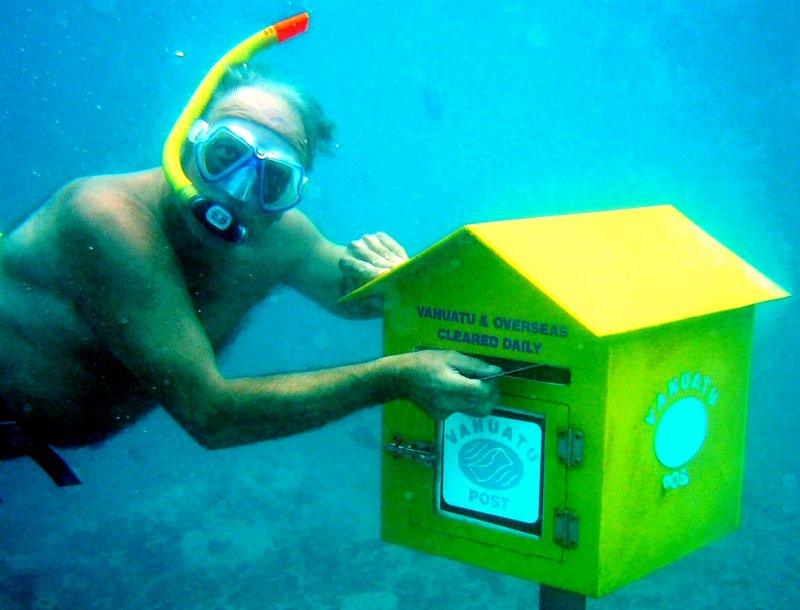
It's really amazing what you can get up to under the waves. Here Dave is posting some postcards offshore on the island of Efate in Vanuatu.
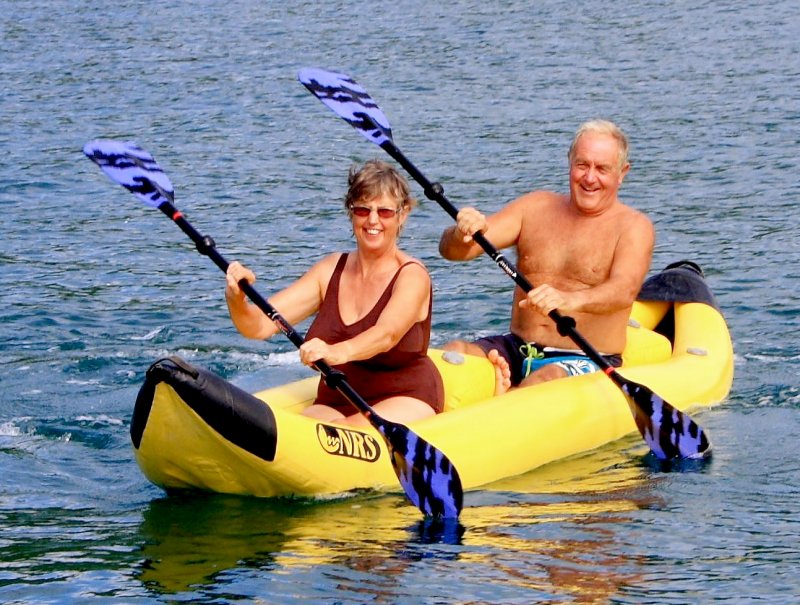
Getting around extensive, shallow reef systems which were often well removed from an anchorage was always a problem in an inflatable using an outboard motor with it's unprotected propeller. This was solved by our two person inflatable canoe, christened "Yellow Peril" by our friends in the fleet. It was incredibly stable, could be climbed back into from the water easily and was even capable of carrying a diving tank in the back section. Needless to say it was also extremely popular with the grandchildren when they came to visit. Now it resides in our workshop awaiting the right day to continue its new career on the coasts and rivers of the UK.
Now to the marine life beginning naturally with fish. As the letter 'A' introduces the alphabet, we'll begin with anemone fish.
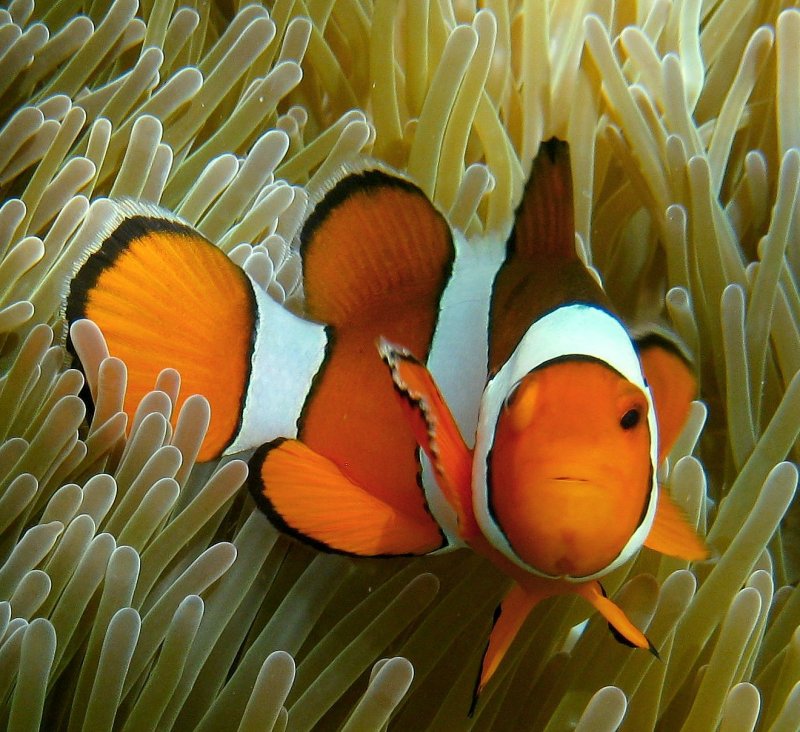
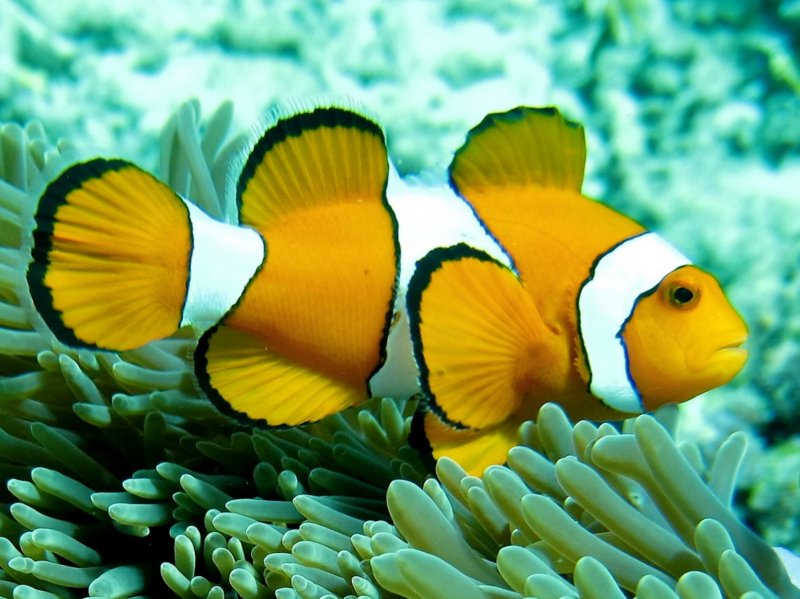
Always a favourite, anemone fish are forever associated with the film Nemo. They invariably live within the protection of the sea anemone, which has a protective mucus, poisonous to most creatures that come into contact with it. The anemone fish have a natural protection so their symbiotic relationship with their host which includes a fierce patrolling of its patch, offers yet further protection.
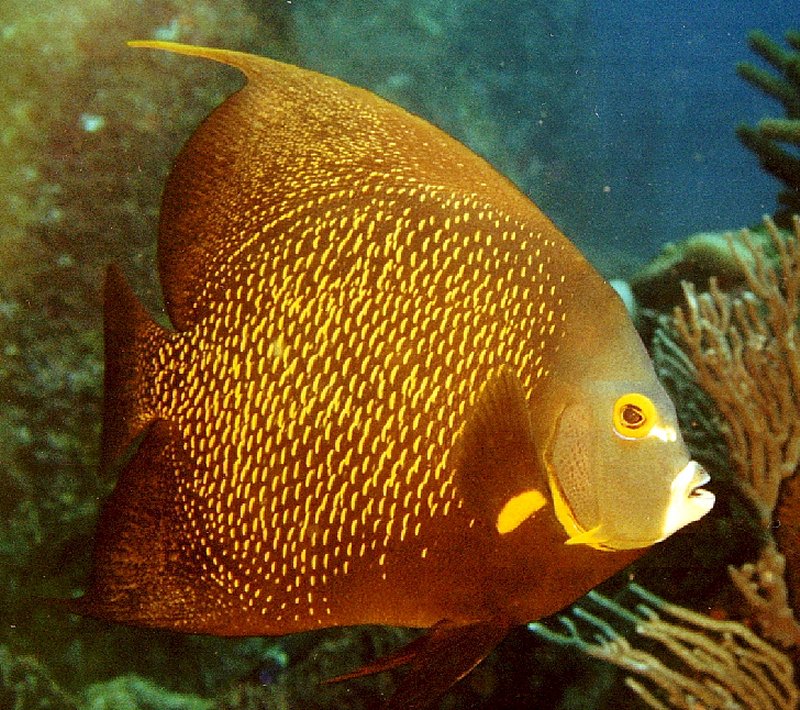
One never ceases to be enthralled by nature's and evolution's variety, especially the colouration and design. Given the most extensive paint box and an endless supply of paper, it would be difficult to better what has evolved naturally under the waves. Not only is there often a stupendous variation within one specie but also differences between the young and mature versions. Just four examples of nature's creative imagination now from the Angel fish family.
These French angelfish at around 45cm long are much bigger than the average fully developed members of the specie. This is due to the upwelling of a cold current rich in nutrients and food which flows up the east coast of South America, surfacing close to the north coast of the lovely island of Tobago. This image was one of Dave's earlier attempts with a 'wet-film' camera. The contrast with the quality and especially resolution of the digitally captured image of the next example of these beautiful fish is obvious.
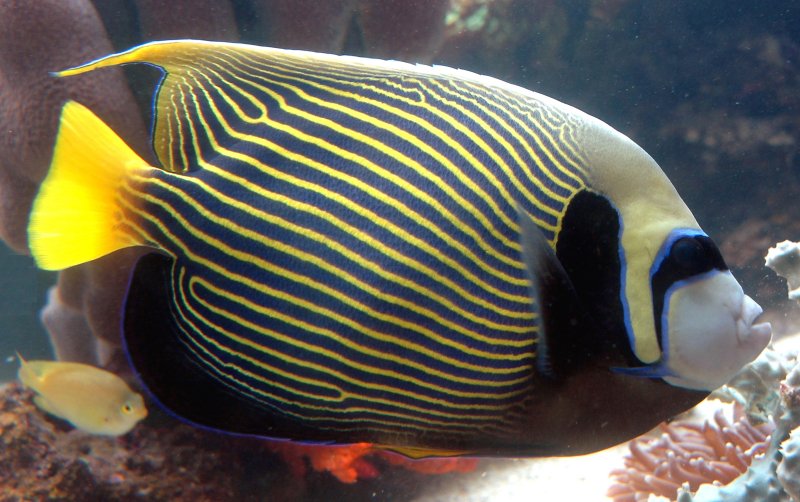
Angel fish have always been a favourite since we first saw them in the Caribbean. Amongst tens of variants we've come across, this one, the Emperor has to be the most stunning. This superb adult example we saw in 2004 at the remote Wallis Island a French territory between Samoa and Fiji.
Angel Fish are relatively approachable, being often seen in pairs which one would like to believe are stable male/female relationships. They also have distinct and equally eye catching markings in their juvenile stages. When we began serious classification of our rapidly burgeoning collection of marine images, we were delighted to find many branches of the family with links that we had failed to recognise before.
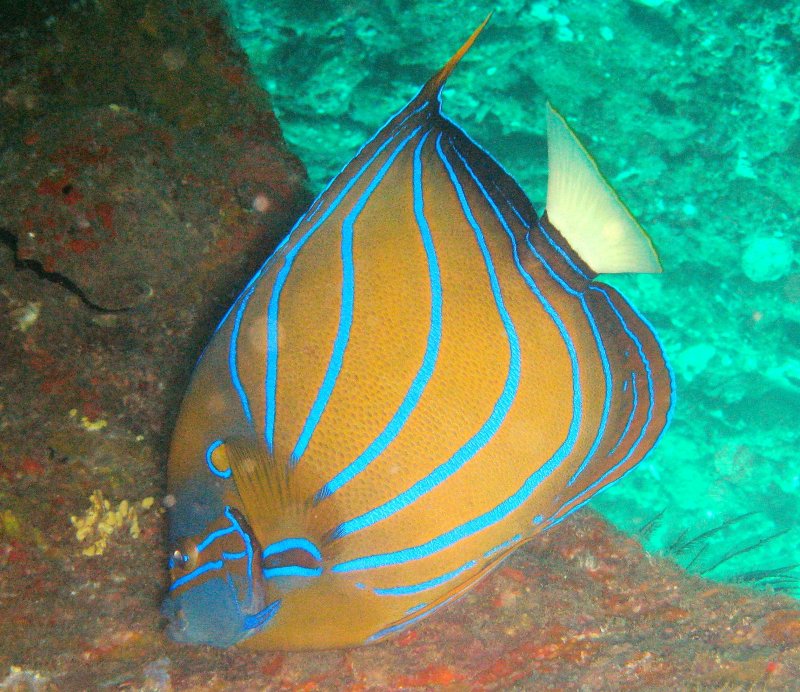
This blue-ringed angel fish was new to us and photographed by flash in a cave at around 25m on the well known Breakfast Reef site. Its background colour seemed more green when viewed in natural light. Colour becomes a much more subjective issue in underwater photography as several metres of water filter the light leaving blue/green components predominant.
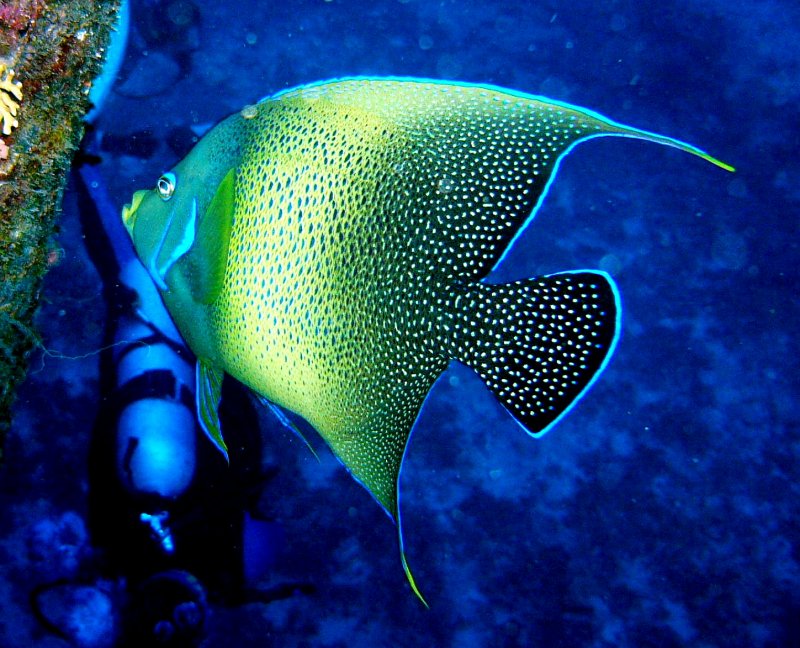
We have always had a soft spot for angel fish like the Indo-Pacific specie below that appeared whilst wreck diving off Luganville at around 35m. The flash picks out the subtleties of its markings very well.
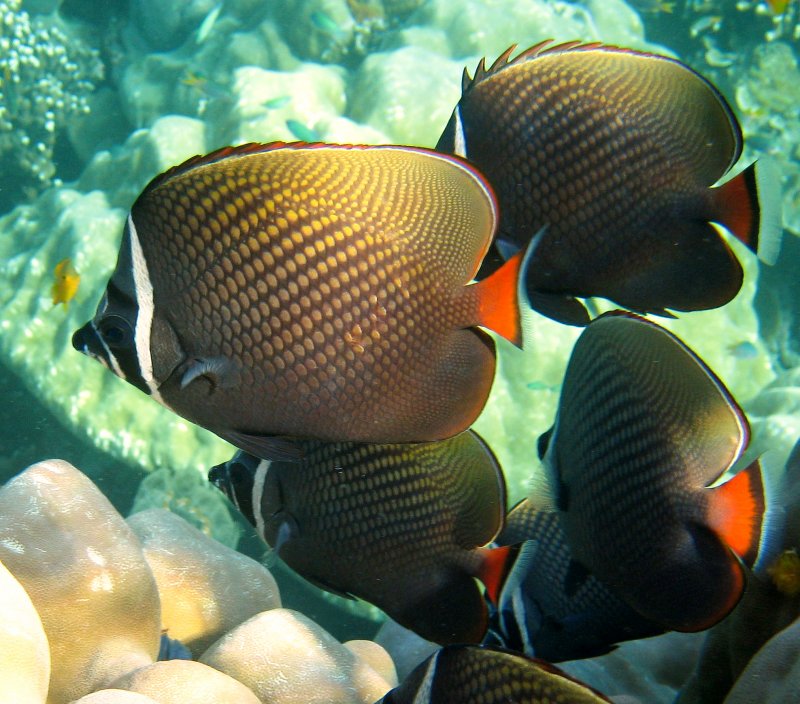
One of the most rewarding experiences is to be swimming amongst large numbers of fish which in a shoal seem much more tolerant of one's presence. These Butterfly fish are relatively large reef fish but often one may be amongst millions of smaller fish which waft to and fro in total unison around you. It is also not uncommon to find a number of fish following you, usually basking in your shade, quite content to accompany you until you leave the area.
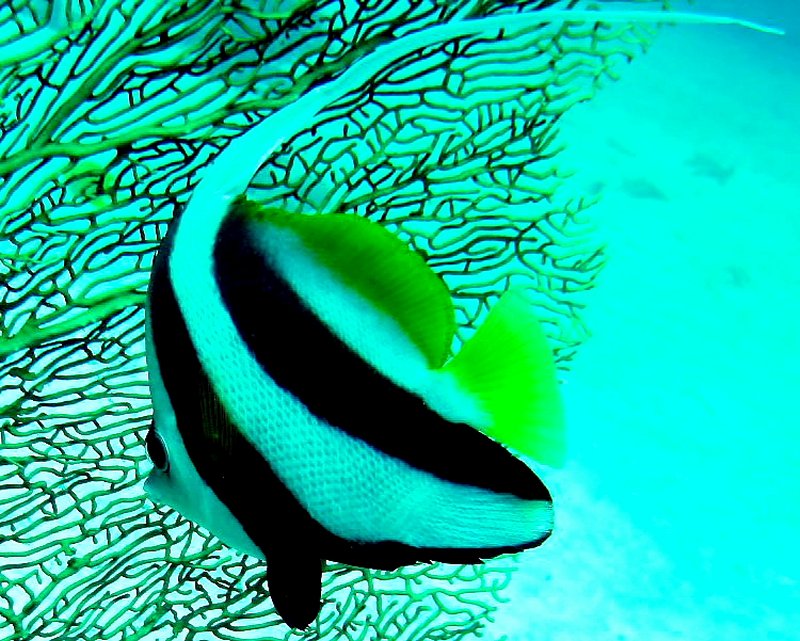
The Butterfly fish family are common, widespread and appear in many guises. Though this Longfin bannerfish variant, seen here against the background of a fan coral is relatively rare.
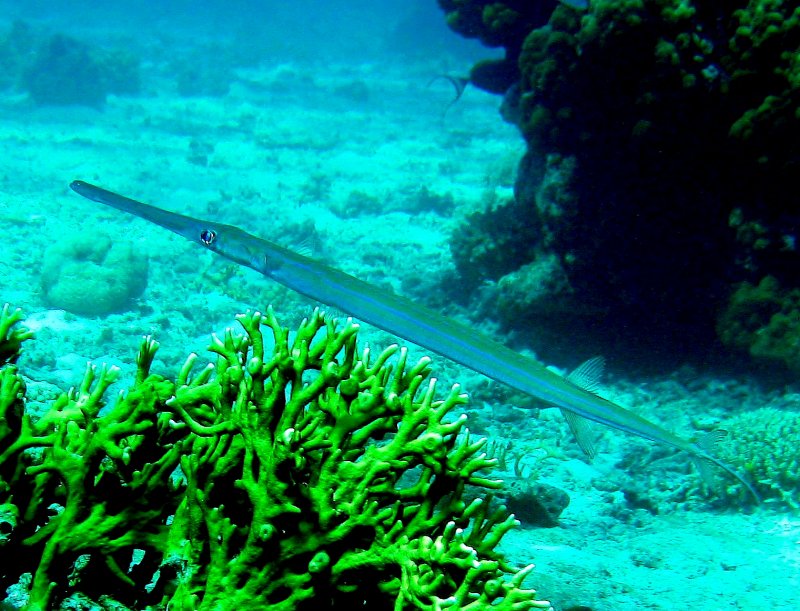
Tall and thin, long and round, nature has them all. The cornet/pipefish family are aptly named with one of the less gaudy decorated examples below.
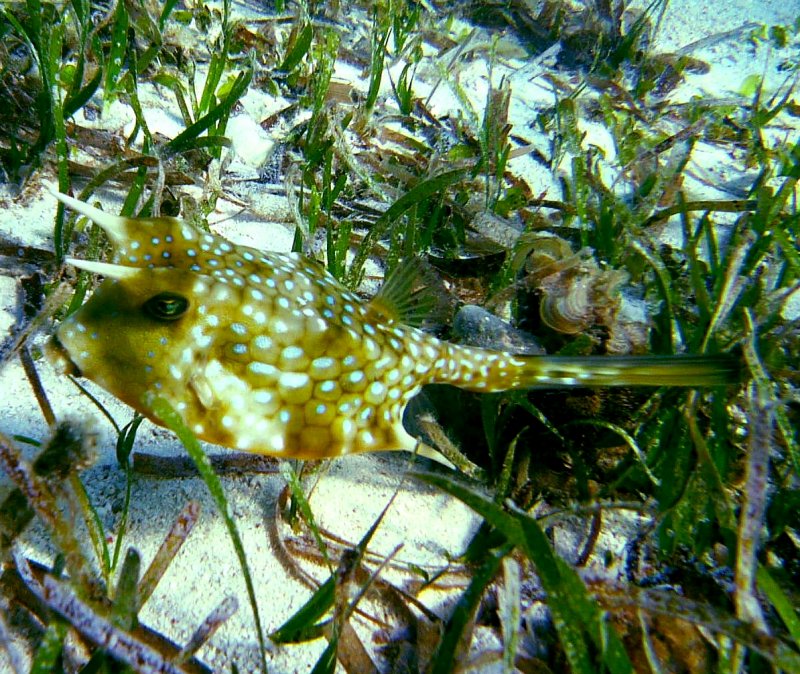
Sometimes the underwater world has parallels in the fields on land such as this longhorn cowfish which has an almost square cross-sectioned body.
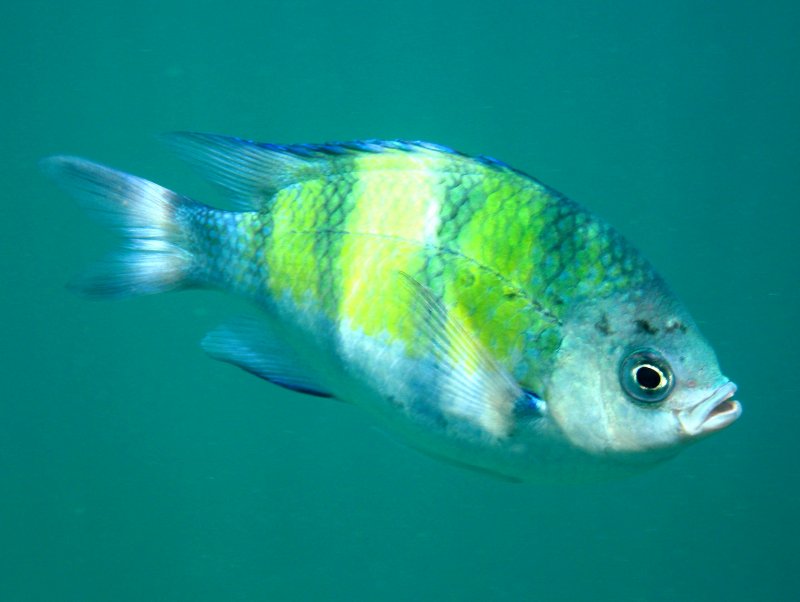
Damsel fish like the butterfly family come in many guises and are major contributors to the cast of actors on the tropical coral reefs. The Indo-Pacific sergeant is a relatively small example being only a matter of around 12cm (5") long. Lucky indeed to get such a good close-up on our first visit to Nai Harn Bay, Phuket, Thailand. They would usually fearlessly surround us as we swam, often coming far too close for the modest zoom setting on the camera. Still, as is usual, if you take enough pictures, you are bound to get one that is at least half decent. This snorkeling trip was made in the bay on the SW of Phuket Island with two Kiwi cruising mates and the swim gave us an excellent appetite for Christmas lunch.
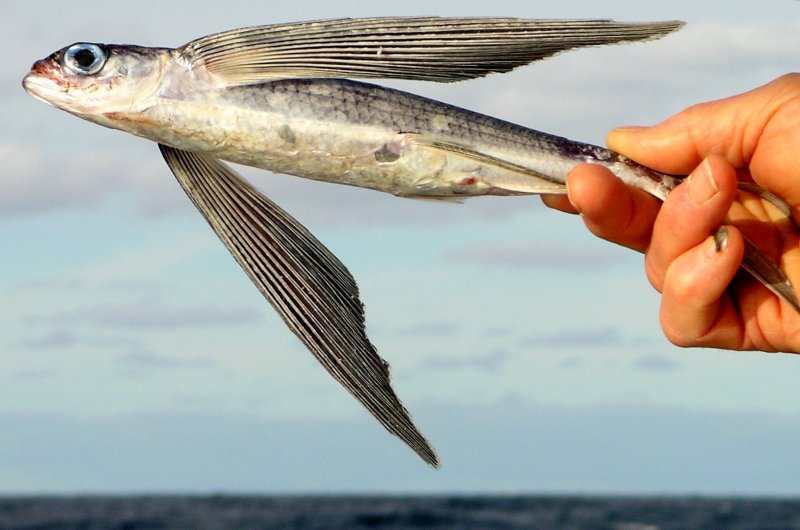
This is one of the first flying fish to jump aboard Amoenitas as we crossed the Atlantic in Dec'99, a comparitively rare event then. However, on our 18 day crossing of the Pacific from the Galapagos to the Marquesas it was initially a nightly event. The first job of the day was to harvest the decks to collect breakfast and good eating they are too. Toward the halfway point they began to be joined by squid which took over on the breakfast menu until by the time we reached Polynesia we hardly harvested any flying fish at all. Di has sore memories of swimming in the reefs on the Venezuelan island of Tortuga when, as she raised her head out of the water, she was struck full in the face by a flying fish which made a definite impression.
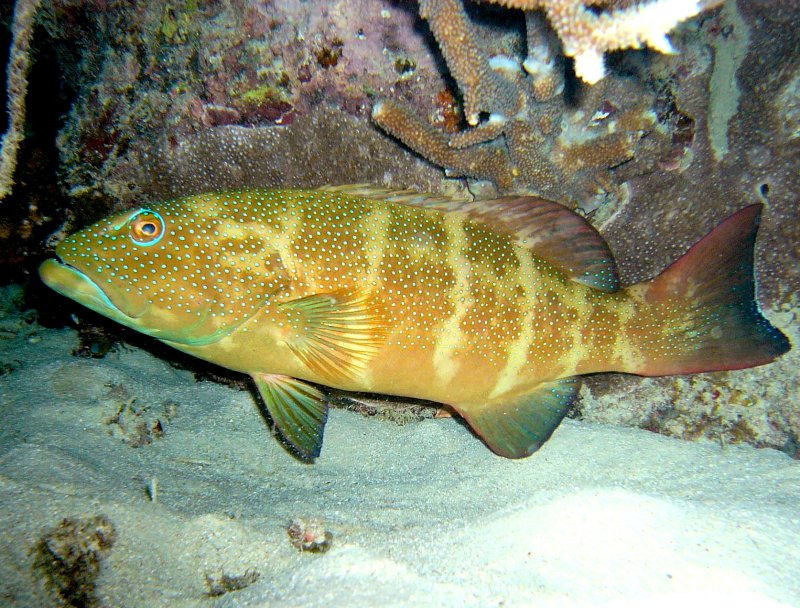
Groupers and associated families like coral trout also make headlines on the menu. Some of the former species can grow to become quite large at around 1.5m (5ft) though the example below was probably around 80cm long. This colourful grouper was photographed using flash fairly deep (25m) on Australia's Great Barrier Reef.
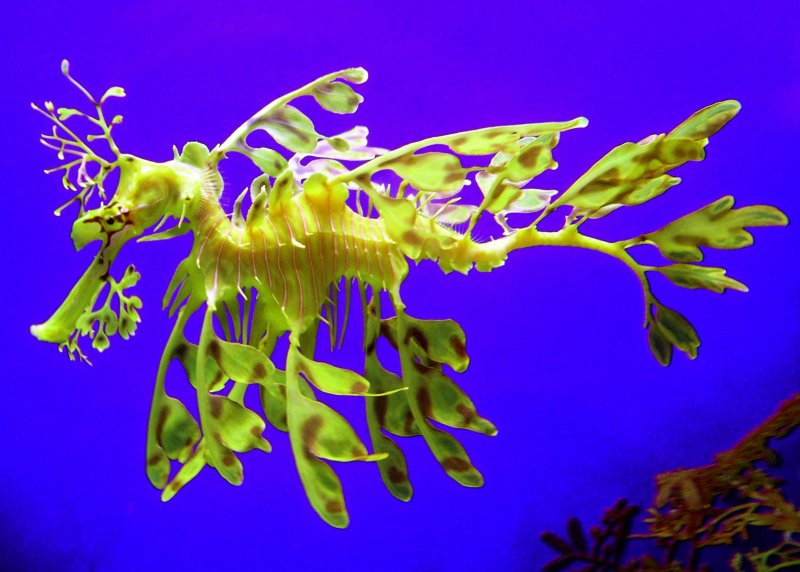
OK, you must be getting used to weird looking aquatic creatures by now, so why not something mind blowing. Sadly, Dave didn't take this picture in the open sea but never the less it is worthy of its place in this collection.
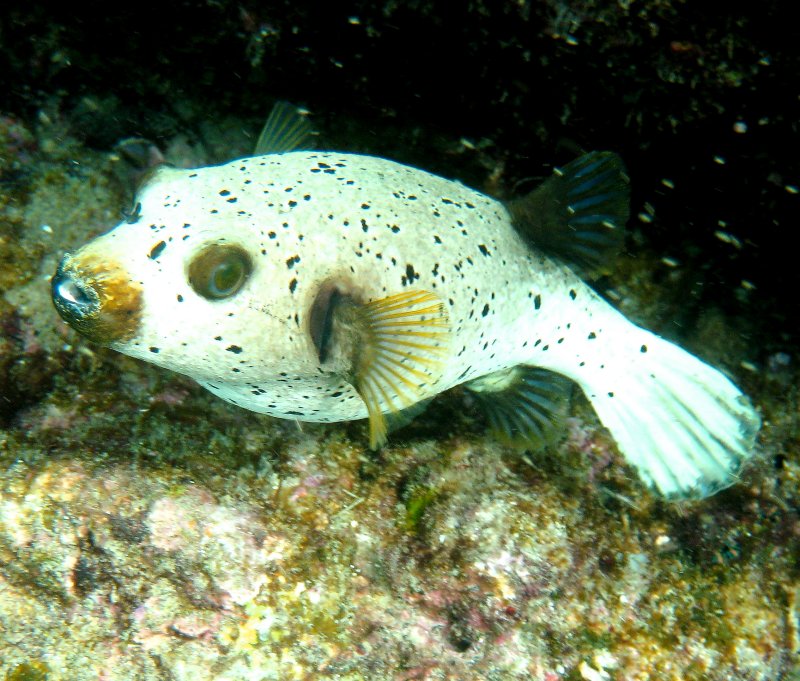
These puffer fish seen in the waters of the Indo-Pacific have strange, almost canine like features.
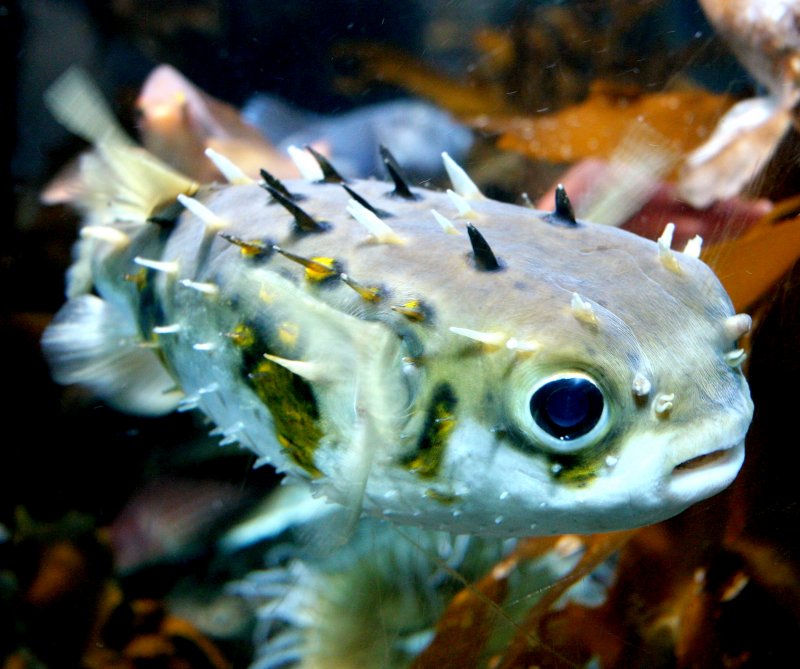
The Poor Knights Marine Reserve off the coast of New Zealand's North Island has some excellent diving with species quite different from the warmer waters of the tropics to the north. The big attraction for Dave was the fact that most of the creatures were unafraid of divers, in fact they were so inquisitive at times, they came too close to the camera.
These islands were so named by Captain James Cook who saw their high white topped cliffs and was reminded of the dessert pudding of that name. They are amongst the hundred or so places we came across that claimed to be amongst the world's top ten dive sites. Species seen there are in the main quite different from the tropical reefs but the quantity of marine life, visibility or lack of it, plus the sea temperature probably mean it is unlikely to feature in Dave's top ten.
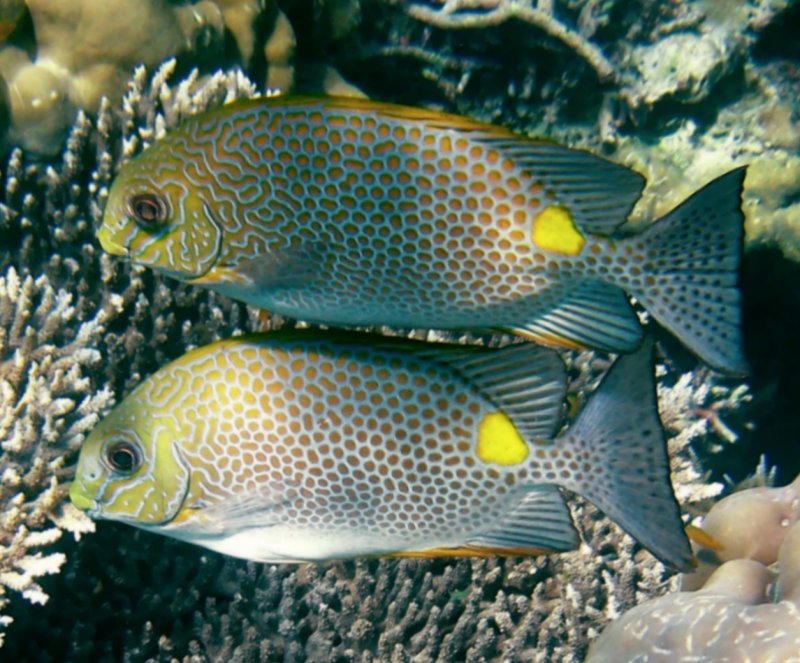
These beautiful rabbit fish usually are seen in pairs or groups.
Razorfish form part of the pipefish family and have a characteristic that no other specie we know possess, they swim vertically, head down through the water. They do this in small shoals in a strangely coordinated way so that when one moves rapidly to the left or right the others follow as if joined by some invisible strings.

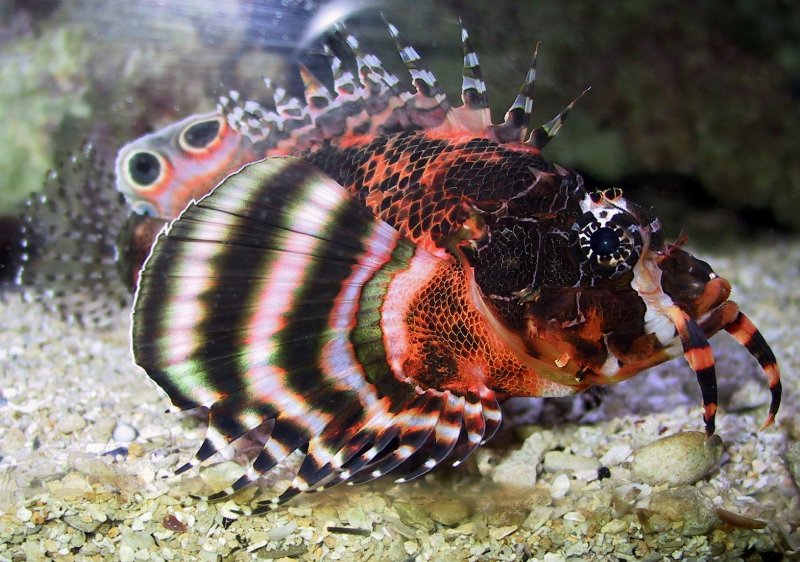
These strange members of the Scorpion fish family are sometimes known as Lion Fish and harbour a dangerous venom. They are fairly rare so Dave was pretty lucky to spot this one in shallow water off the remote Wallis Island between Samoa and Fiji. This one was not particularly large, probably about 30cm long.
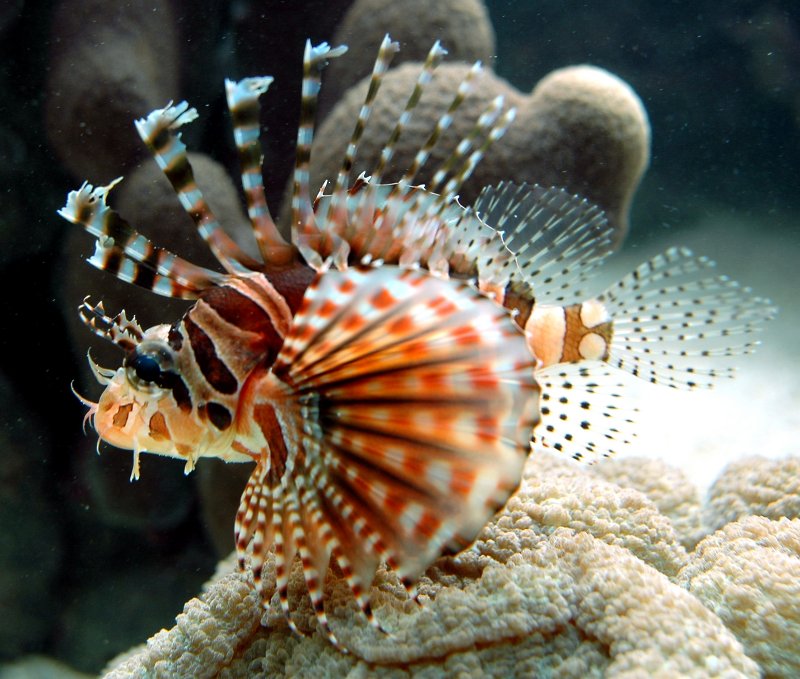
A further example of a scorpion fish family, the exotically named Fumanchu twinspot lionfish seen in Tahiti.
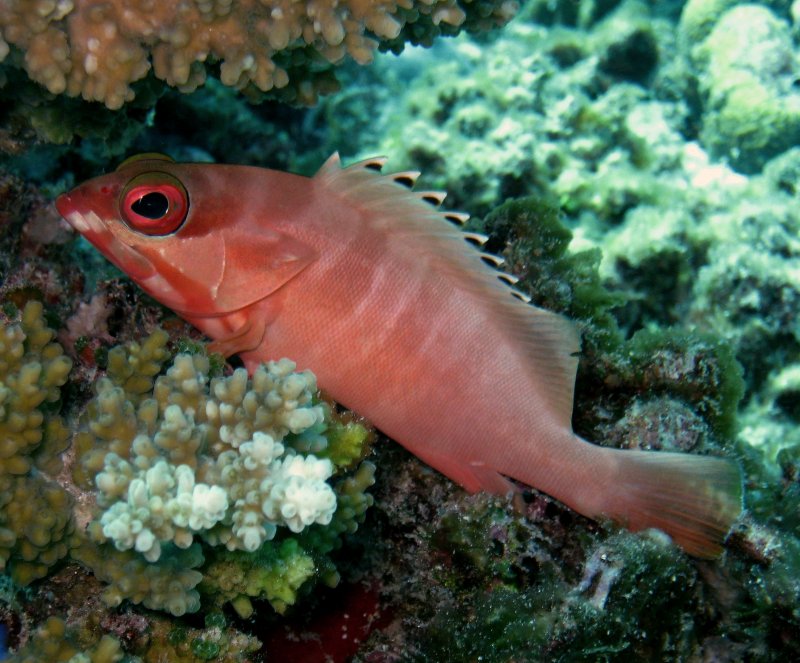
Squirrel fish are invariably coloured pink, often with more pronounced striping than this one. They are quite small (15cm) and timid, so to get close enough to capture this image was unusual.
This strikingly coloured powder blue surgeonfish came as quite a surprise as we did not come across it until we reached the waters of SE Asia.
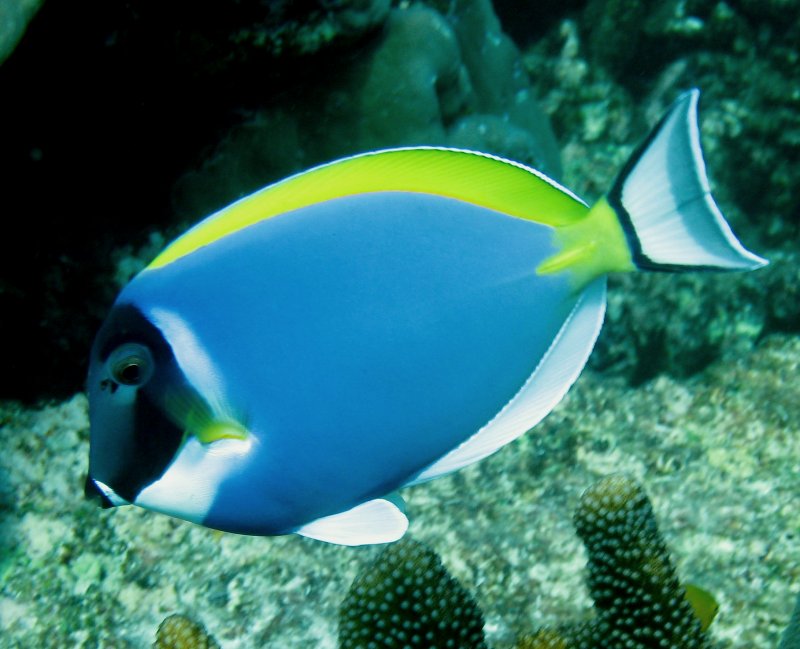
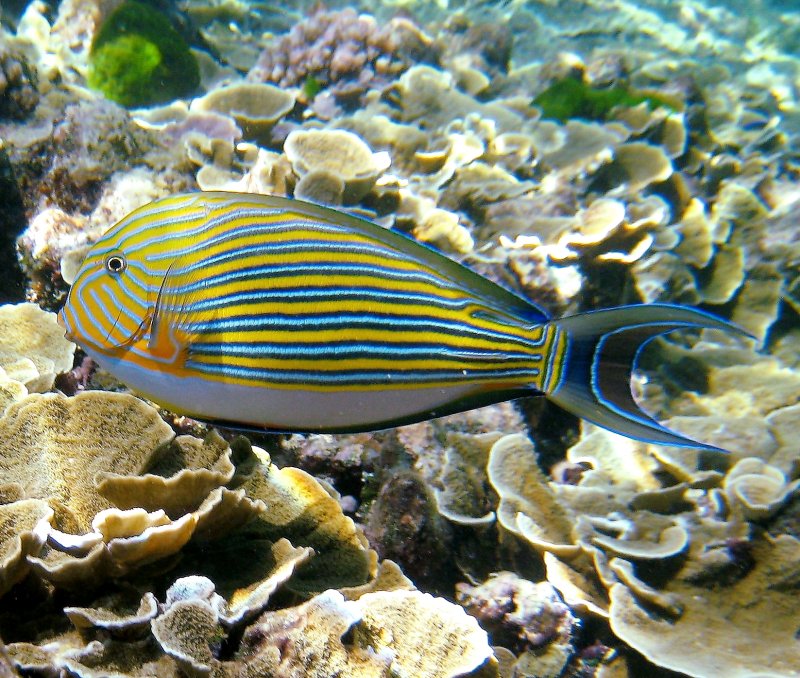
Here's a further example of an attractive surgeonfish from the same waters. Their name is derived from the sharp defensive blades they carry on either side of their tails. On the powder blue above they are coloured yellow but on the one below it can just be discerned within the blue stripe.
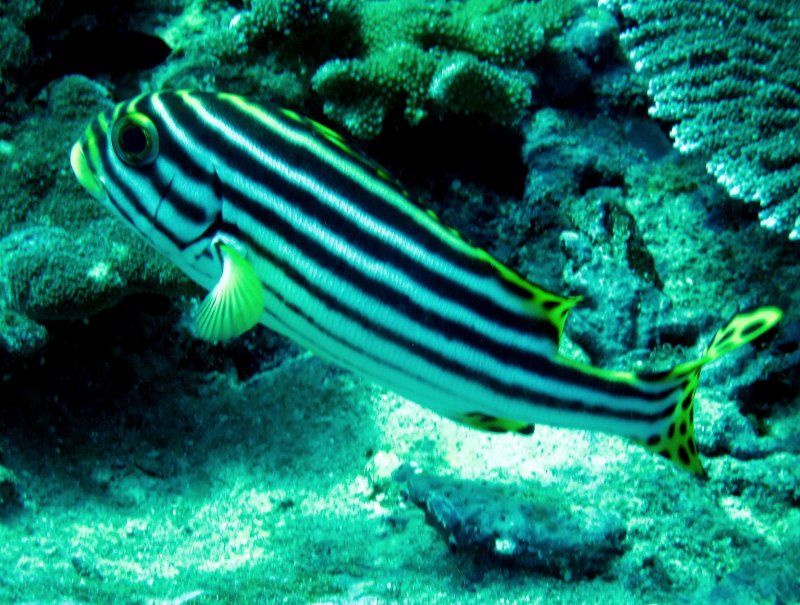
These sweetlips are amongst our favourites, not so much for the bold stripes with black spotted yellow tails and fins but from their demeanor on the reefs. They move sedately and give every impression of being sage like elder statesman keeping a close eye on you.
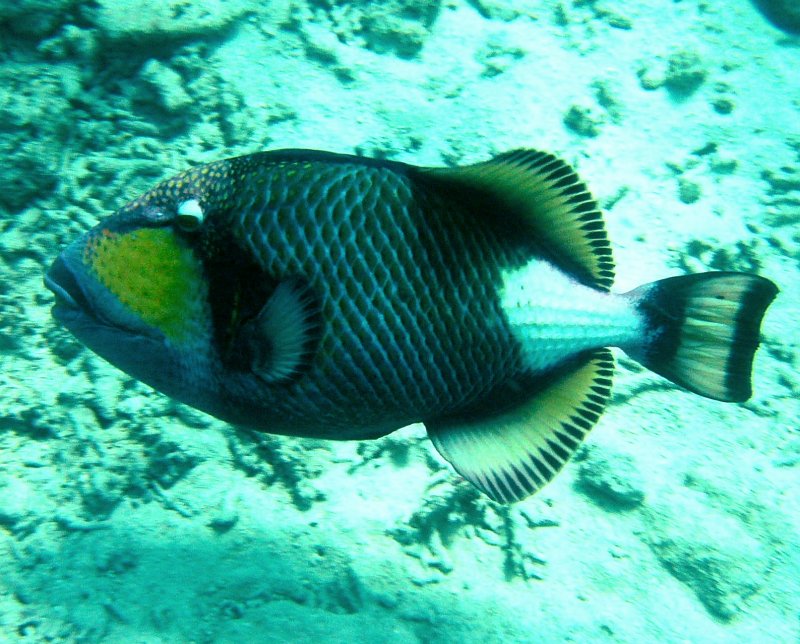
These large oval shaped trigger fish are distinctively patterned, often quite curious and were very common around NW Thailand. This specimen around 75cm long came to check us out as we were decompressing at around 10m after a dive on a fishing boat wreck.
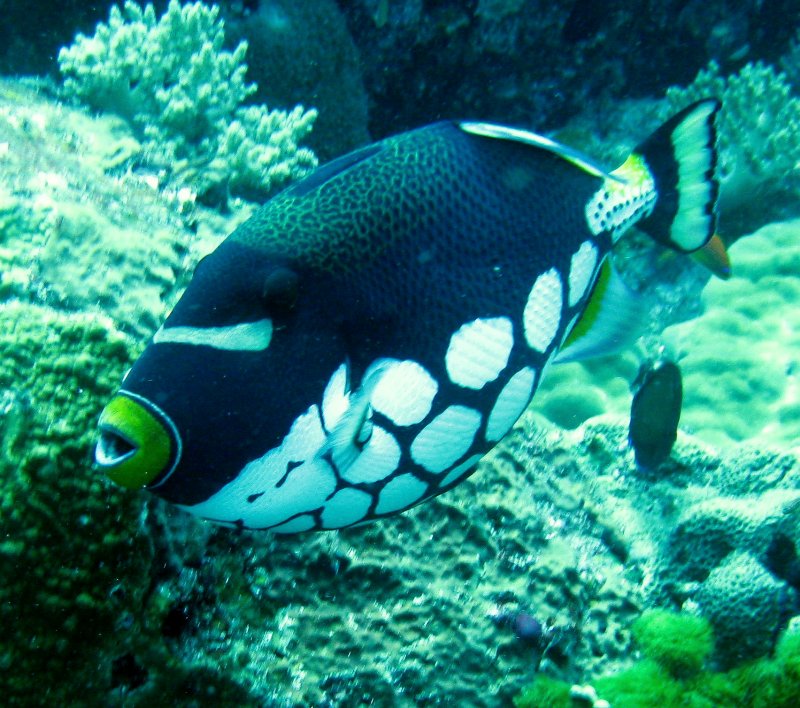
Now we get to one of Di's favourites, the moustacheo triggerfish. They certainly have striking markings and this one was a real biggy about a metre long. Dave captured an interesting video of one painstakingly re-arranging small rocks on the seabed, possibly to create a nest in which to lay eggs.
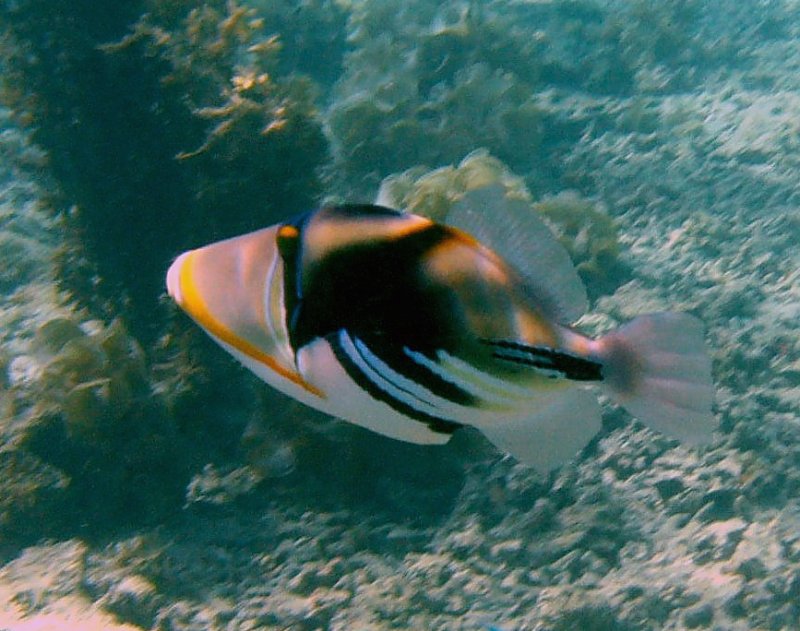
We began to see Picassos around the mid point of the Pacific in the Society Islands of French Polynesia and they seemed to become more common as you move westwards. The diversity and form of their markings could only warrant a link to one of the most famous of abstract artists. Often they are easily approached and on the reef in Apia, Samoa where this picture was taken they actually brushed against us in what appeared to be a territorial statement.
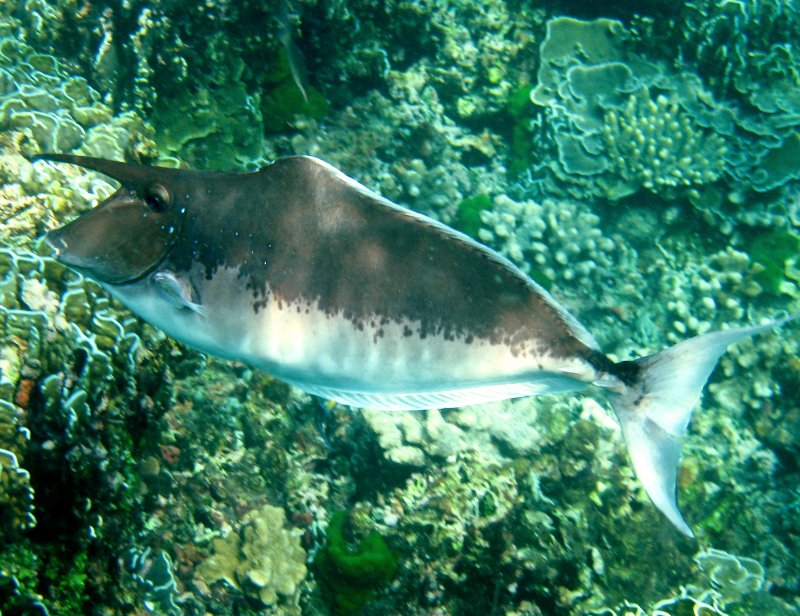
The only unicorn fish we have seen in any number before the Similan islands of Thailand were in the Tuamoto archipelago of French Polynesia and those were a monotonous light grey colour. The SE Asian variants were much larger and distinctive like this humpback.
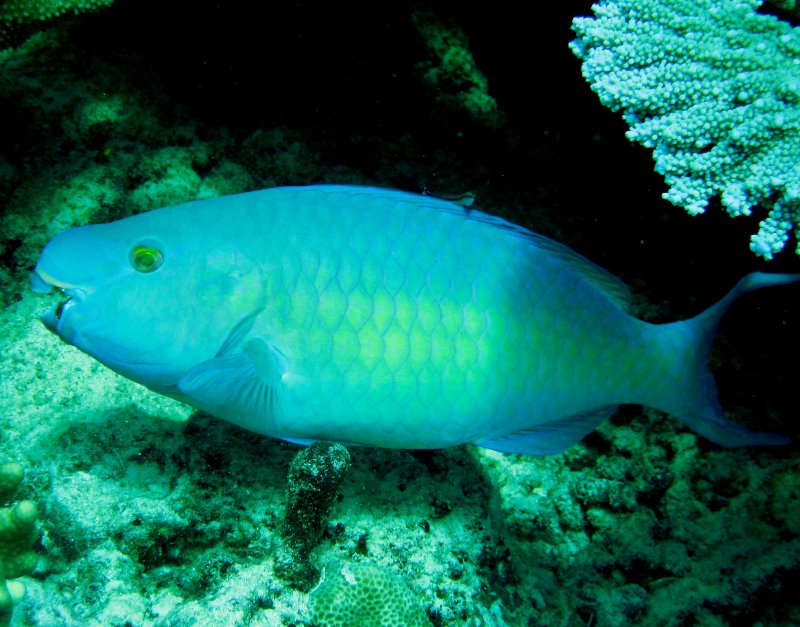
Parrot fish are amongst the most common reef dwellers and come in a wide variety of colour schemes, including the 'stoplight' of the Caribbean with appropriately coloured square patterned markings. They eat the algae which forms on coral with powerful beak-like jaws that one can actually hear several metres away as one swims by. They often grow to lengths of around 80cm or more.
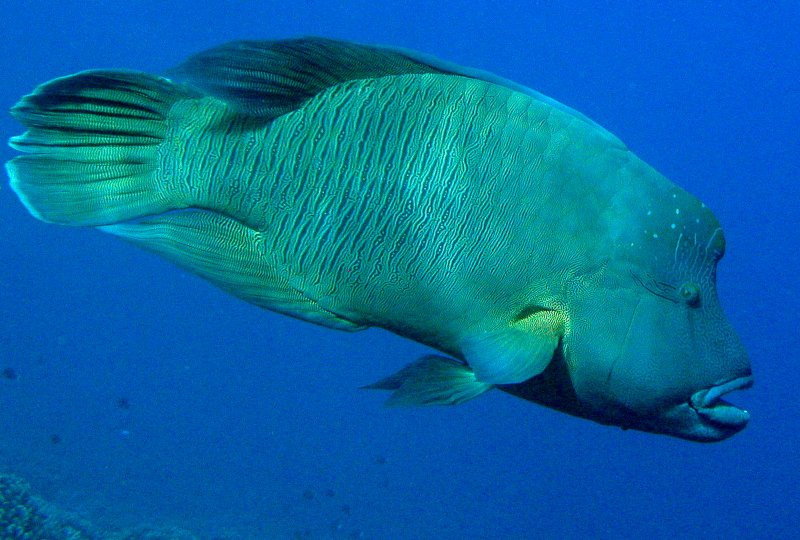
Wrasse are another common denizen of the reefs, usually interestingly patterned with characteristic solid flat tails. They are renowned for being bony fish but generally are good eating if one has the patience. Typically they are around 25cm long but this humphead Napoleon grows to over a metre long.
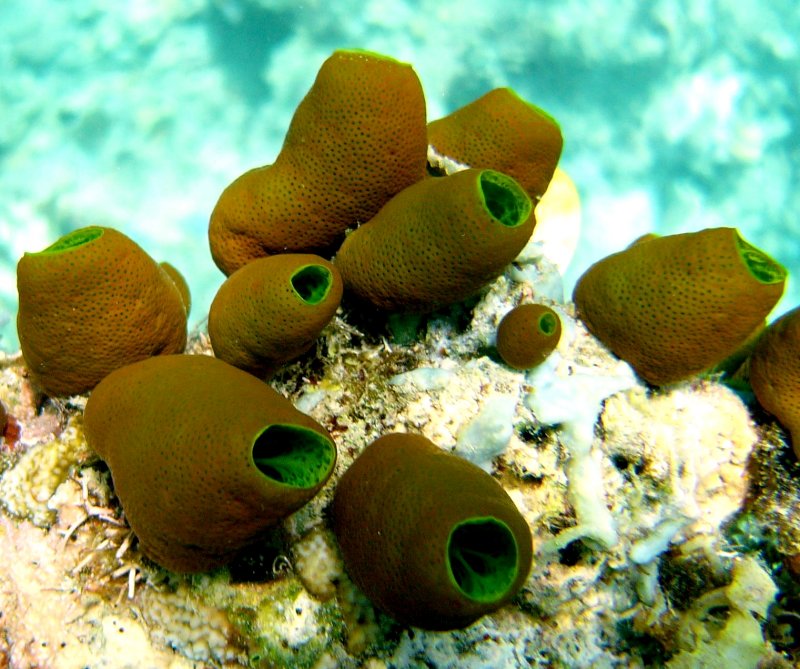
We move on now from fish to a collection of images representing a wide range of marine creatures, again beginning alphabetically with a primitive form. Ascidians (sea squirts) are efficient filter feeders and usually quite colourful. Never before had we seen such an abundance of them as there were in Indonesian waters. In many places they were in there tens on almost every rock.
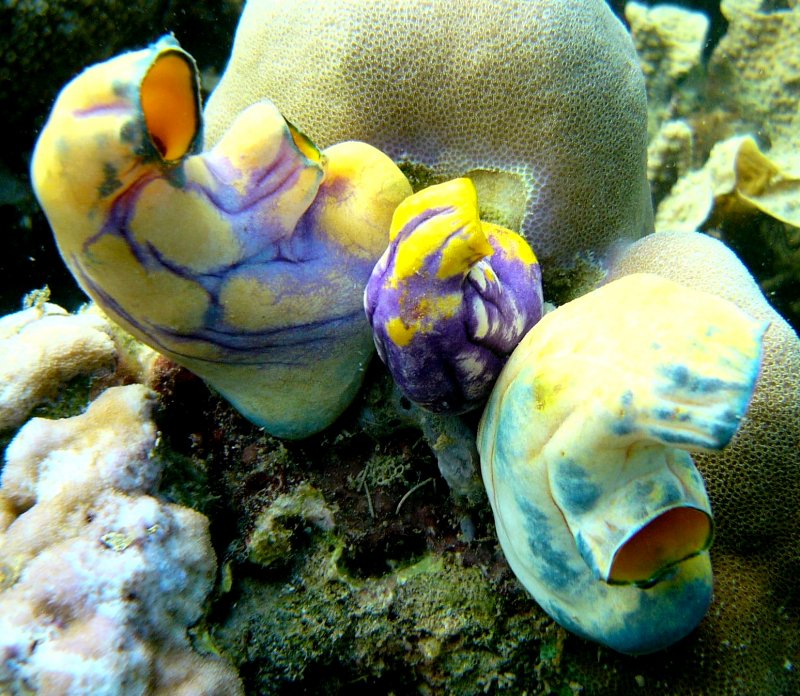
A close view showing the size of the filter apertures.

Yet a further example of ascidians.
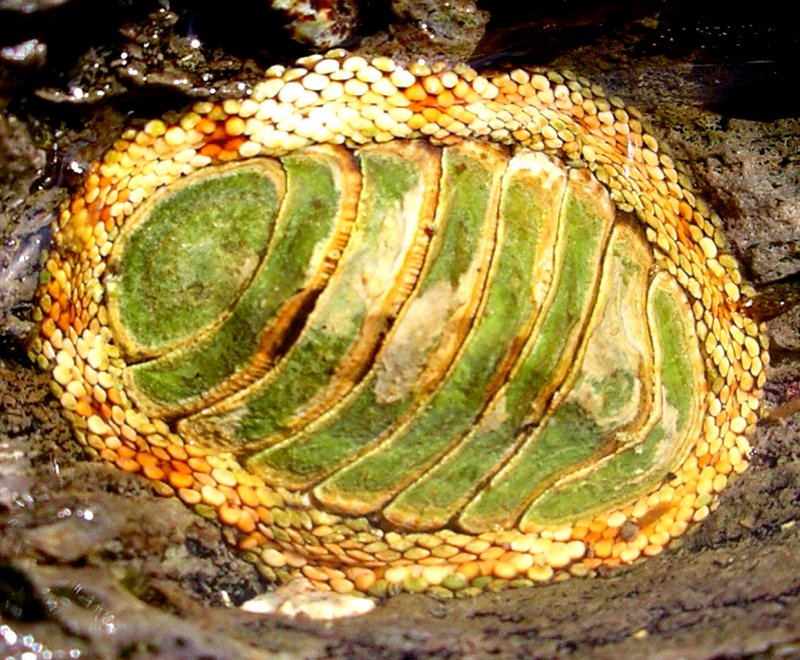
Chitons are seen only rarely, clinging tightly to rocks in the intertidal zones. They form a separate class, Polyplacophora, are a very ancient, primitive form of algal feeding mollusc characterised by eight plates surrounded by a fleshy mantle. This one was seen on the little visited Mayor island, a Maori reserve out in the Bay of Plenty on the east coast of New Zealand's North Island.
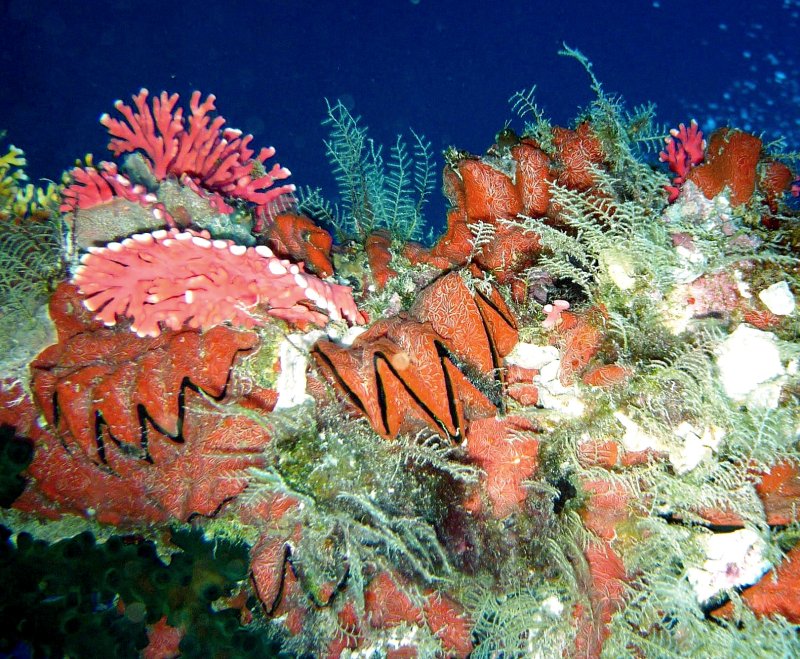
Below is an agglomeration of corals and molluscs topped by white tipped fire coral (Millepora), a branching Hydrozoan which as the name implies can deliver a mild but irritating sting. It was found clinging to a wreck. off the island of Espirito Santo in northern Vanuatu. Normally the clams are greyish in colour but here they were covered with this red sponge. There are also a few strands of feather star (Comanthus parvicirrus) scattered around to further decorate the collage.
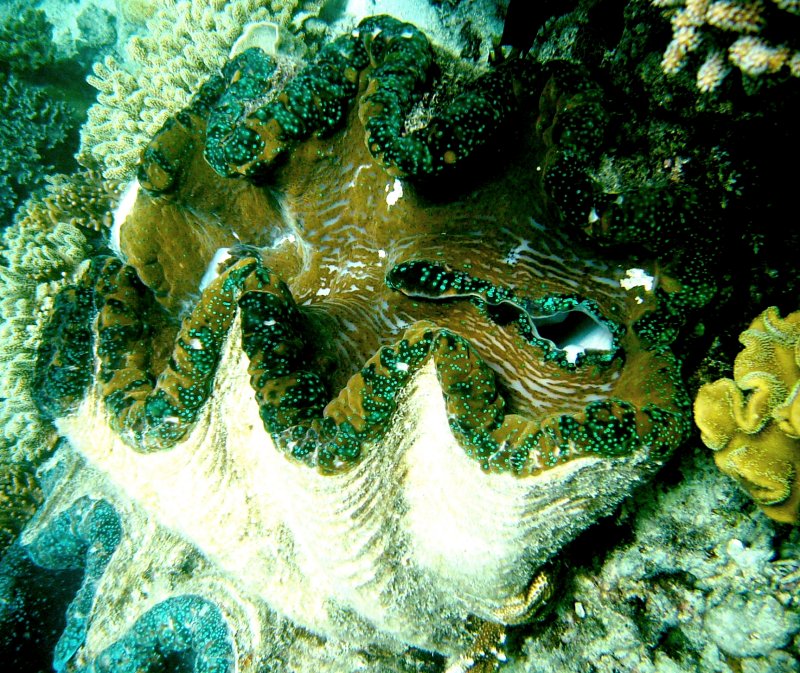
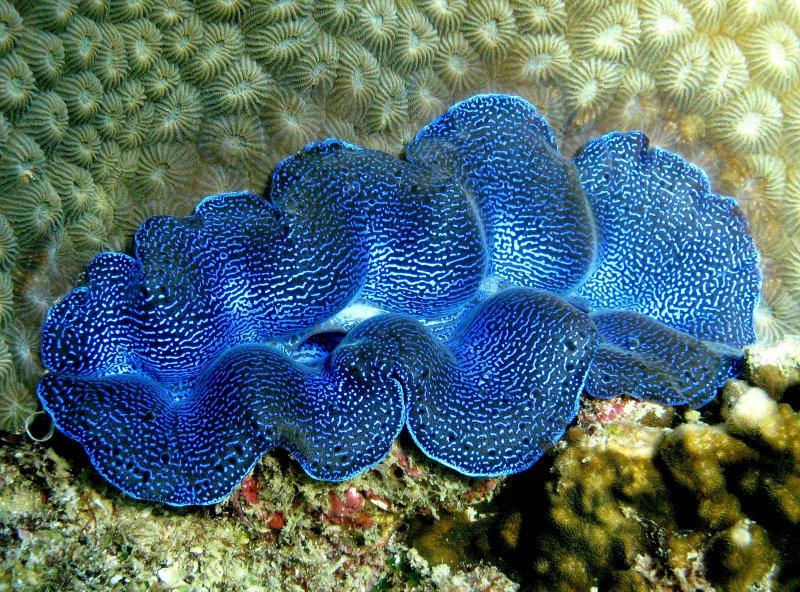
Lizard Island about 150nm north of Cairns is a magic spot, famed as the place where Captain Cook climbed the hill to search for a way through the Great Barrier Reef. The bay on the NW is named after Mrs Watson, who in the early days of the colony, fled from attacking aborigines by taking to the sea with her Chinese servant in a large, cast iron pan used to render whale blubber. Escape they did but sadly they landed on this small islet without water and died of thirst. In the marine world Lizard Island is now famed for an extensive colony of huge clams. That adjective used on a member of the giant clam family implies that there size is indeed prodigious. Many are close to 2m across with flesh in various colours and patterns.
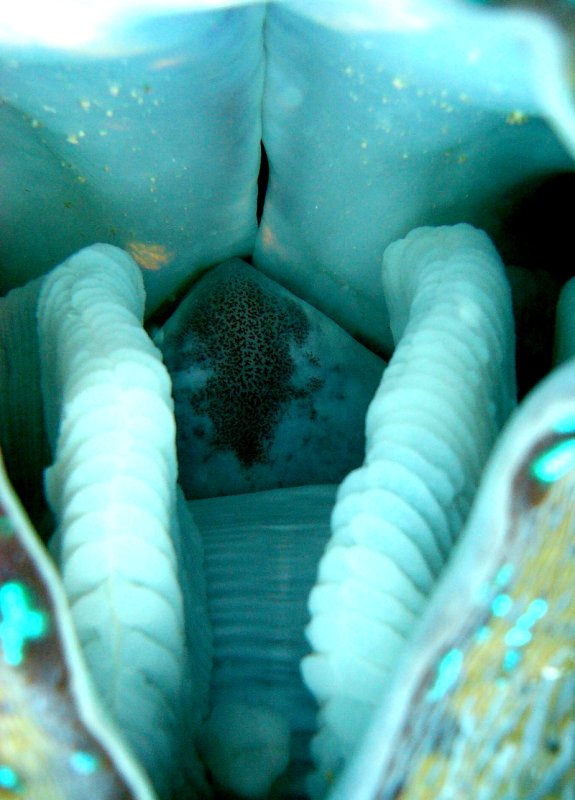
This is what the innards of a giant clam look like if you are brave enough to stick your arm and camera in close enough. Dave did have have some close up on him but fortunately it was a relatively slow business. It still did tend to raise the heartbeat just a little!
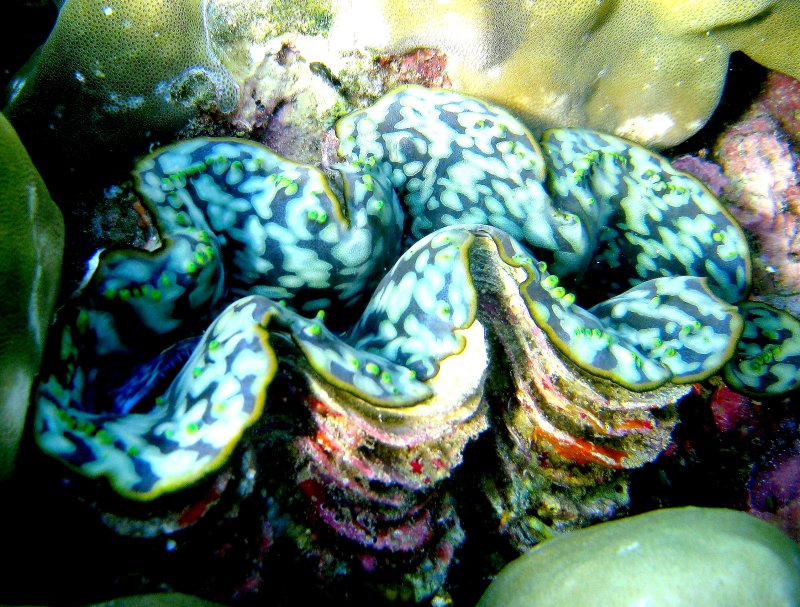
We did not see clams of this size (30cm+) until we reached the Pacific, where they are held in place by coral growing around the base. Their mouths are decorated by fleshy, vividly coloured veils ranging from red through green to purple.
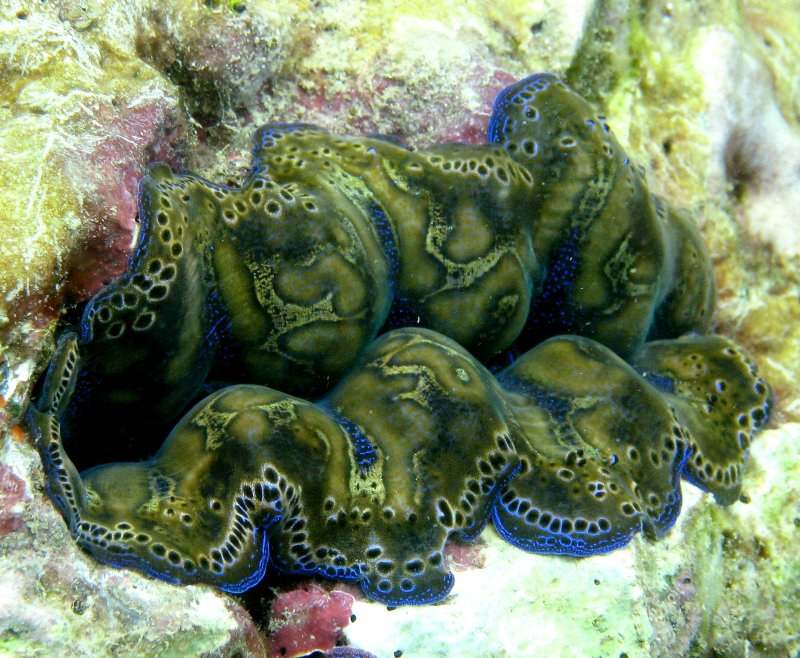
Another colourful example from the Indian Ocean against a background of Flaviidae hard coral (Diploastrea heliopora).
Yet a further example from an island in north west Thailand close to the Myanmar (Burma) border.
When we first came across these floating agglomerations of jelly with what appeared to be a seed within, at the Similans we naturally assumed it was the initial stage of development of some larger life form. We have since managed to identify it as a pelagic Comb-jelly (Ctenophore).

A close-up of Pelagic Comb-jelly (Ctenophore)

Crabs from the crustacian family come in much more exotic garbs than their brothers from the colder north European waters.
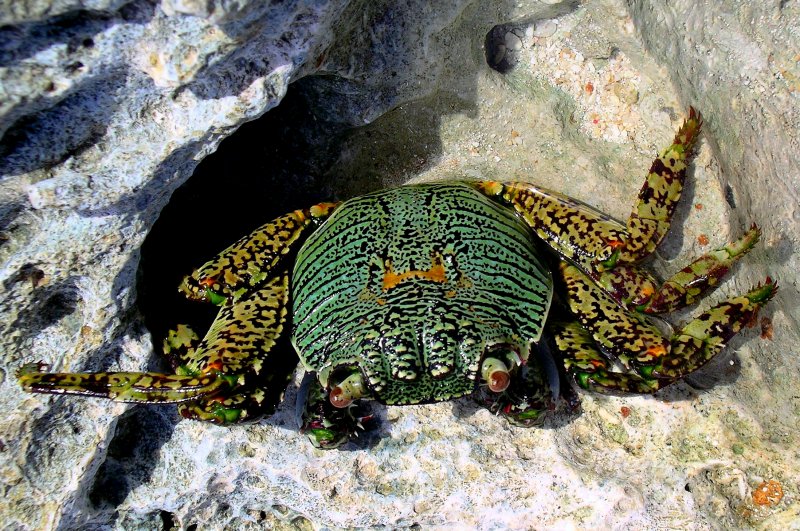
The crab below was spotted below the tideline of a beach on Yadua island off the SW coast of Fiji's second largest landmass. He's only around 10cm across so was probably feeling pretty intimidated by the camera lens up his nose. Surprisingly, marine crabs as opposed to their shore based coconut colleagues are not as common in the Pacific as in the cooler waters of the North Atlantic. Never after we left the San Blas Islands off Panama's Caribbean shores did we enjoy the taste of excellent crab meat.

Crabs are also common on the beaches, shoreline and even inland.
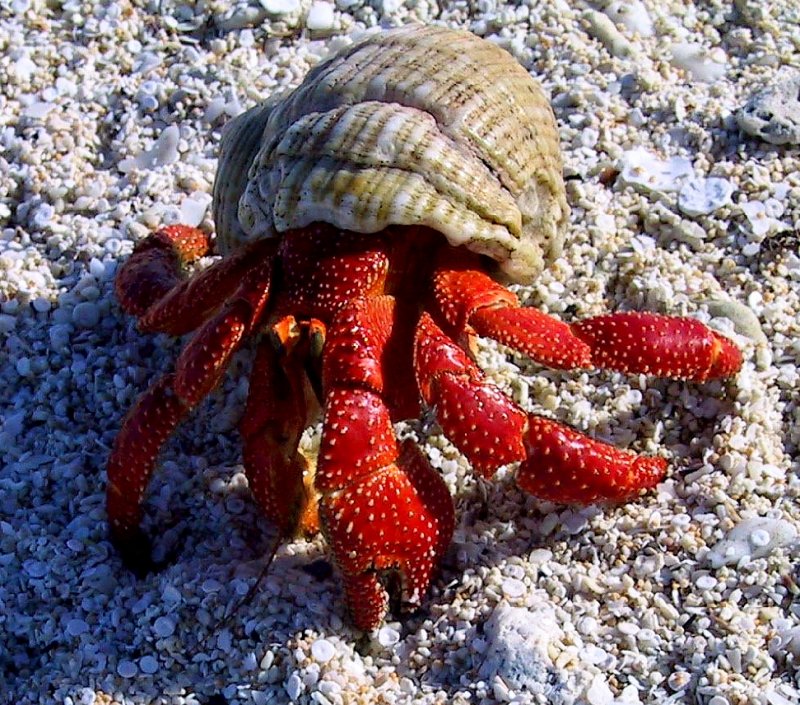
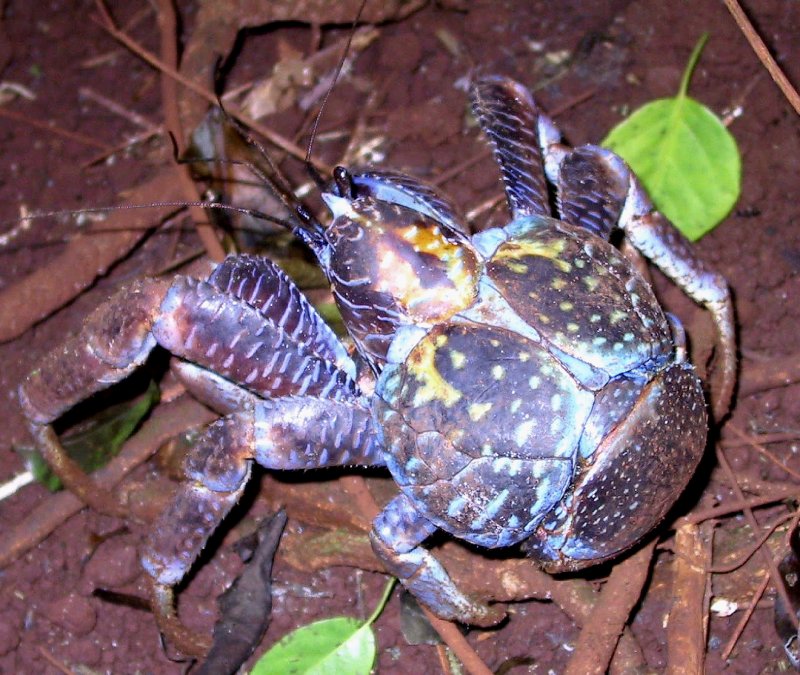
We found the big coconut crab below roaming a small islet off Vanua Balavu in Fiji's remote Lau group. It's body was around 30cm long and as we were running short of protein in a region that had been devastated by a cyclone barely six months before, we thought it was a prime candidate for the pressure cooker. It did however lodge a last protest, as when Dave tried to remove the rucksac it was being transported back to Amoenitas in, he needed to take off his shirt as well, the big claw had griped both tightly.
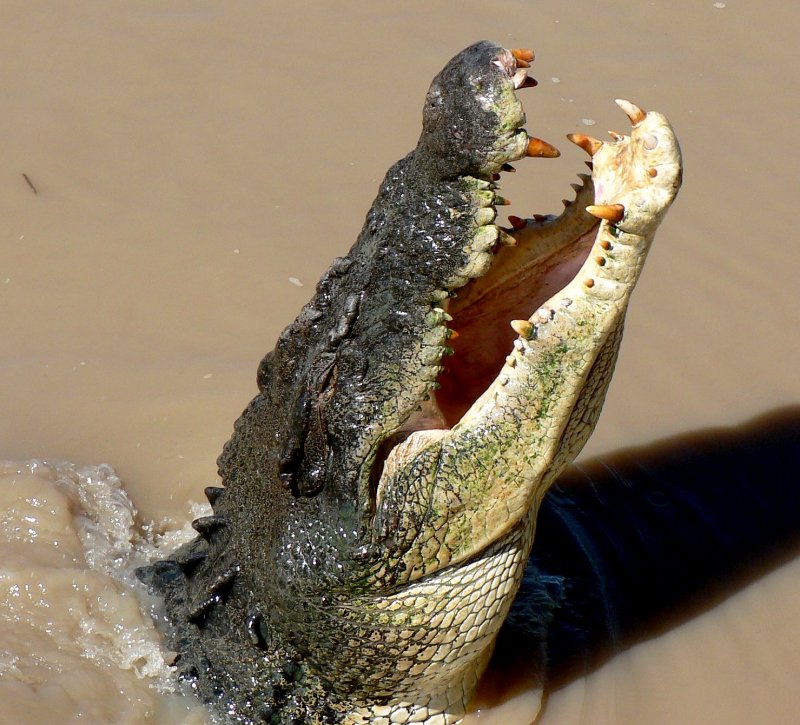
Estuarine (seawater) crocodiles are to be taken very seriously and present a severe risk to the unwary in some areas of the Pacific, especially along the north east coast of Australia north of Cairns. They are known to have snatched dogs and even children from boats with low freeboards and have rendered most beaches dangerous places to roam on a regular basis. They are capable of noting the time people go ashore, only to return in wait on subsequent days. A Scandinavian cruiser dived-in to check his anchor in Vanuatu, as we often do, only for his wife to watch him being grabbed an taken off to nearby mangroves to be lodged for storage underwater.
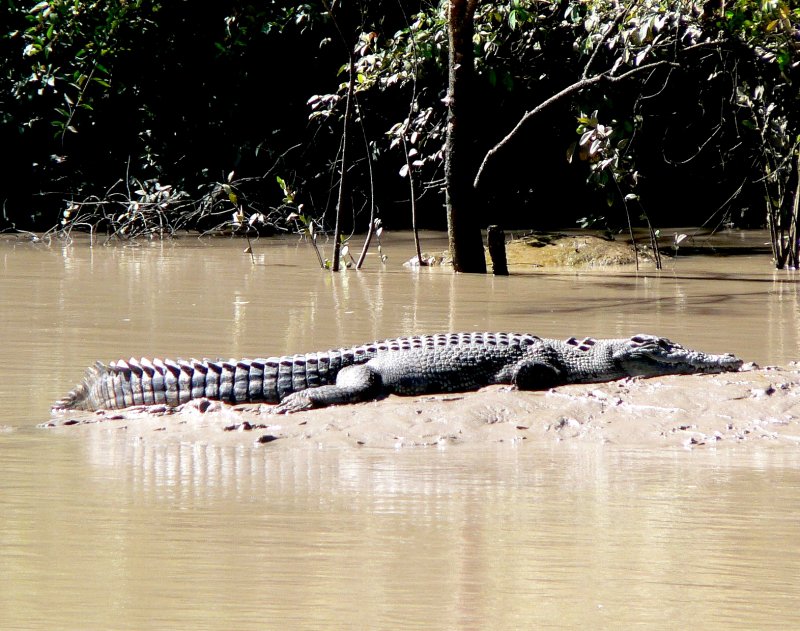
On the Adelaide River at Djukbinj in the Northern Territory we had a chance to observe these formidable hunters at close quarters. It was revealing to see a male overseeing a bevy of females, each in their own nest every 100m or so along the banks. Also we observed their limitations, especially the energy to fuel their every movement. Making an attack is a demanding investment of a scarce resource and is done with great care.
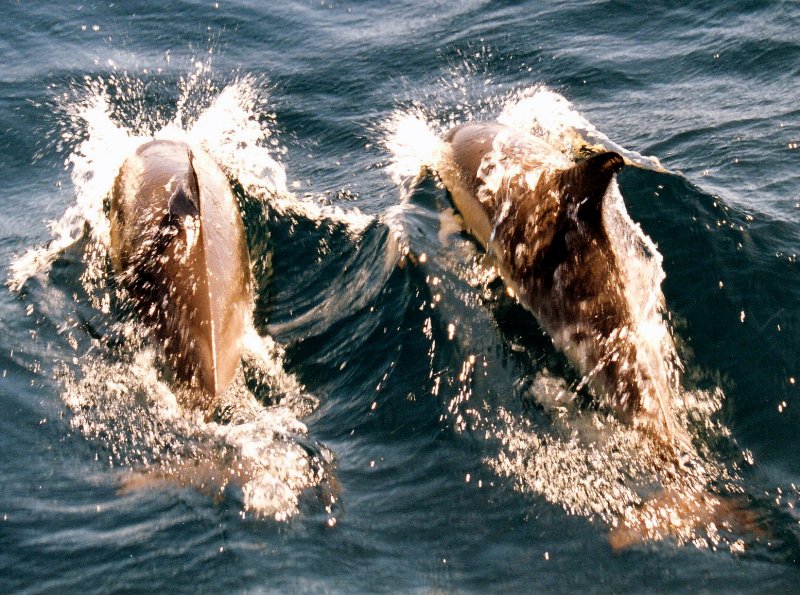
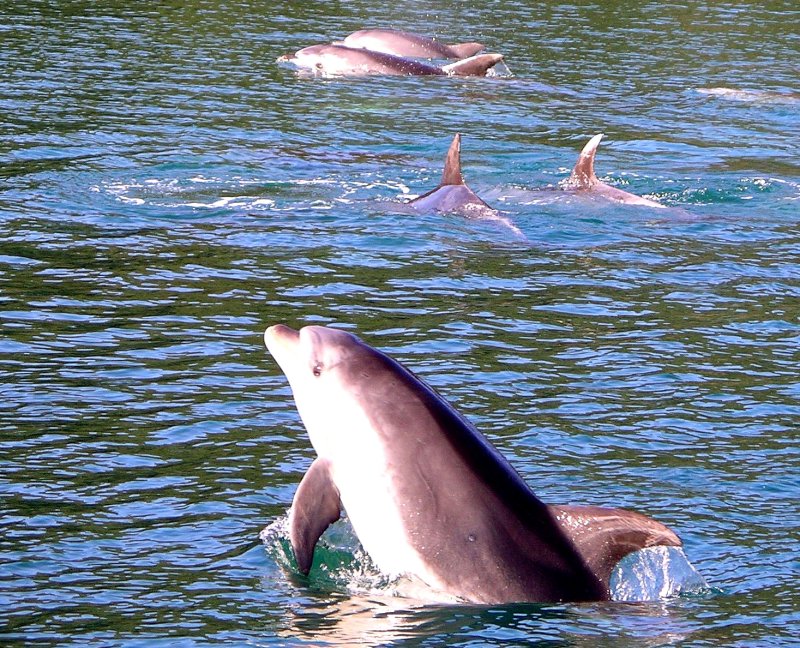
No matter how often the cry of 'Dolphin' rings out, we can hardly wait to get on deck to greet them and try to communicate. It has probably happened over a thousand times now but each occasion seems unique and very special. They typically come in pods of six to twenty with pairs cavorting around the bow and diving under the hull. Our most dramatic encounter was in the Caribbean on passage between St Vincent and St Lucia in very rough conditions where there were around ten pods totaling over a couple of hundred dolphins. This was most probably a combined fishing operation where a large shoal of fish like tuna was the target.
Orcas, also known as Killer Whales are large and characteristically have a tall narrow dorsal fin. They are from the dolphin rather than the whale family and are aptly named, being voracious killers of large prey such as seals. On this occasion a pod of around ten appeared about 400m away in Fitzroy, a huge natural harbour on the NW of Great Barrier Island off the east of New Zealand's North Island. They allowed us to motor over slowly towards them, with some coming over to explore Amoenitas's underwater profile. The cow and calf above had just surfaced off to our starboard side having swum beneath us.
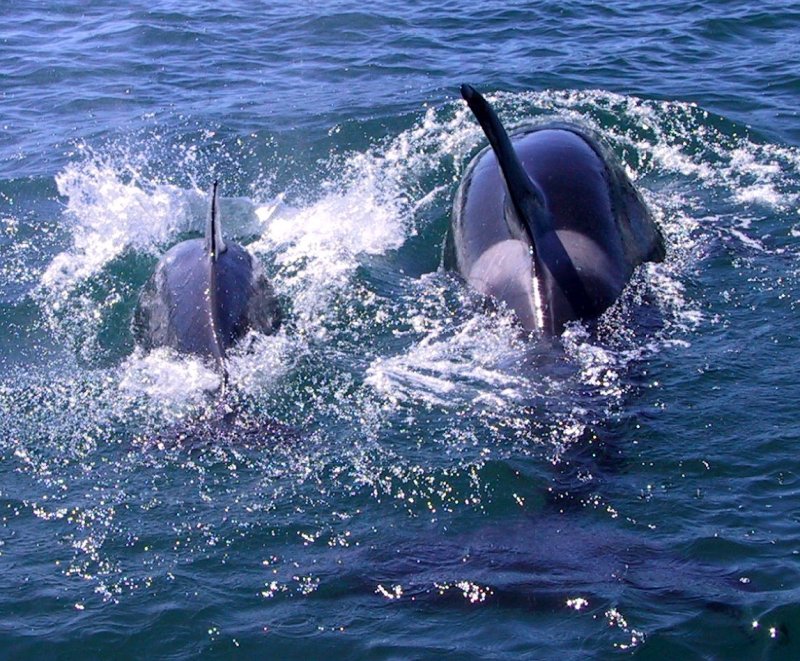
Also, on another occasion in Fitzroy we observed this further school of around twenty who were quite happy to linger. There is no doubting their intelligence and willingness to engage with humans. One dark, moonless night in mid-September 2004 we were making a 410nm passage from Wallis Island to Savusavu in Fiji with Di on watch. She became aware of a crying noise immediately off the starboard side of the cockpit and was initially quite concerned. Peering across into the darkness she eventually made out a large, single dolphin keeping pace with us around 3m away. The crying noise continued until Di acknowledged it with a call and a wave, thereupon it departed.
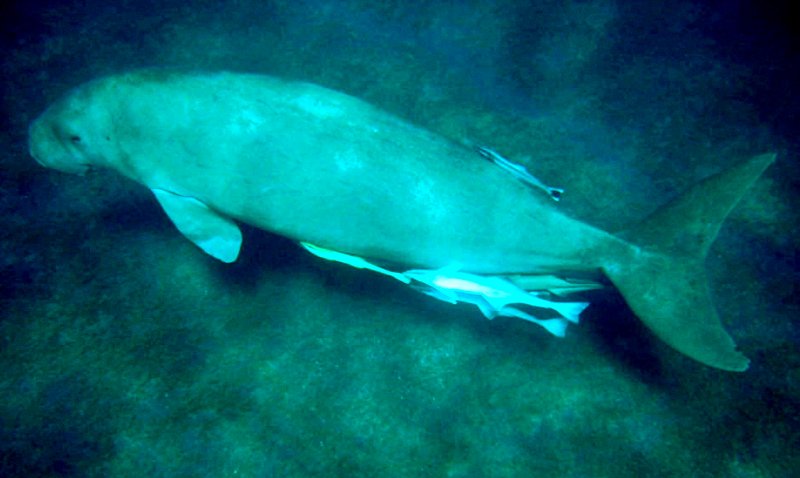
To be able to swim with a dugong is a very special experience. Though they occur widely from East Africa to the Solomons, they are rare and are in the IUCLN Red Data Book as an endangered species. We had caught sight of them in a mangrove infested bay in Puerto Rico in 2001 but the water was so murky it was impossible to make out their shapes. So, when we heard that there was a small family of them in Lamen Bay on the island of Epi in Vanuatu, we made a special effort. After several days and many hours of scanning the waters of the anchorage, one appeared. Dave and camera were poised ready and he managed to get close enough to this specimen around 3m long to capture this half decent image. There they feed on the shallow meadows of seagrass. Whilst feeding it will come to the surface for air about once every minute or so but they have been known to submerge for 6-7 minutes. Note the remora or sharksuckers attached by the adhesive pads on top of their heads. We caught a remora about 75cm long once whilst fishing off the boat. Having stuck it head down in a bucket of seawater for a moment before releasing it, we were amazed to find its pad so well attached to the side of the bucket we could lift it and its contents of around 6kg off the deck by the tail. Hence Di's reticence to swim if they are around the boat.
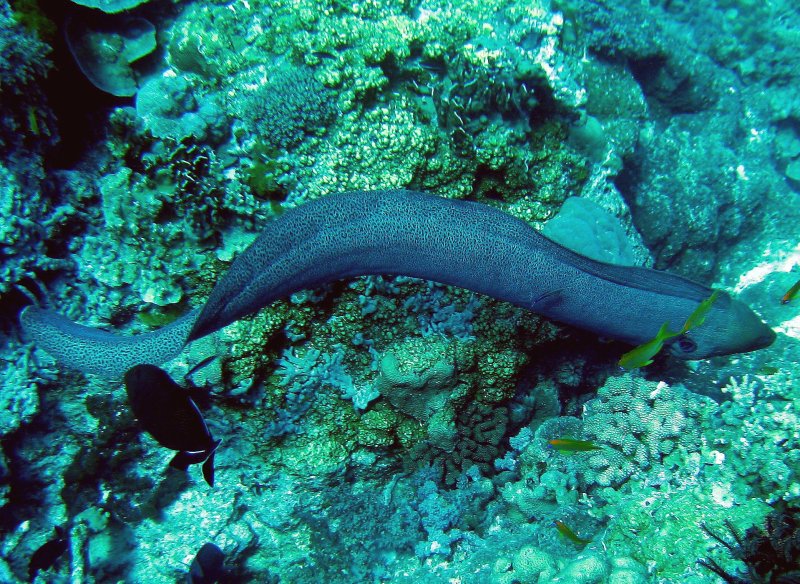
The moray eel below had a superb home with a view, high on a vertical cliff of rock but didn't appear to be very welcoming. The aggressive stance is usually all show and no action but it pays to be exceedingly cautious as their razor sharp teeth and strong jaw would make retreat impossible if they did get a hold on you. It is definitely not wise to go indescriminately feeling into any underwater holes.
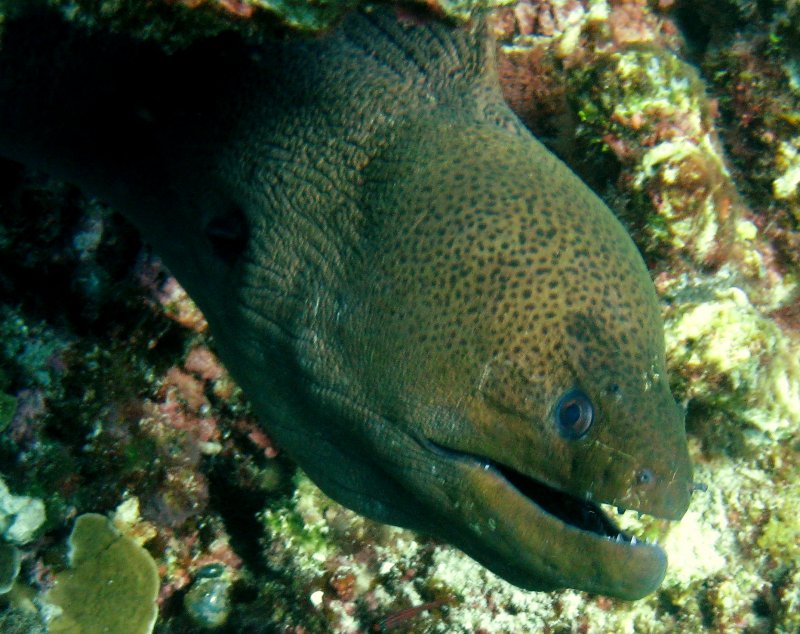
On a prominent rock at East of Eden, a dive site in the Similans, there is a notorious and very large Moray eel that has quite a reputation. In 2005 Matt Butcher, leading a dive group, approached this eel with a sausage in hand to tempt him from his hole. The eel took the sausage, then mistaking Matt's thumb for another, bit it cleanly off. To see all 2m of it in the open is most rare as they normally inhabit small fissures in a rock with head alone emerging from time to time in search of prey. Should you ever be foolish enough to put your hand in a hole and be grabbed by a moray you have a serious problem. There is no way of escaping those strong jaws equipped with needle sharp teeth other than by amputation!
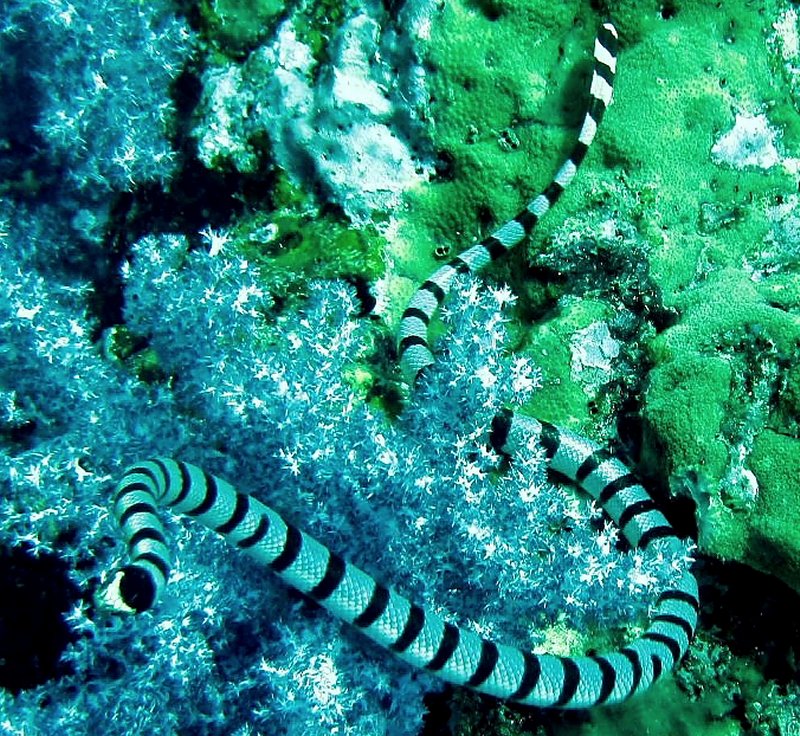
Now for another nasty with a bite. These striped eelsnakes are fairly common in tropical Indo-Pacific waters. We have observed them in Tonga swimming across our bow on the surface of the sea using a wide sweeping motion and watched one climb up the outboard motor shaft into some friends tender in the Yasawa Islands of Fiji. We also saw one making its way towards us as we ate lunch in the shade of a shoreside rock not far from Musket Cove also in Fiji. They are however exceedingly poisonous with a venom that could disable or even kill a human. The good news is that their jaws are pretty small and would have difficulty finding some part of the anatomy to grab hold of other than the webbing between fingers or toes but the bad news is they can dislocate their jaws. This one arched up to get a better view of the camera at East of Eden in the Similans, scary!
In the Caribbean, Holothurians (sea cucumbers) of the echinoderm family like starfish all seemed boringly black and smooth skinned. Not true of the Pacific where they come in an amazing range of sizes, shapes, colours. and surface finishes. They are sand gobblers, like slow moving 'conveyor belts' they crawl across the sea bed digesting edible organic material on the surface of sand particles. They can grow up to around 1.5m long (75cm more the norm) and are so soft that they flatten and distort if you attempt to move them, a bit like a slimy, empty sausage skin. Several species are harvested to be smoked and shipped to China where they are reputed to be somewhat of a delicacy. We have never heard of locals in Caribbean or Pacific waters consuming them.
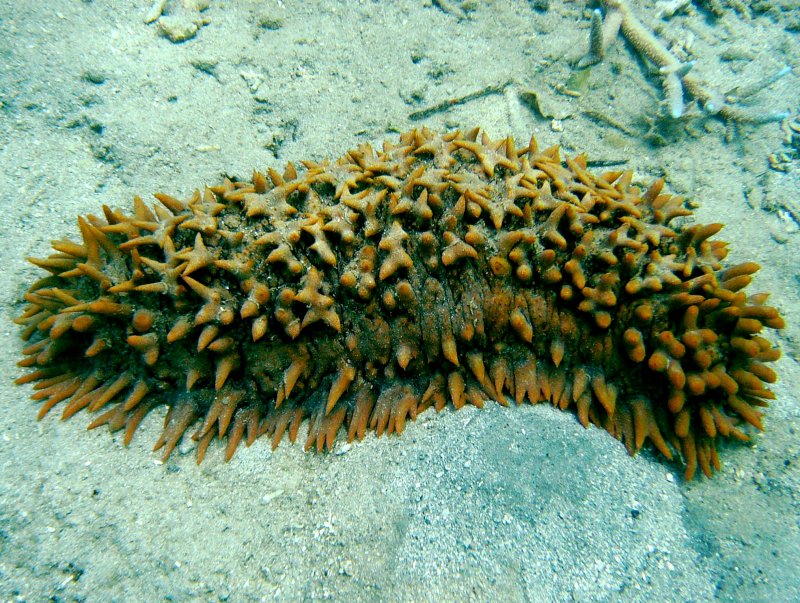
How about this spiky like covering? It is neither hard nor sharp, so unless it is deploying some defensive chemical agent, its difficult to see how it works other than just being more scary.
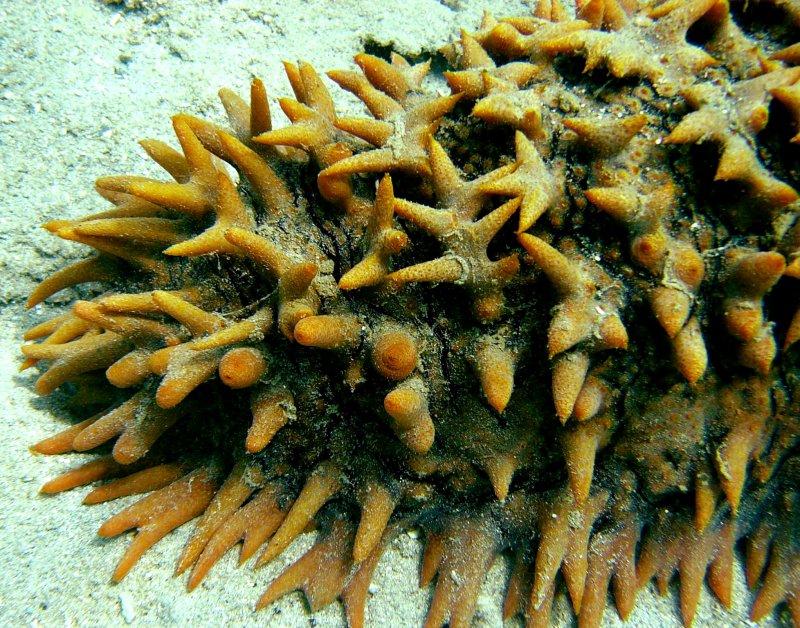
Another variant with a more interesting colour scheme.
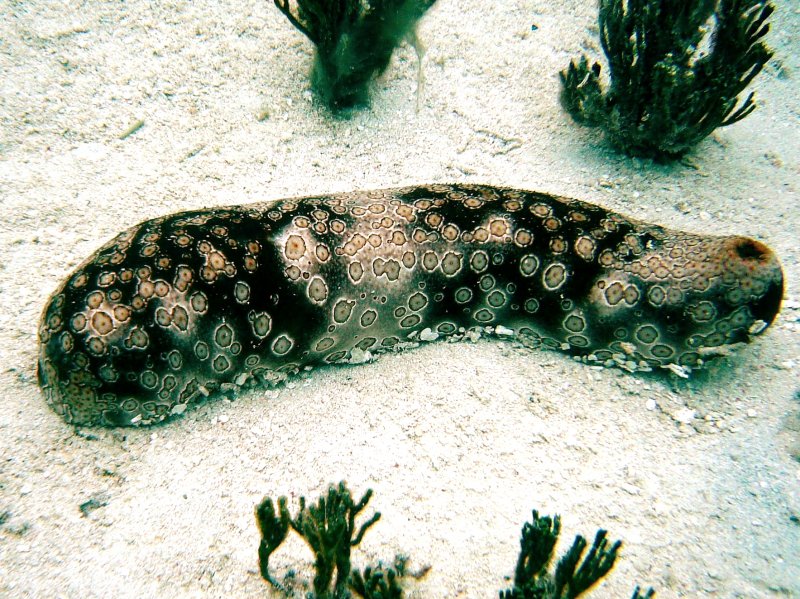
The holothurian below sports a pretty pattern on its tough, leathery grey skin and appears to have recently deployed the sticky, toxic threads used to deter disturbance or handling. These threads are elastic, sticking to the fingers just like a strand of drying impact adhesive.
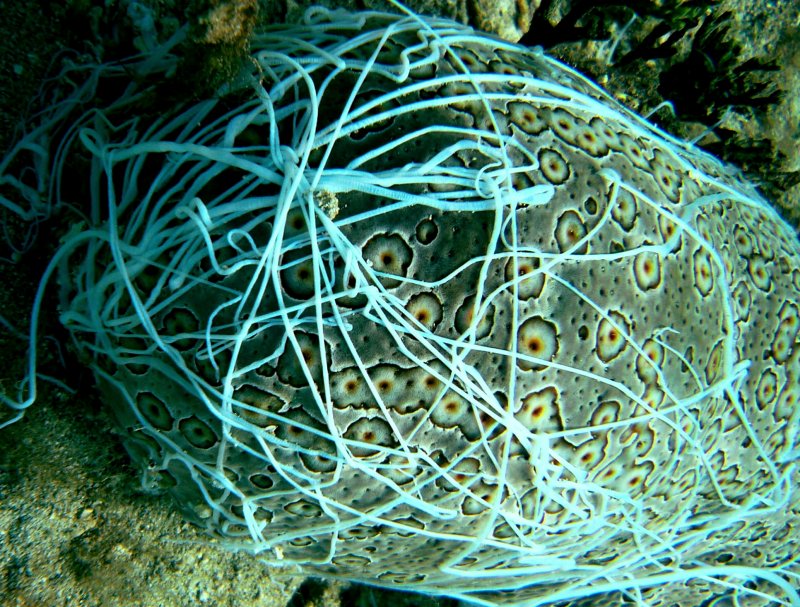
This one in the Andaman Islands of India is showing evidence of having a serious go at camouflage.
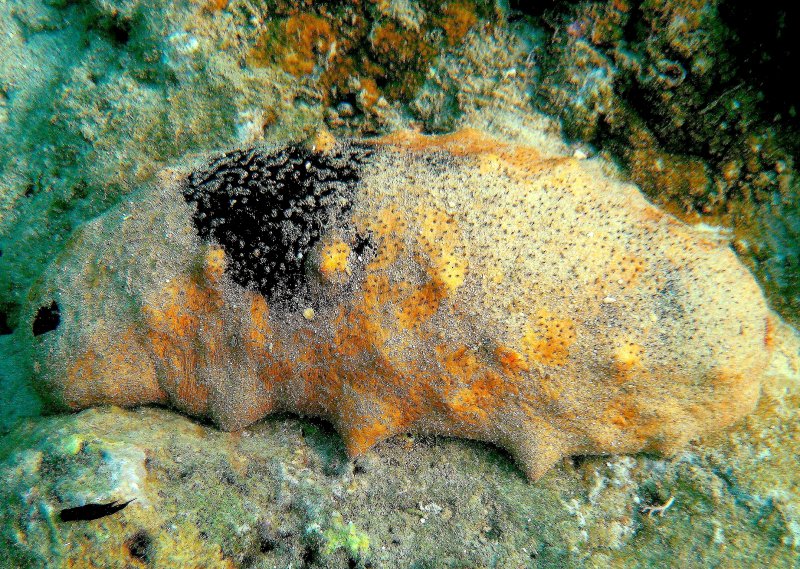
This example is just weird.
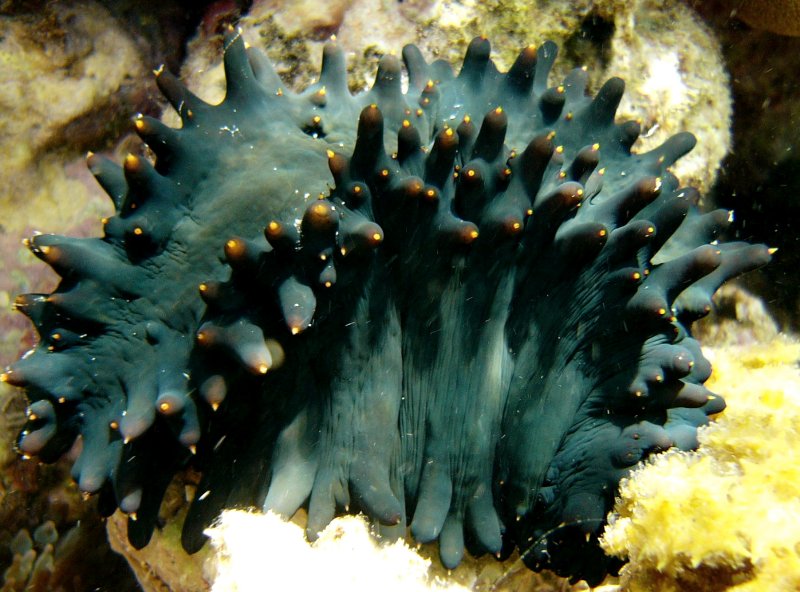
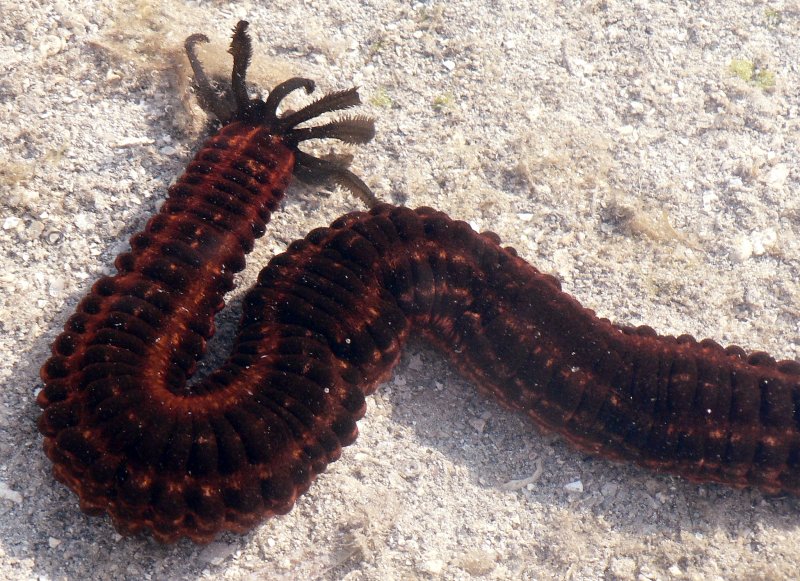
This one is unusual in that the feelers that surround the mouth are exposed and clearly visible.
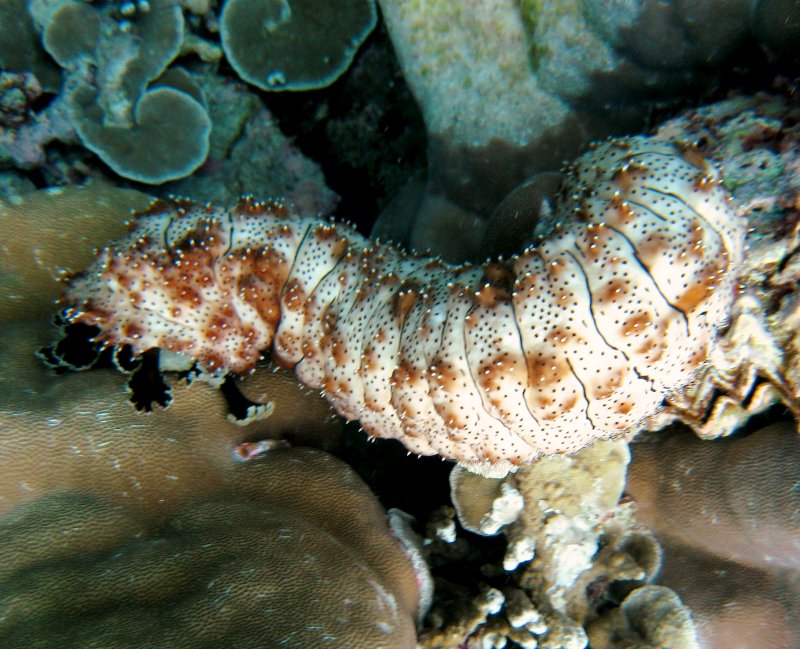
Just another shaped and decorated one from Vanuatu.
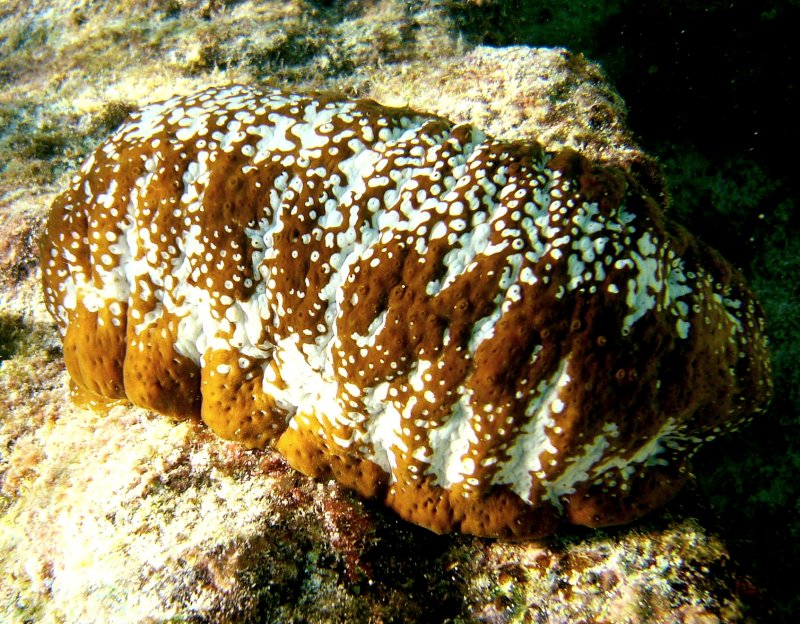
Yet a further view of food gathering mouthparts, here in the very shallow waters of Flores, Indonesia.
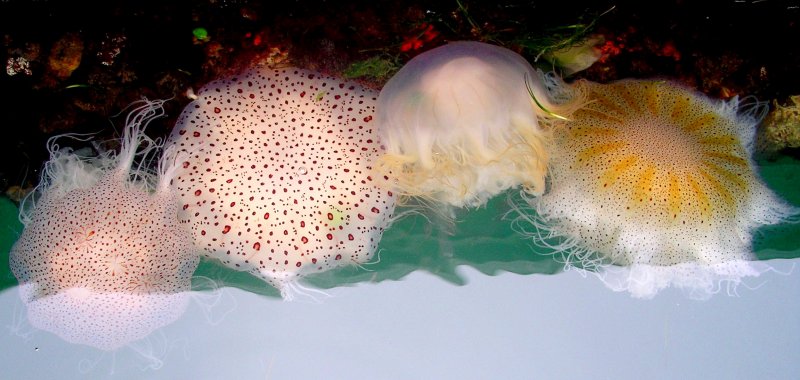
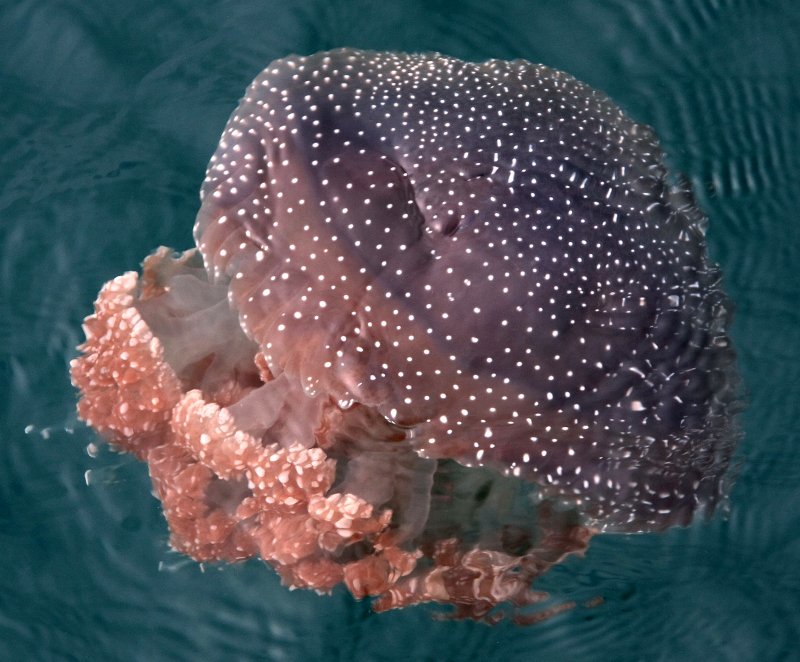
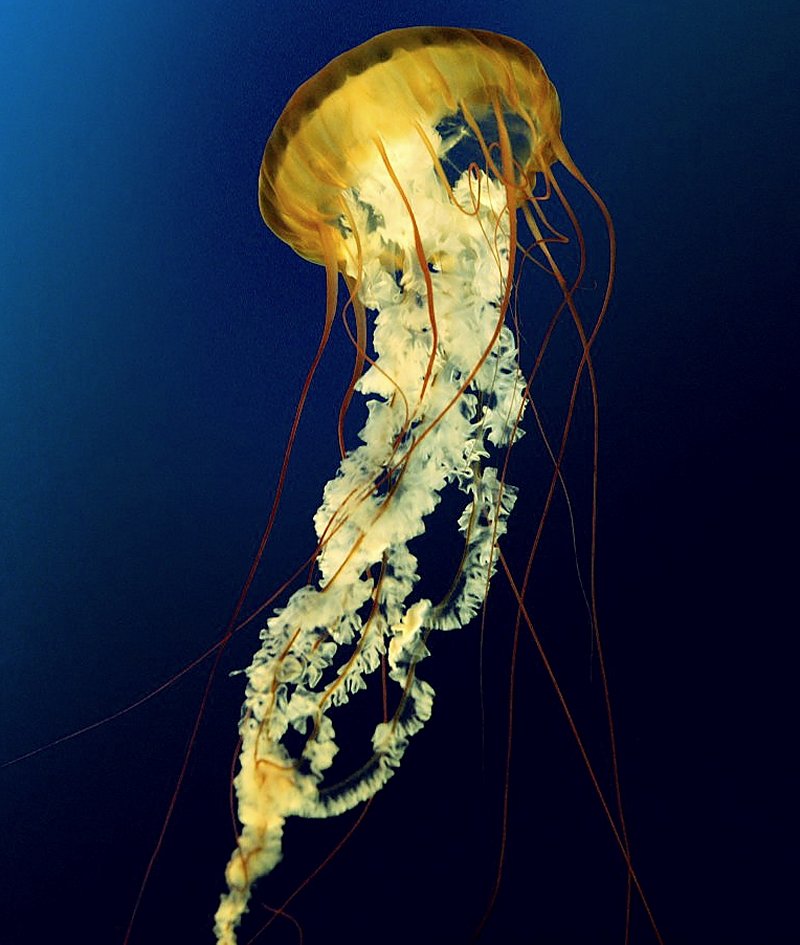
We didn't go far or even get wet to observe the pretty and differently decorated jelly fish above. They appeared during January in their thousands at the marina in Tauranga, NZ where we were berthed. All our reference material relates to the Indo-Pacific region so we haven't been able to identify them.
Jellyfish generally come in swarms and this particular day on Ko Dam Khwan island close to the Krabi shore of Phang Nga Bay was no exception. This image was captured from the deck of Amoenitas as one came close, just below the surface. They are around 50cm diameter so when a few days later what must have been millions of them were blown ashore in one afternoon on the beach at Ko Nang Bay, you can imagine the environmental impact of a pile nearly a metre high and several hundreds of metres long.
The one below also strayed into the murky waters of a marina, this time in Scarborough in Morton Bay, north of Brisbane Australia.
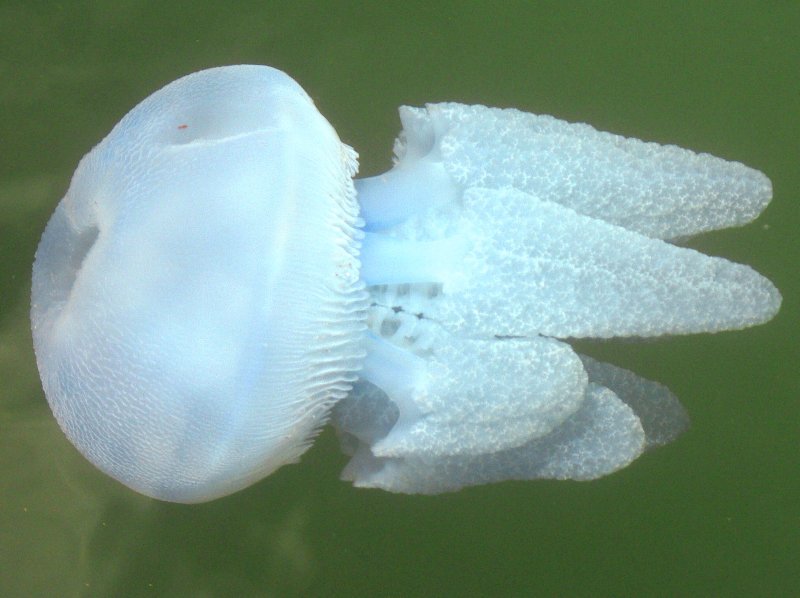
Jellyfish occur in prodigious numbers at certain times of year and can easily be drawn into refrigerator cooling systems and loo inlets of boats (not a pleasant job to clear!). Surprisingly, we rarely come across them snorkeling and diving. This solitary one we saw snorkeling off a remote rocky islet between the Similan and Surin islands off Thailand's NW coast..
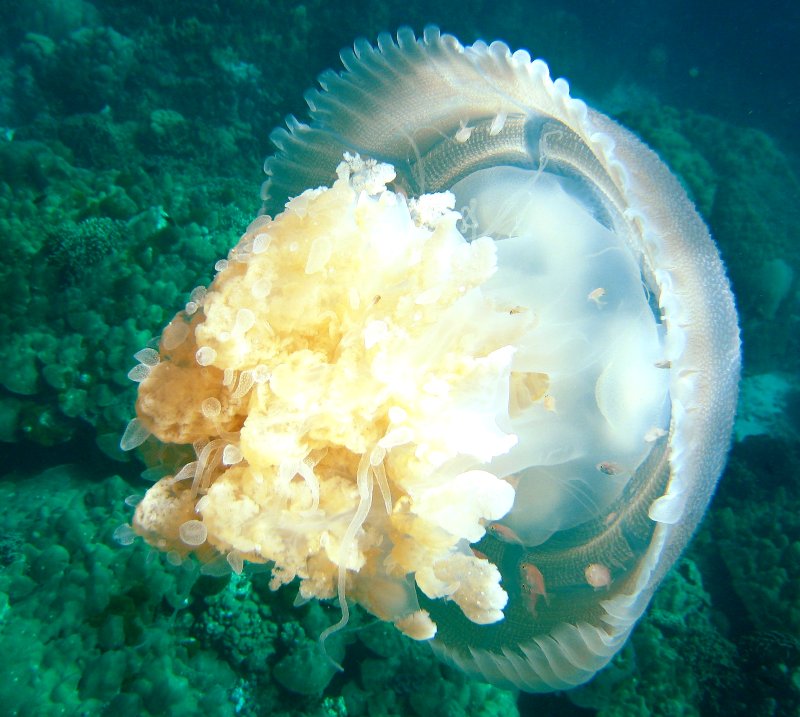
Clearly this Box Jellyfish is swimming past Amoenitas's bow in Rebak marina off Langkawi in the far north of Malaysia. This specie is extremely dangerous, a sting from which can prove fatal to even a grown adult.
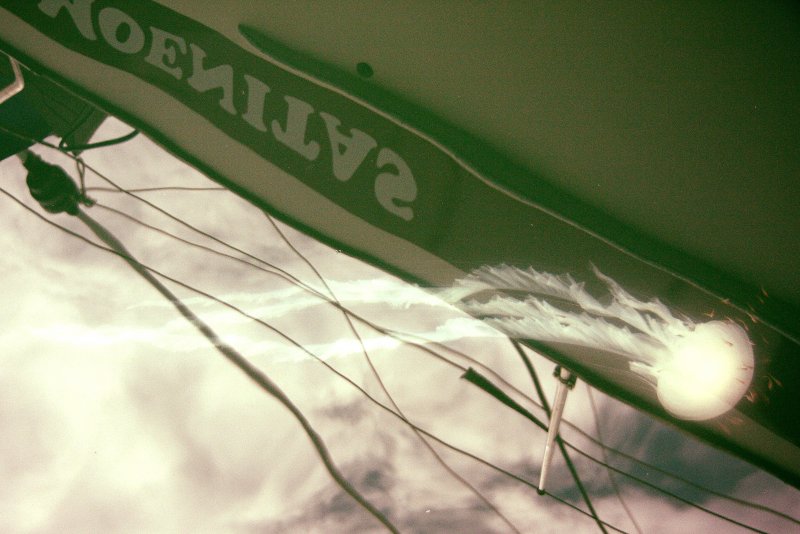
Below is a much clearer image of a Box Jellyfish taken in the Sentosa Island aquarium in Singapore.
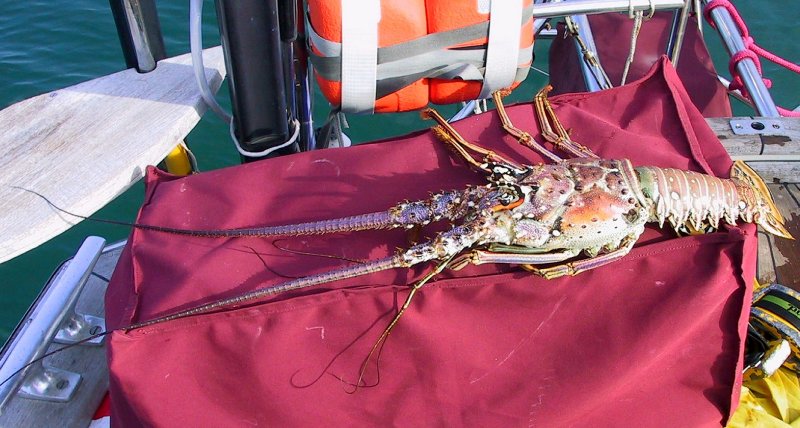
Below is an exotic example of what is known in the tropics as a lobster but to those of us who appreciate their cooler water cousins with two huge claws, they are definitely crayfish and inferior eating. Normally their colouring is more prosaic, an orangy brown with some black markings. The southern coast of Cuba abounded with crayfish so we could eat our fill almost at will. We find the meat relatively tasteless and very filling.
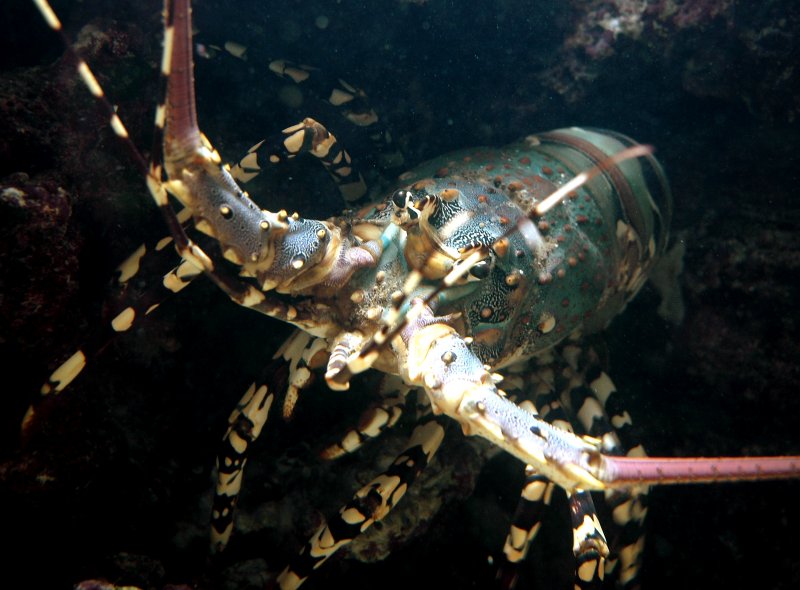
Another example, a Blue Spot rock lobster we caught in the beautiful San Blas islands off the coast to Panama. Normally all one seems of them on the reef is part of those long feelers sticking out of a hole in the coral. Getting them out is a another matter.
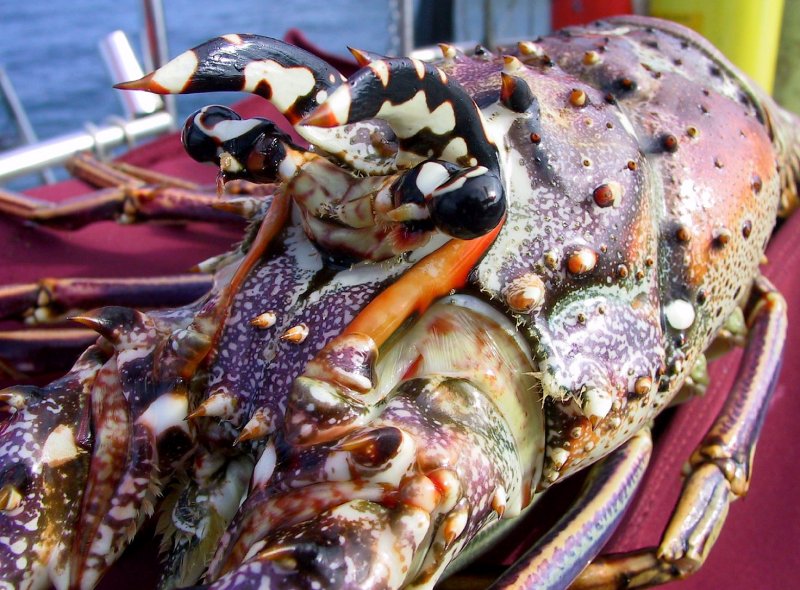
A close-up of a Blue Spot illustrating the formidable sharp defences you have to avoid when catching one.
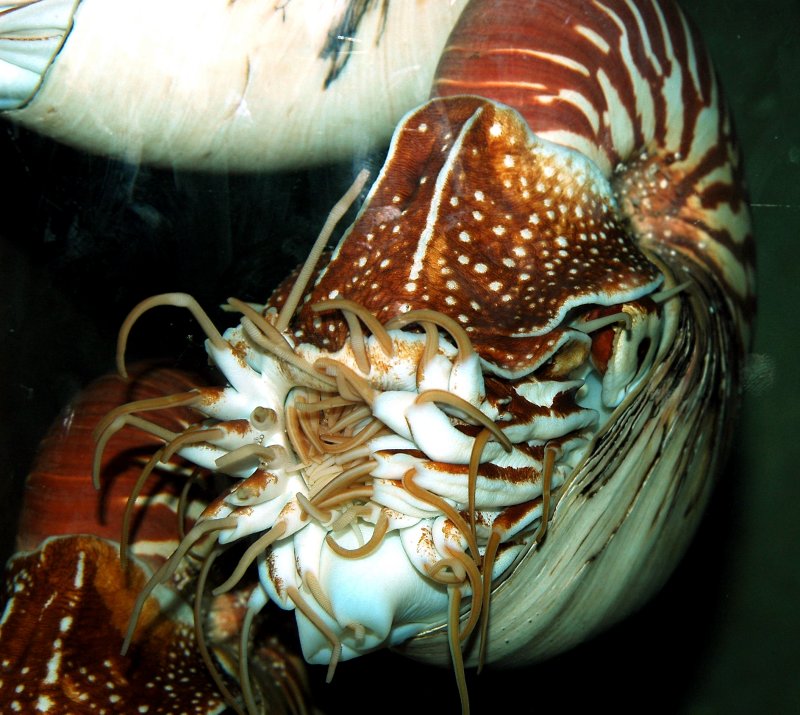
There are five species of Nautilus, a primitive marine mollusc, belonging to the only surviving genus of the nautiloids, which were the largest predators in the seas of the Ordovician period, 510 million years ago. Visible are the up to 90 small tentacles arranged in two rings around the mouth, used to catch its prey. Its most familiar characteristic is its smooth, coiled shell, up to 28 cm in diameter. The shell is lined with mother-of-pearl (nacre) and is separated into a series of progressively larger compartments, the most recently formed of which is inhabited by the animal. The chambers are filled with gas and liquid and the walls (septa) dividing the chambers are pierced by a thin strand of mantle tissue (siphuncle) connected to the nautilus. Gas and liquid exchange occurs through the siphuncle, and by means of this the nautilus can adjust the content of each chamber and so regulate its buoyancy and attitude in the water. The nautilus normally rests on the ocean bottom during the day, at depths ranging down to 600m. At night it swims about by forcing water through a primitive funnel eating diatoms, shrimps, fish, and algae. Little is known about the behaviour and life cycle of this mollusc.
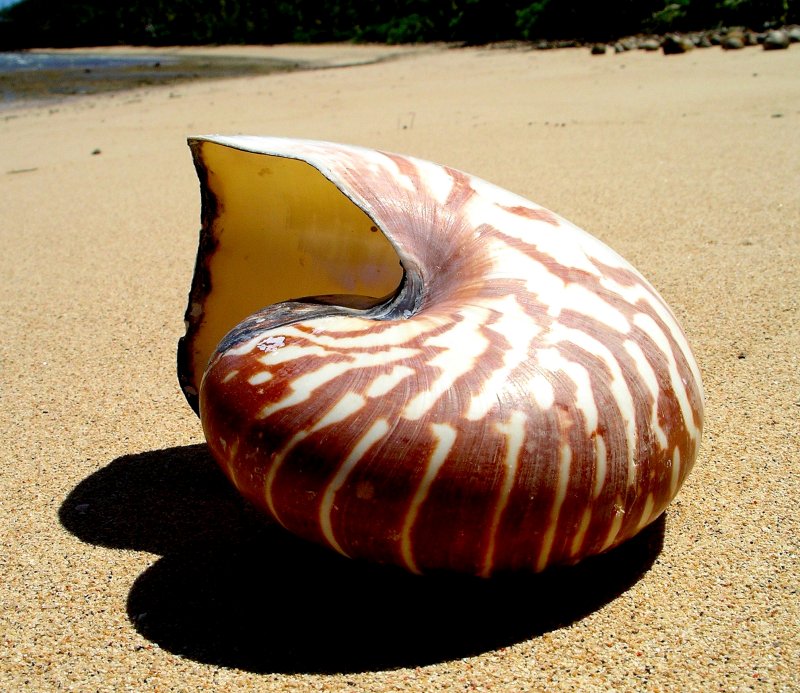
This is the way we normally saw Nautilus, as empty shells on remote windward shores opposite a wide expanse of deep ocean. We found several over the two year period when we visited the small island of Yadua in Fiji.
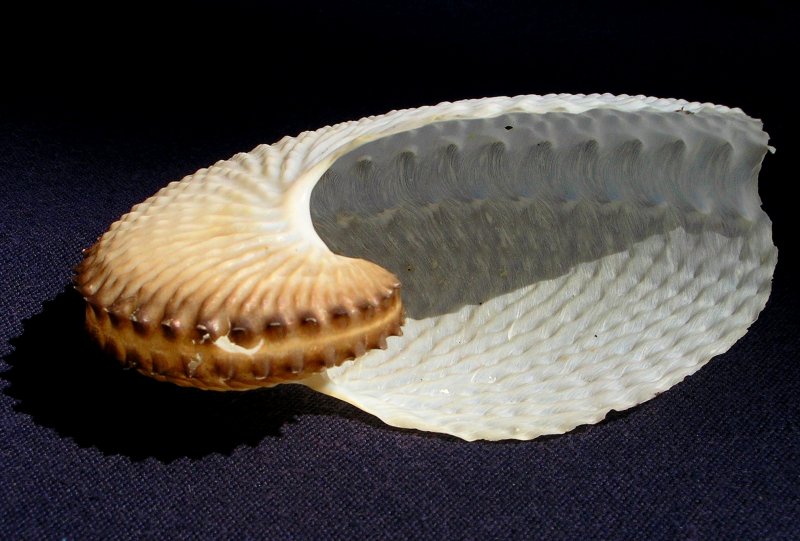
This rather different example is of the Paper Nautilus found on Mayor Island in the Bay of Plenty at the east of New Zealand's North Island.
Having been quite used to seeing the flat skeletons of the cuttle fish member of the Cephalopod family all around the world, it took a long time to find a live specimen within camera range. It is propelled and steered at low speeds by the membranous lateral fins on its sides and at higher speeds by a syphon ejecting a jet of pressurised water into which a black ink can be injected to deter a pursuer. In this picture it is moving from right to left.

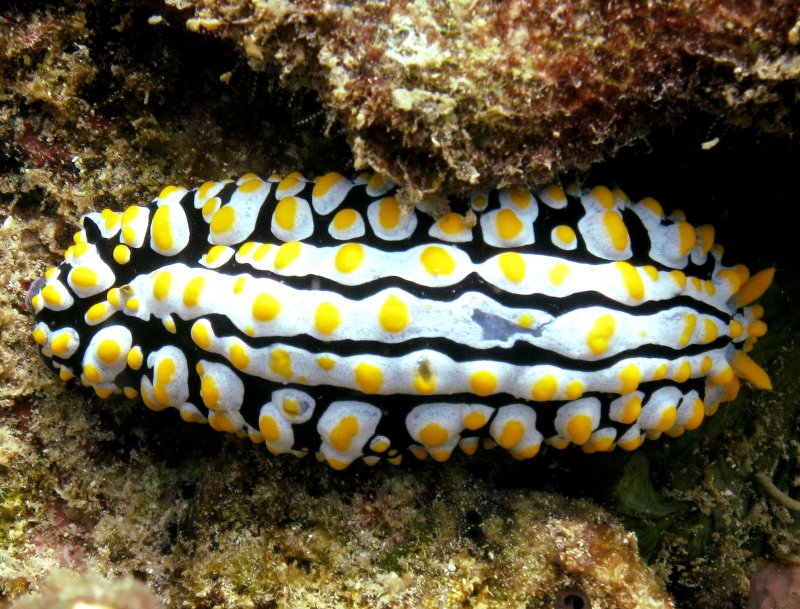
Nudibranchs appear often in diving and tourist promotional material but we have found them to be rather rare throughout our travels. The last ones we saw in any numbers were on one small island just north of Efate in Vanuatu. This one is quaint in that appears to have been decorated with fried eggs. It also has suffered a couple of tears in its outer canopy.
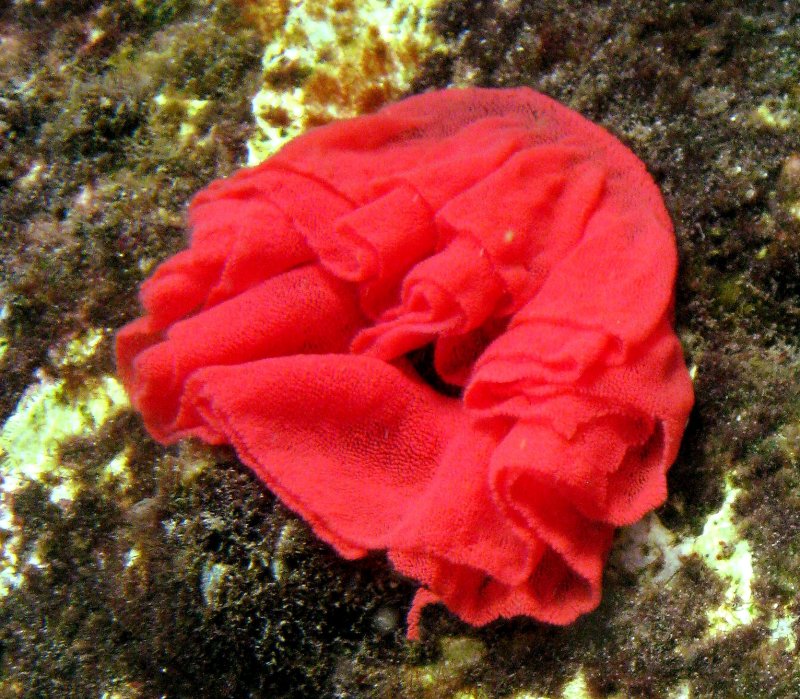
Snorkeling off the SW point of Ko Kraden south of Phuket, Thailand we came across what appeared to be a man-made, flower-like object but closer inspection revealed it had a regular polyp type structure. Subsequently we saw one more on Phi Phi Don island, these are the only two we have ever seen and they do not appear in any reference book we possess. We took photographs to the Thai Marine Research Station in Phuket and they seemed equally baffled. Much research and several marine scientists later we thought we might be on the path to naming a new specie 'Redrosicus jesingerii'? We took our data to the London Natural History Museum who we were surprised to find took them seriously. After some months came the reply that what we had was a complex ribbon of Nudibranch eggs (Hexabranchus sanguineus). These are native to the Phillipines and had never been seen elsewhere before.
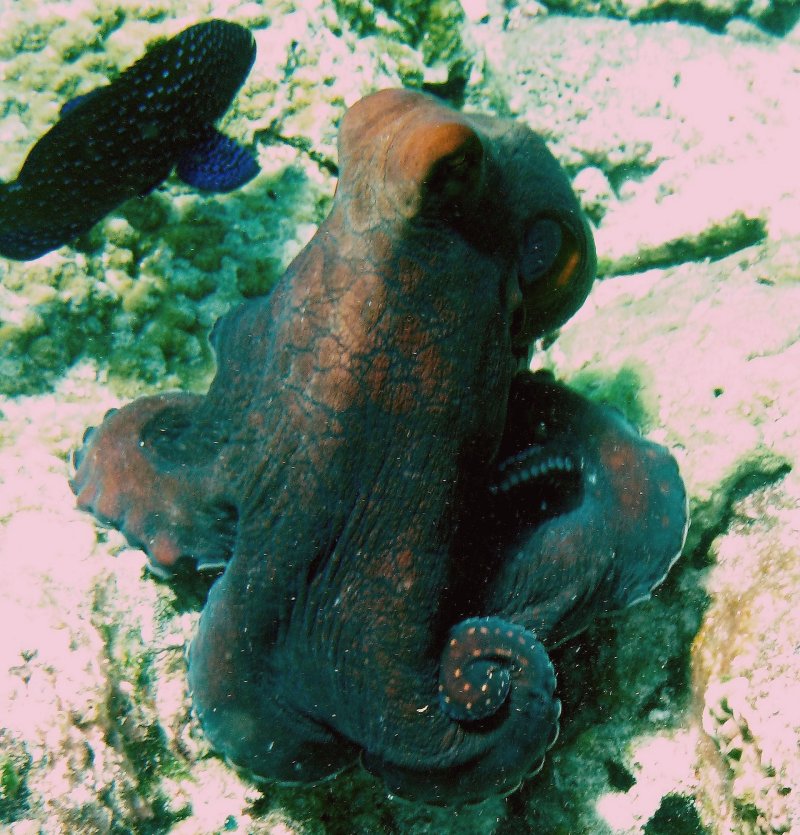
Surprisingly, in all our years of exploring tropical waters, this Octopus encountered in the Thai Similan islands was the first we had seen. Our attention was drawn to it as it it had around four largish fish accompanying it and apparently goading it (note the juvenile Speckled-fin grouper). We spent around 20 mins following it along the seabed between rocky holes observing its rapid colour changes as it adapted to match the backgound. It must have been around 80cm long with its tentacles extended.
This ray was one of a group of around twenty that appeared to order at around 10am every day for the benefit of trip boat punters in a beautiful tropical paradise lagoon. on Bora Bora in the Society Islands. Needless to say, they are fed liberally to ensure their cooperation. The water was only around 2m deep so it was easy to join in the party from your own tender.
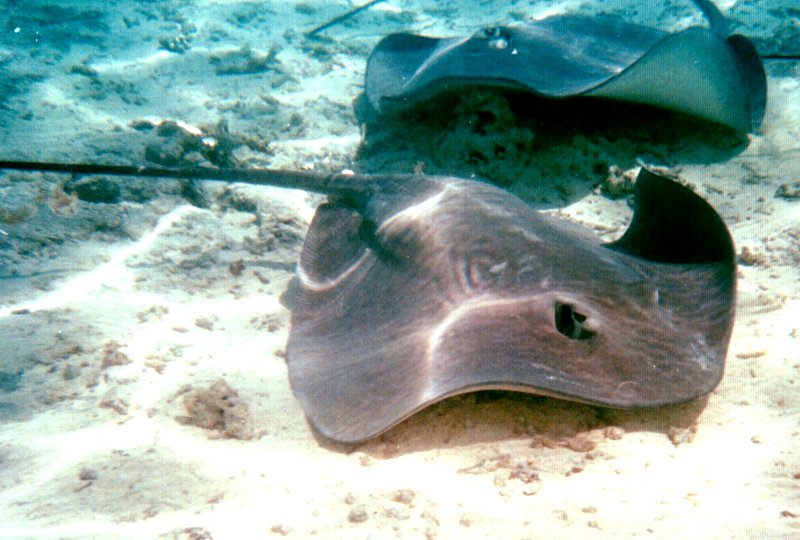
Yet again the contrast between this picture of a ray taken on the Thai, Similan islands and the previous one taken eight years earlier in French Polynesia in 2002 illustrates the difference between the old wet film and digital photography.

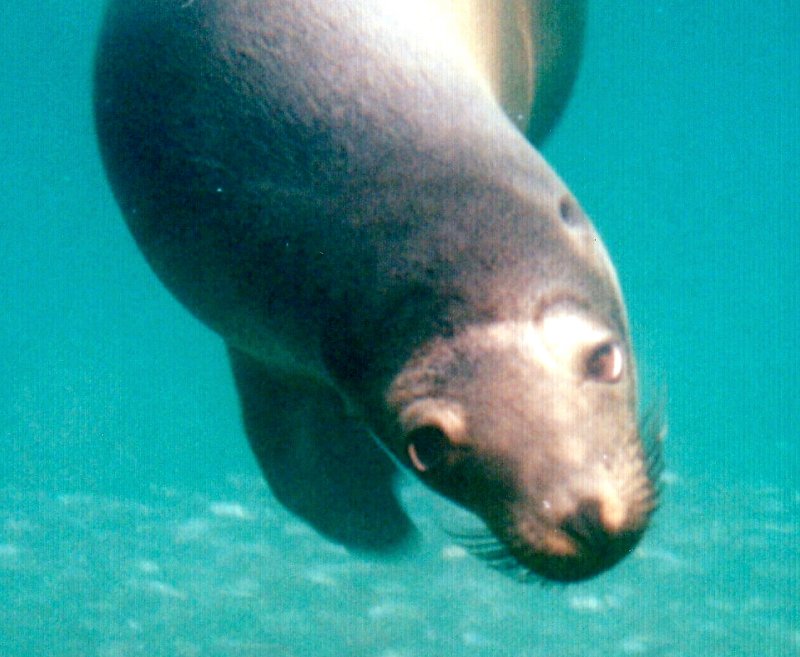
The Galapagos sea lions are legendary for their antics which though friendly are sometimes unwelcome. Such as when they climb into your tender at night leaving a vile smelling legacy of their sojourn. They are however irresistible, especially when they join you to cavort together in the water. Typical of the attention they pay you was the experience Dave had whilst holding onto a cliff, decompressing after a dive in the Galapagos. The sea lions kept swimming up between his arms and the rock with such precision they never touched on the way through. A bit scary at first though!
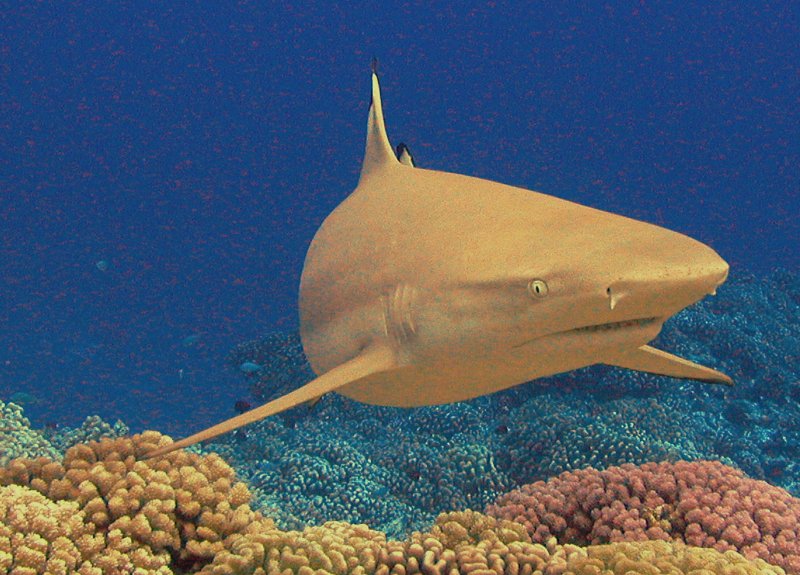
Now we get to some seriously scary creatures! Sharks were not really an issue until we were well into the Pacific. They were supposedly common in the Marquesas but the water was never really clear enough to see them. However, once into the crystal clear waters of the Tuamotus they became a regular feature of every snorkeling trip. Generally they were pretty small, 1.5m or less, so unless you had speared a fish in what they considered their territory, they generally showed an interest in we strange large creatures but kept their distance. This rather large specimen of over 2m would have appeared quite menacing had Dave not been concentrating on the photo opportunity. Sharks can tail you in the water but rarely approach as close as this. Just in case, we try never to take our eyes off them, searching for any clue of unusual movements such as arching of the back. Don't assume you are safe in shallow water either. We have seen sharks swimming close to sandy beaches and over the top of reefs in around 30cm of water with their dorsal fin well out of the water.
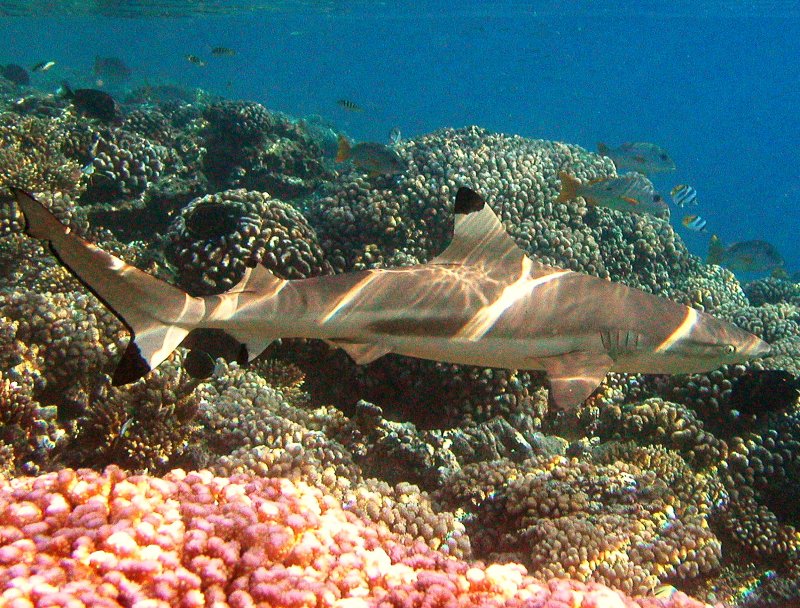
We had our first worrying shark experience on Beveridge Reef, an atoll in the Cook Islands when Dave speared dinner and in spite of raising it out of the water above his head within seconds, had four reef sharks of about 1.7m circling around him. Di was asked to get a bucket from the tender to hold the catch, a task she performed with great valour, approaching to within throwing distance before retiring at great speed. A week later we were in Tonga when a local guy was taken by a tiger shark and barely survived.
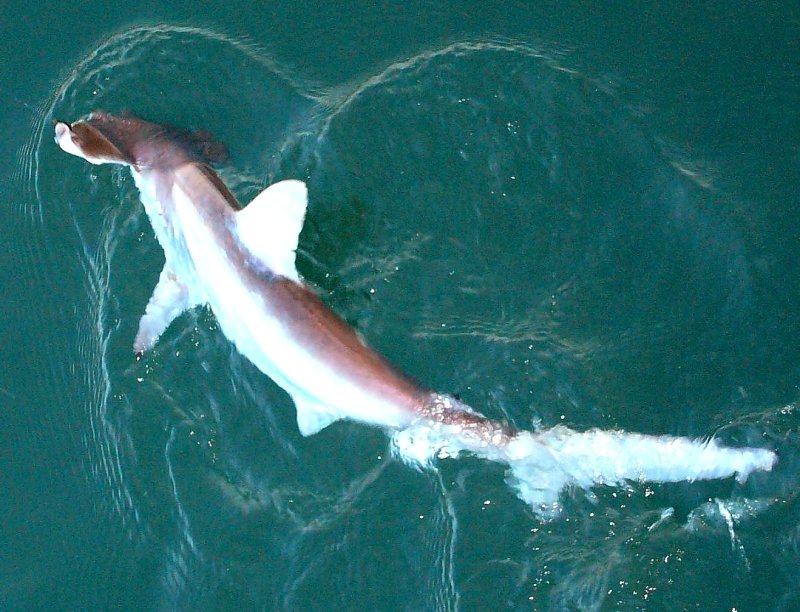
Hammerhead sharks look especially scary with searching eyes set right at the ends of their head extensions. The best sighting of some large examples was in a deep submerged valley in the Galapagos islands after the film in Dave's camera had run-out. Perversely, we caught the one below whilst fishing at anchor at the south end of Fraser Island south of Bundaburg on Australia's Queensland coast. We managed to remove the hook and release it but not before getting a feel of its very rough skin surface.
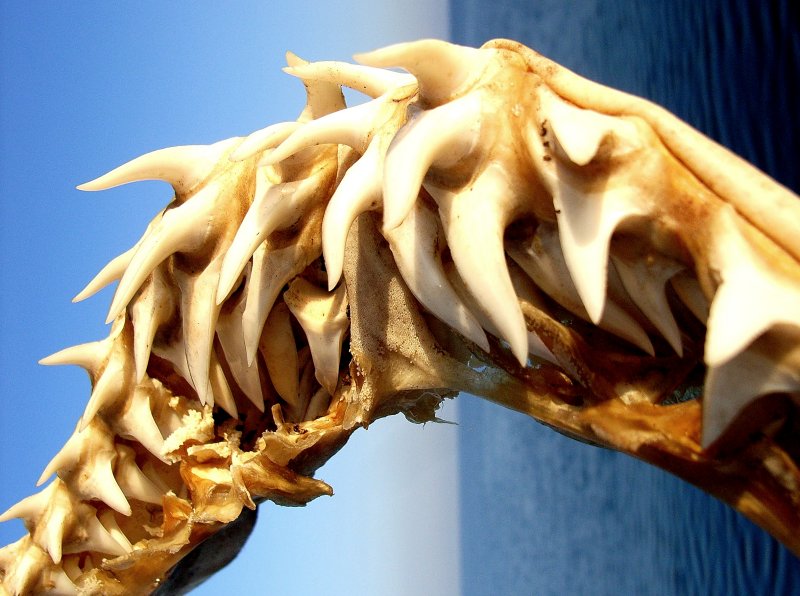
Whilst on the Indonesian island of Lembata in August 2007, we were lucky enough to be able to visit the remote village of Lamalera, famed for its tradition of catching whales from small open, rowing boats. Getting there involved an over three hour trip in the back of a truck on very rough roads. Of more concern was that our party had an accompanying truck full of police! The villagers saw few visitors and were keen both to demonstrate their whaling skills and earn cash by selling us artifacts. One of our contributions to their funds was for this jaw of a deadly Mako shark just about large enough to accommodate Di's head.

This close-up illustrates the multiple rows of viciously sharp teeth that any prey would have little prospect of escaping from.
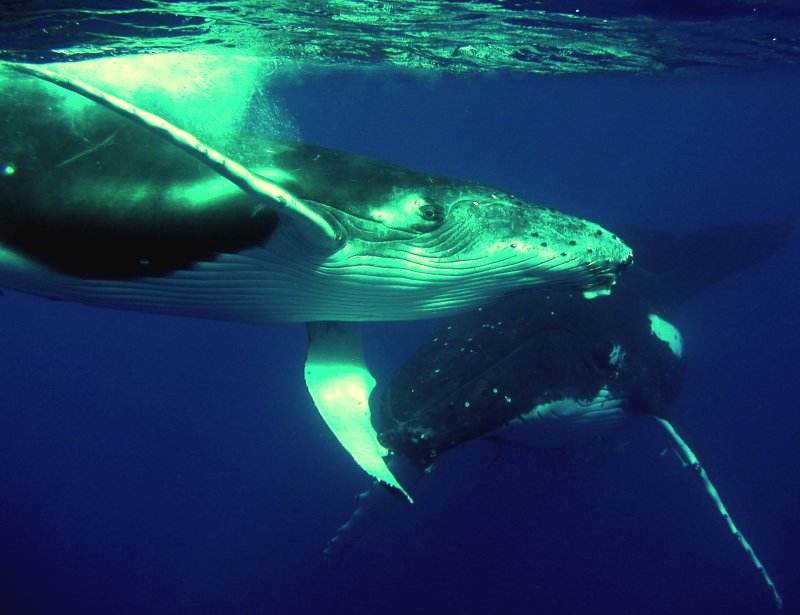
The Tongan Vavau island group toward the north of the archipelago is a southern hemisphere Spring gathering place where breeding Humpback whales give birth to their young. Anchored in remote bays on the north of the island, we were kept awake much of the night by their cries which seemed incredibly close.
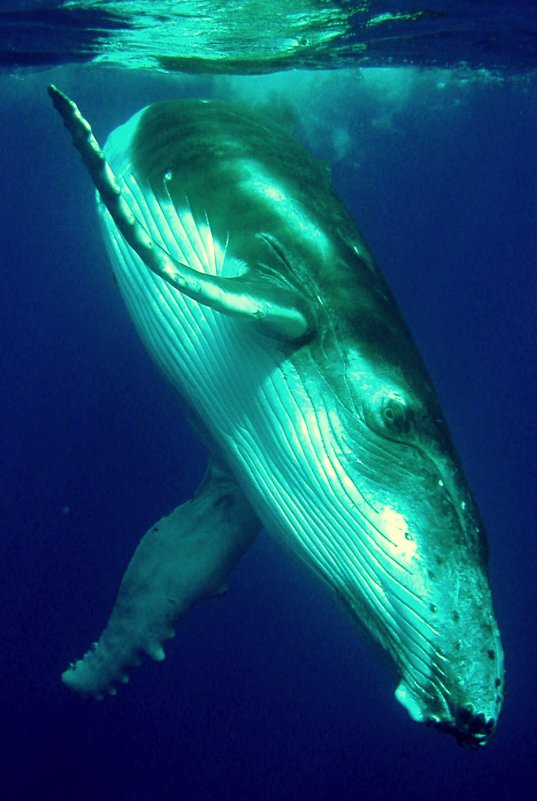
As can be seen, they were friendly and allowed divers to swim amongst them, even when they were with their young. Occasionally though, they can be a threat to sailors. Whilst approaching the Queensland coast of Australia on passage from Vanuatu we observed several breaching hump backed whales that were jumping clear out of the water. Whilst we were in those waters, there was a case of a cruising yacht with Brit tourists aboard that was dismasted by a whale landing on it. Bet the whale might have had a scar or two to show as well.
Filter feeding Sponges have the least complex body structure of all multi-celled creatures. A typical sponge comprises an outer layer of tissue, the cortex and a fibrous inner layer impregnated with numerous glass-like slivers of silica or calcium carbonate.

This simple but effective filter feeder was seen in Vanuatu.
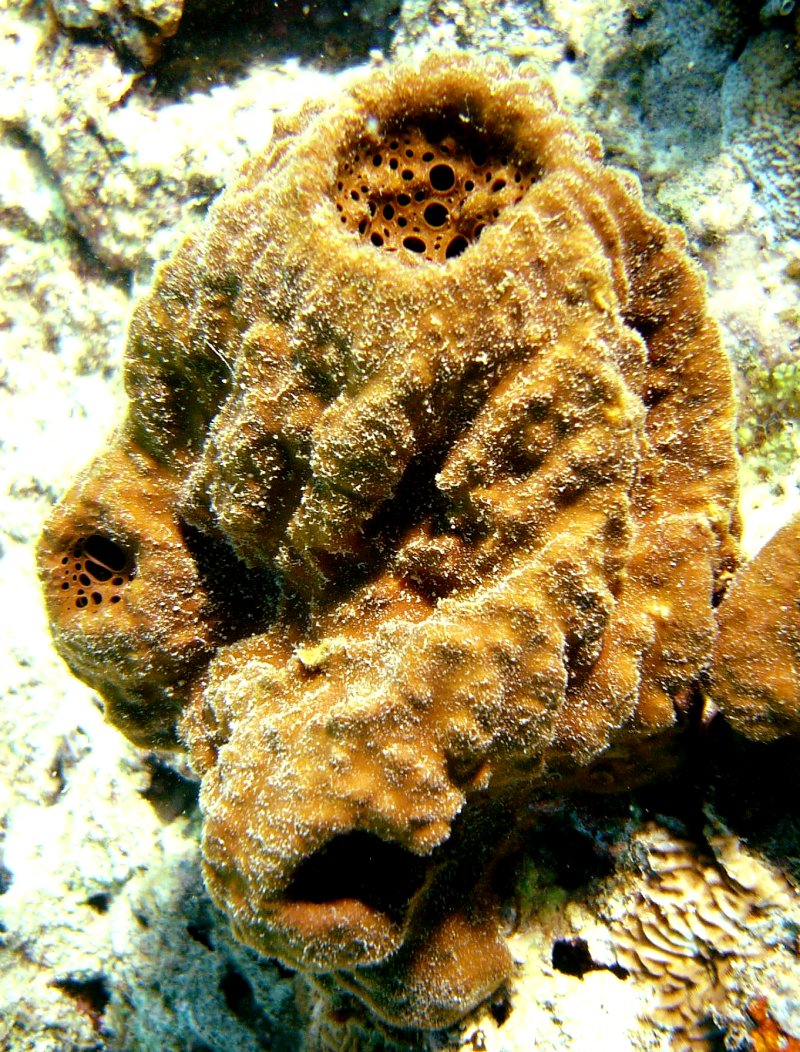
Yet another colour and more striking form from this example from Indonesia

Yet a further variant of form in the Similan Islands of Thailand.
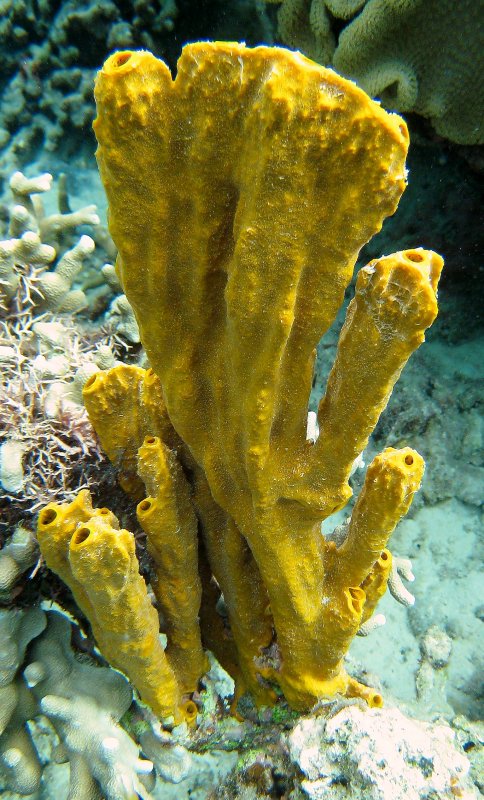
This last one from Alor island, Indonesia is known as a vase sponge for obvious reasons.

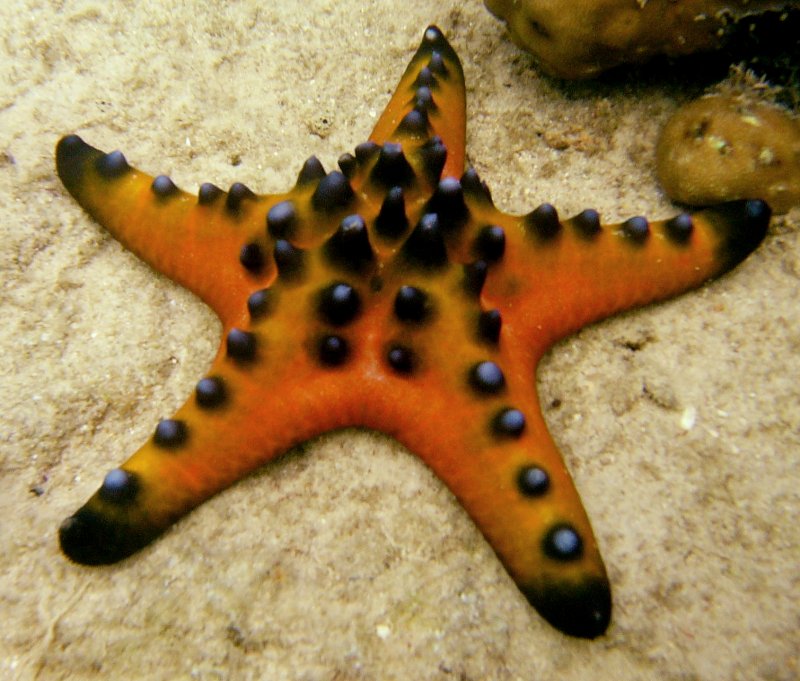
Now on to Starfish. This strange looking star was new to us but they are relatively common in shallow waters. We saw this one at Riung in Ende Province on Flores. They come in widely varying colour combinations and remind you of a three dimensional representation of a complex mathematical function.
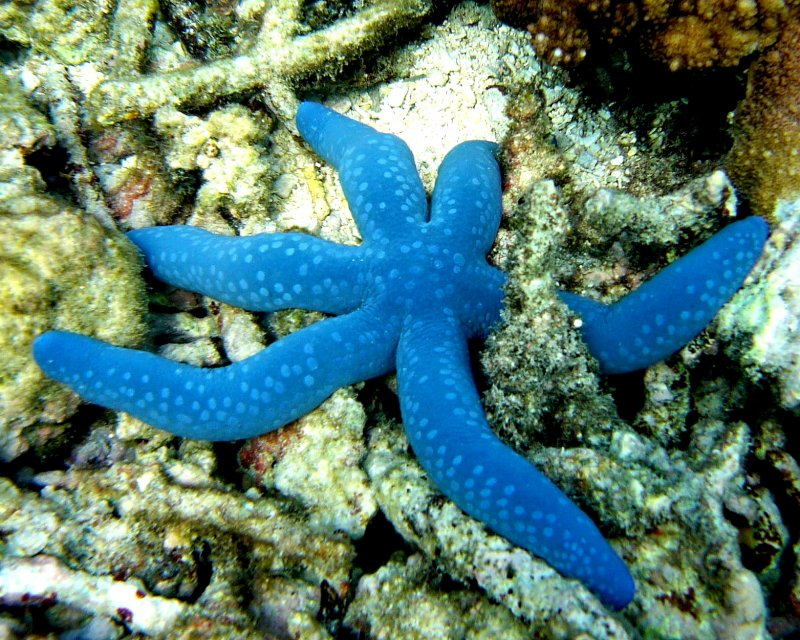
These vivid blue starfish are common throughout the whole Pacific and are also quite large, typically 25-30cm in diameter. Often we see them wrapped around fingers of coral. In this case it is the debris of dead coral which unfortunately is becoming ever more common in the tropics as a result of global warming and cyclone damage. However, these bright blue, five armed linckia starfish are common throughout the Indo-Pacific. One finds then distributed over the coral formations like some mass produced Christmas decoration.
The same specie but a differing colour scheme this time in Vanuatu.
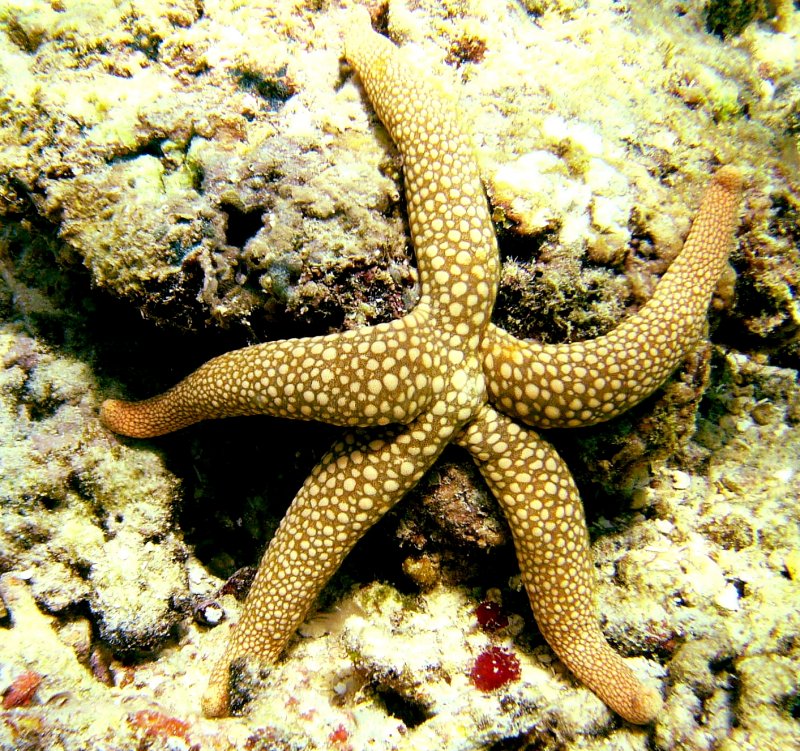
Yet again in the Indian Andaman islands but with a central marking of the arms.
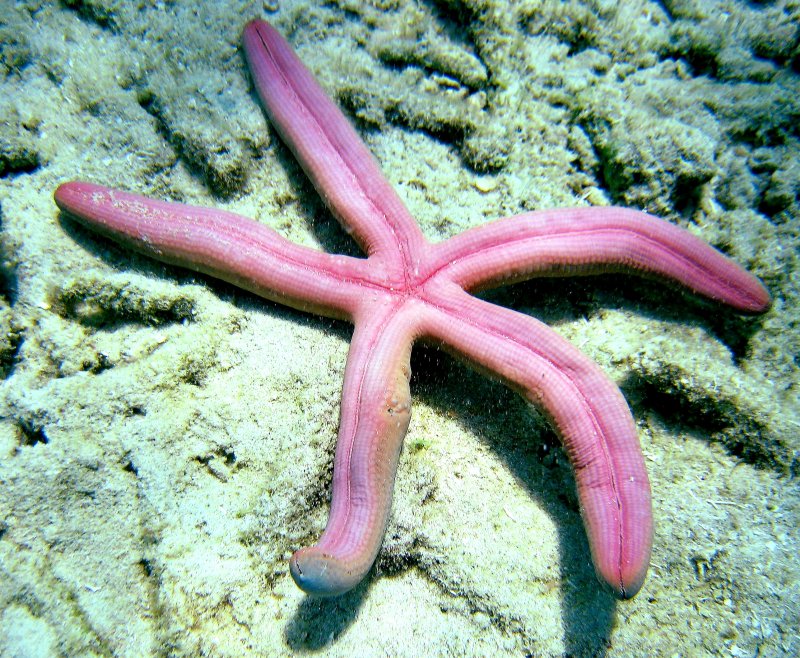
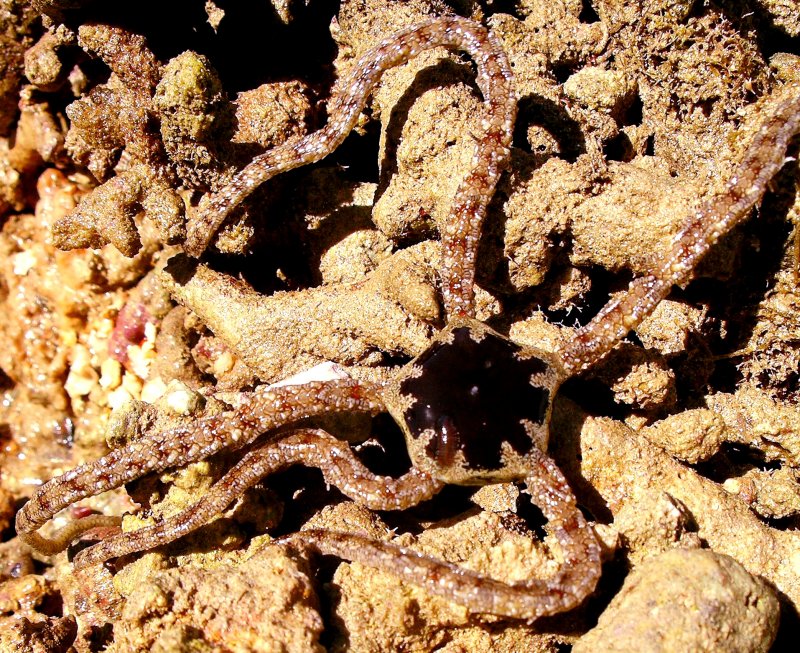
This skinny looking example, called a Brittle Star has distinctive markings on the body and legs.
There is a class of these creatures known as cushion stars that are five sided, rather than five legged. Though their shapes are similar they have varying 'paint jobs'.
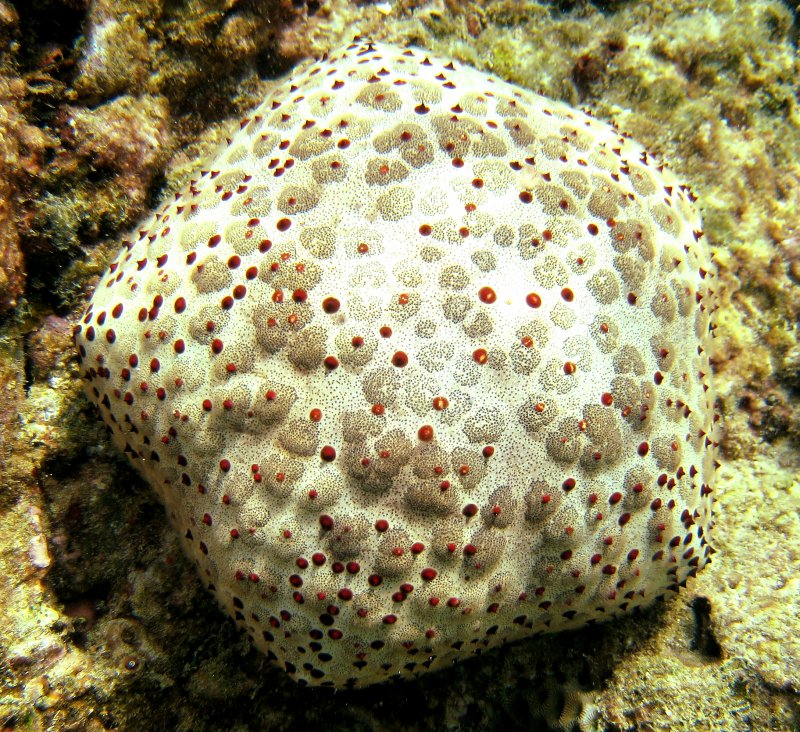
This one is host to a lush covering of red algae.
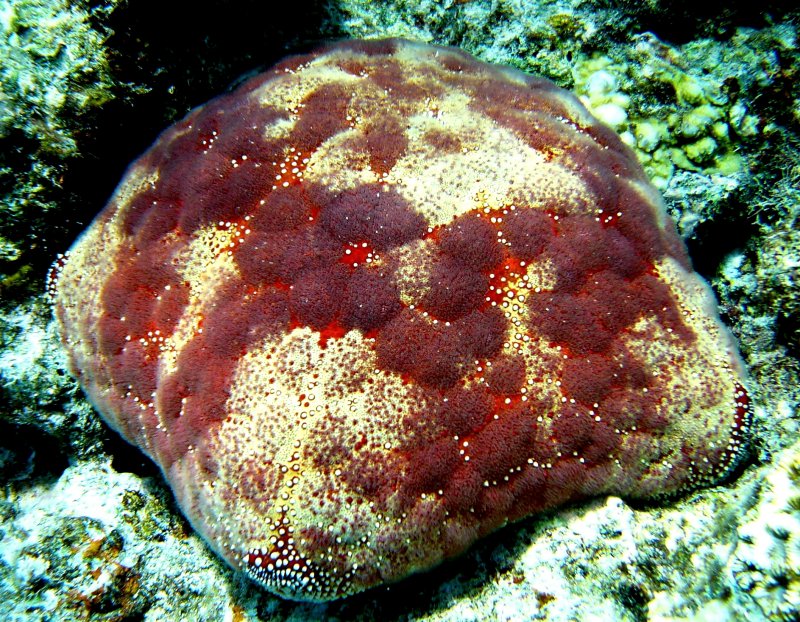
This specie was common in both South Pacific and Indian Ocean waters, having the 'seams' between its five segments defined on its underside.
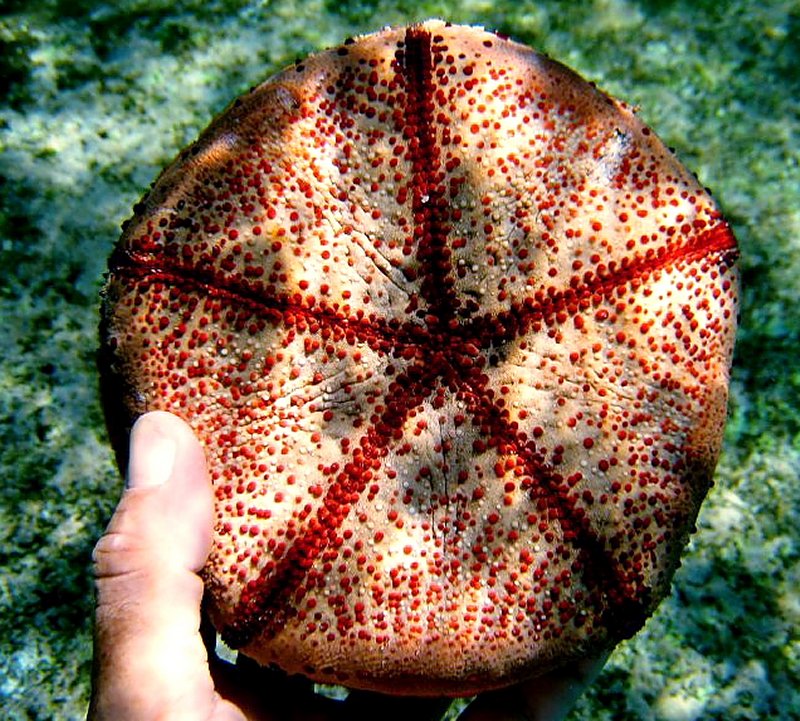
The Crown of Thorns starfish is another matter and is such a threat to the well being of a coral reef that we were encouraged to collect and destroy them. They crawl across the coral, emitting a digestive juice to dissolve the polyps that are the living surface of the reef. One can normally see where they have been by the lighter colour of the dead coral. Never did we seen so many in one place as we did at Batu Boga on Flores in Indonesia. A count along a strip around 20m by 10m revealed over 40 of the pests.
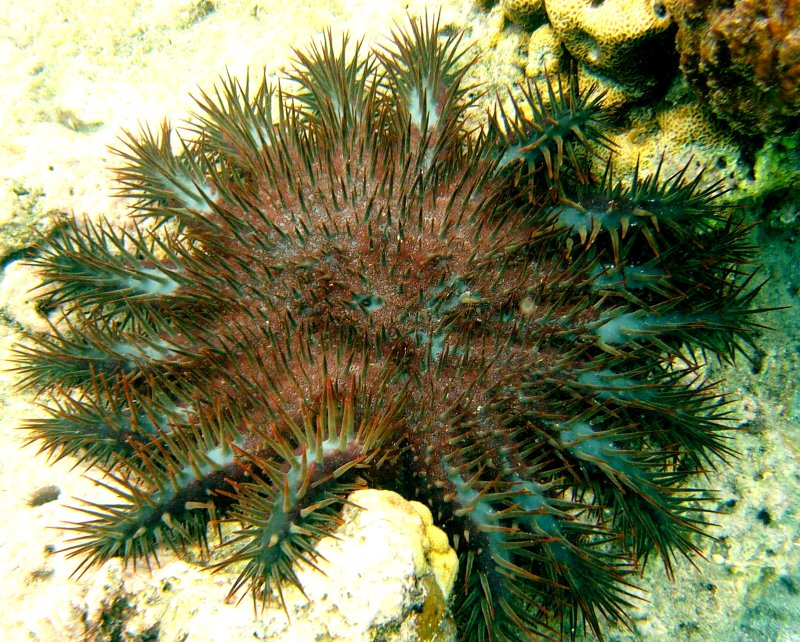
Normally they have around seventeen arms (or legs), their colouration being a grey/brown mixture as in the above example. However, on the reefs, colour is often determined largely by the variety of algae in the region. Here are some other options starting at the blue end of the spectrum
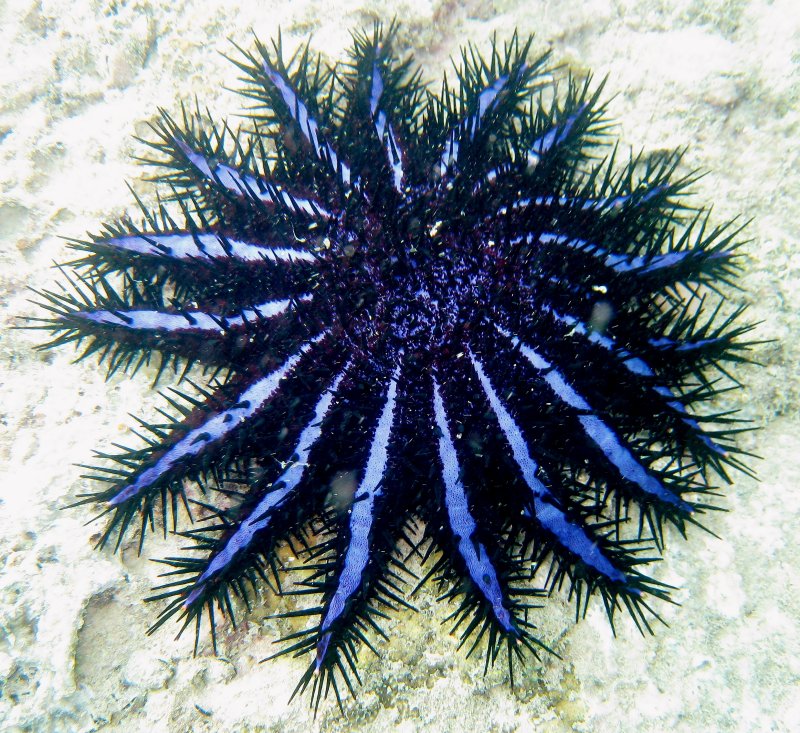
Similar model but in brown and white.
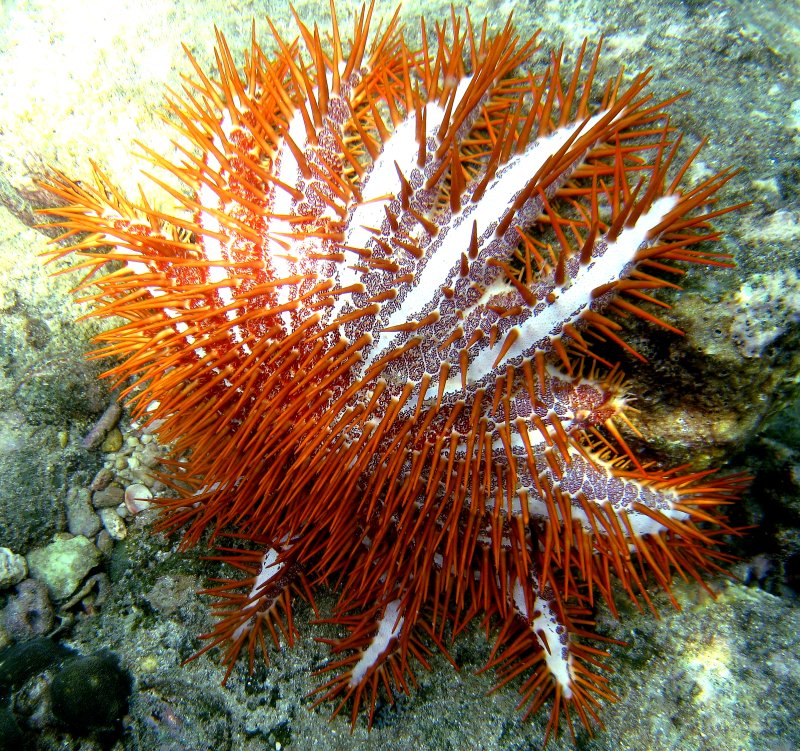
Should you decide to skew natures work by picking some up and casting them ashore, you'll be needing a thick pair of gloves. Penetration of the skin is easily achieved and believe me it is painful for many days!
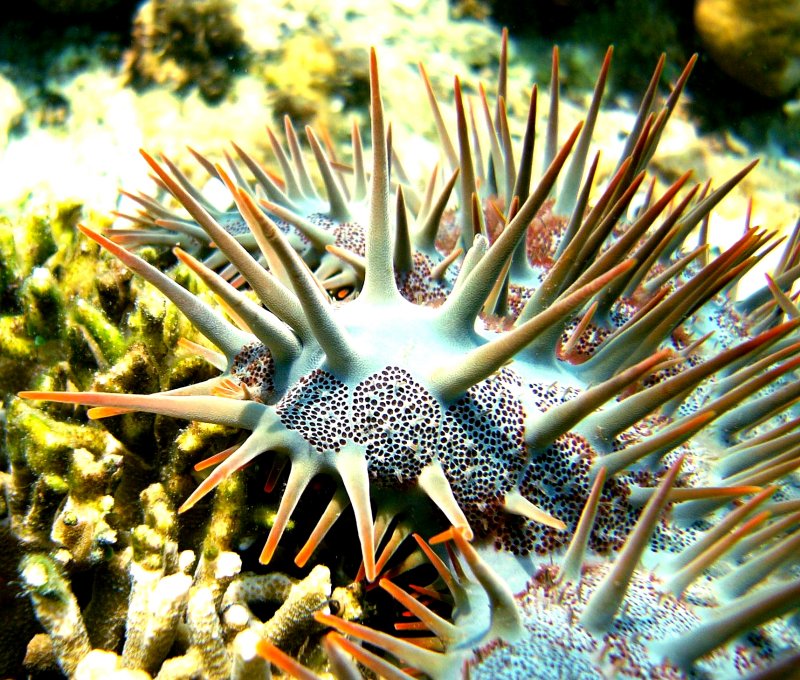
Feather stars are another of those species we regarded as relatively rare until we swam in Indonesian waters where they are commonplace. This one was at Batu Boga on the northern coast of Flores.

Fond structure and colour do vary significantly across the species.
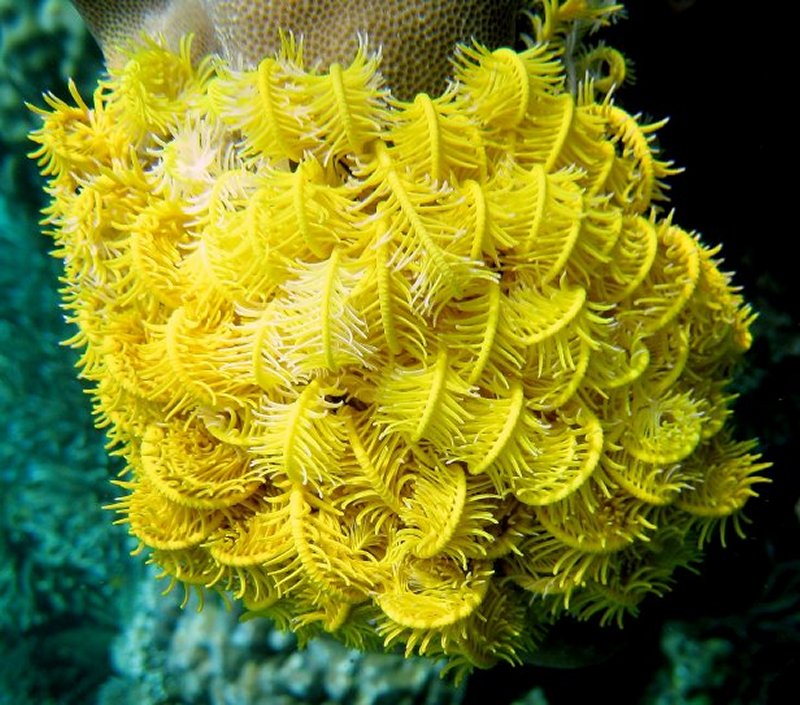
Yet another two-tone example from Indonesian waters.
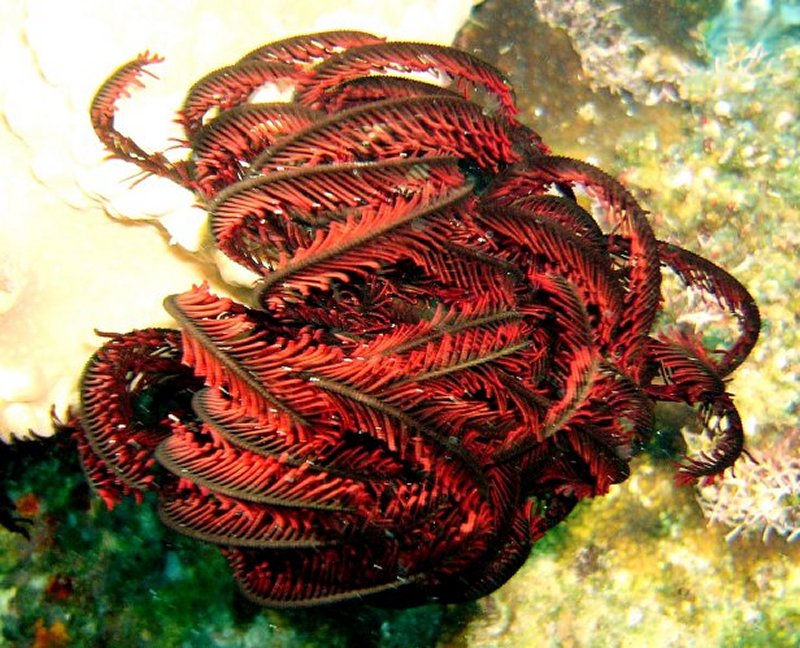
Yet again from the waters of India.
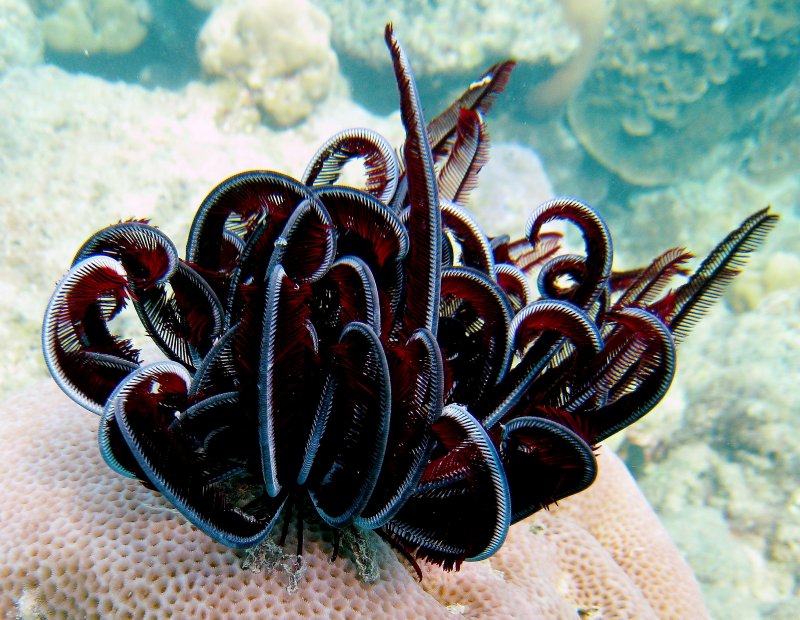
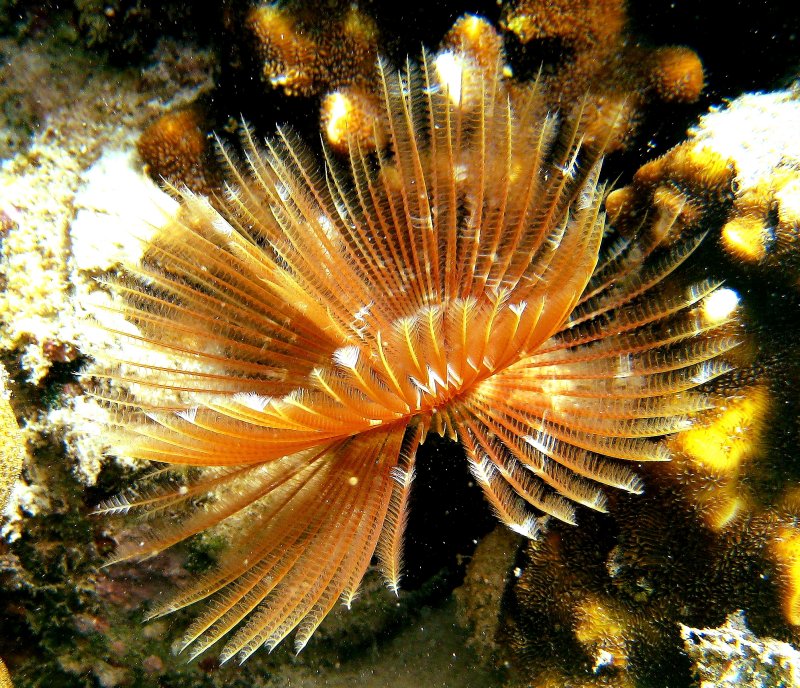
More exotic still are the feathered worms that live within holes in the coral around 10mm in diameter, deploying fir tree like, food collecting structures into the waters above. They are often multi coloured as below.
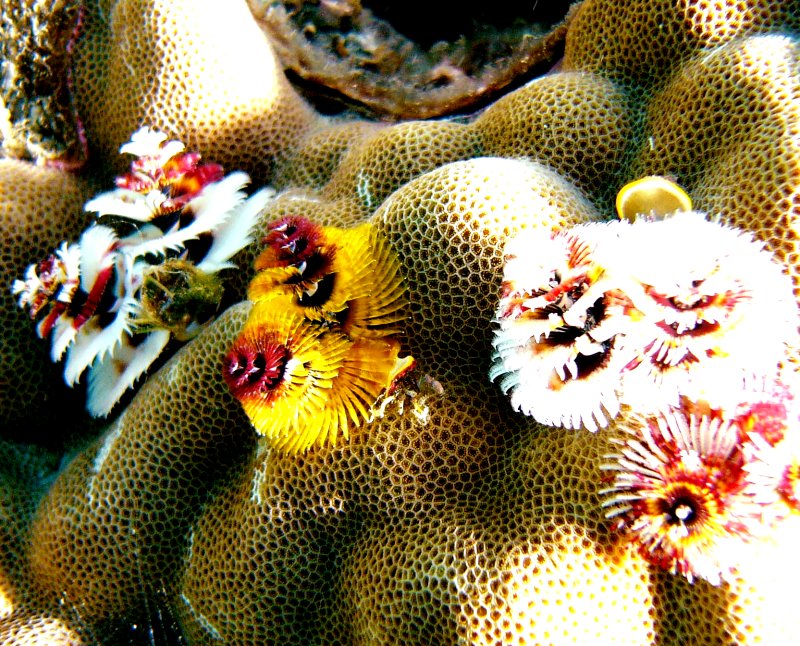
Often known as Christmas tree worms, they are about 35mm tall and come in every conceivable single colour or mixtures thereof. We saw them initially in Venezuela but not until Vanuatu did they appear in such significant numbers. They are ultra sensitive to light and pressure changes, so when disturbed they withdraw into their tube virtually instantaneously. Young worms settle on coral heads, in this case Porites and secrete chemicals that form a tube by killing the underlying polyps. New coral growth quickly surrounds the tube.

A further form of Tubeworm that withdraws within its hole whose plumage bears a remarkable resemblance to a a Feather Star.
Seagrass on the bottom at our Lamen Bay anchorage in Vanuatu where we saw the Dugongs was also a favourite of the turtles. Untypically, there they seemed pretty much at home around the boat and we several times came close to them in the tender. This one was one of many that fed in the morning within metres of the boarding ladder. Here he is on his way deciding there is a limit to how much human intervention he could tolerate.
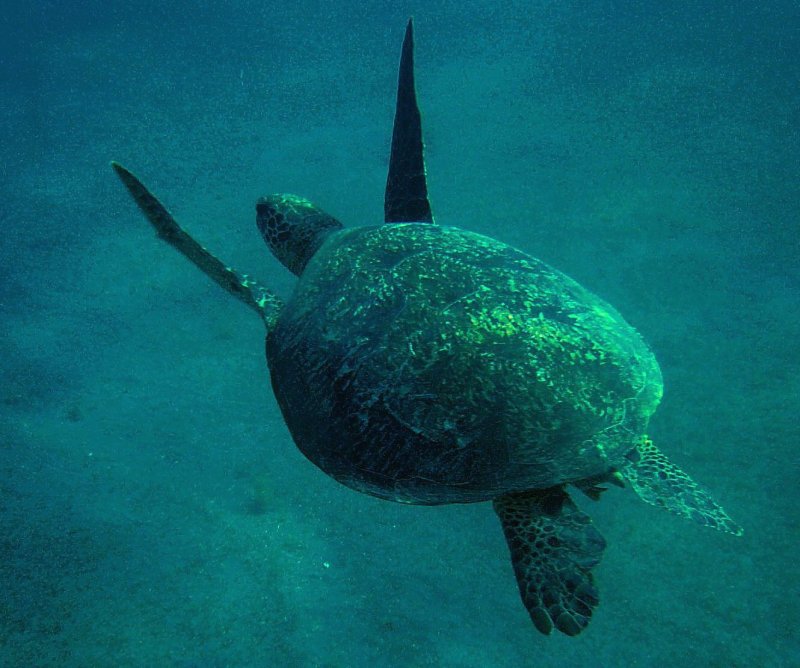
Turtles are nervous subjects to capture underwater, hardly surprising considering the efforts that most locals expend in catching them, irrespective of whether they are protected or not. I've managed to get pictures of them most easily on night dives when they are sleepy. However, this character came out of a shallow cave on the shore and swam straight past me.
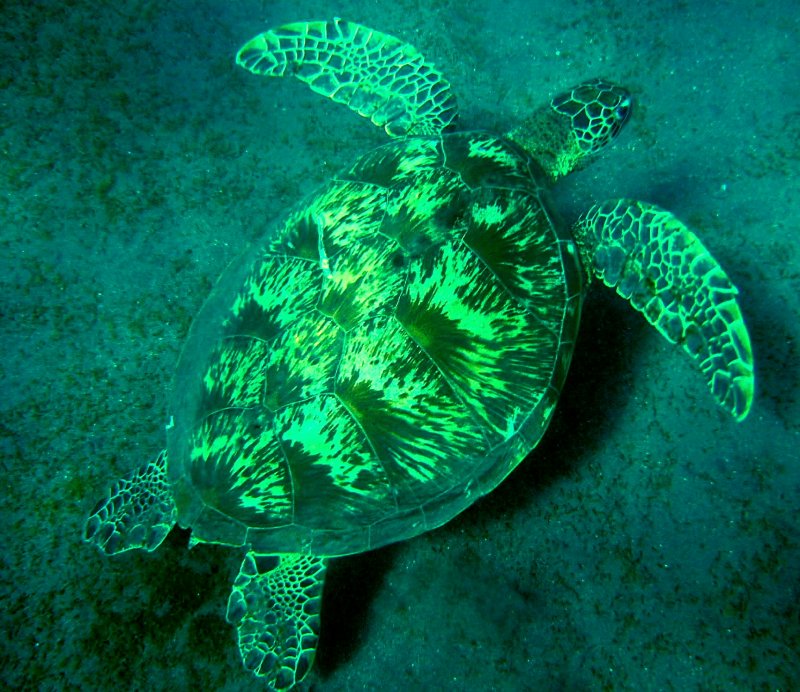
You may just be able to make out the loop of copper wire attached to the back of this beautiful mature Pacific Green Sea Turtle's shell. The poor creature was kept tethered by the people of Lohivary village in the Maskelyne Islands of Vanuatu, used to entertain any visiting cruisers. As there is no industry or other work in so many of these island communities which rely totally on subsistence farming, the only way of earning any money at all is by trading with visiting cruising yachtsmen.
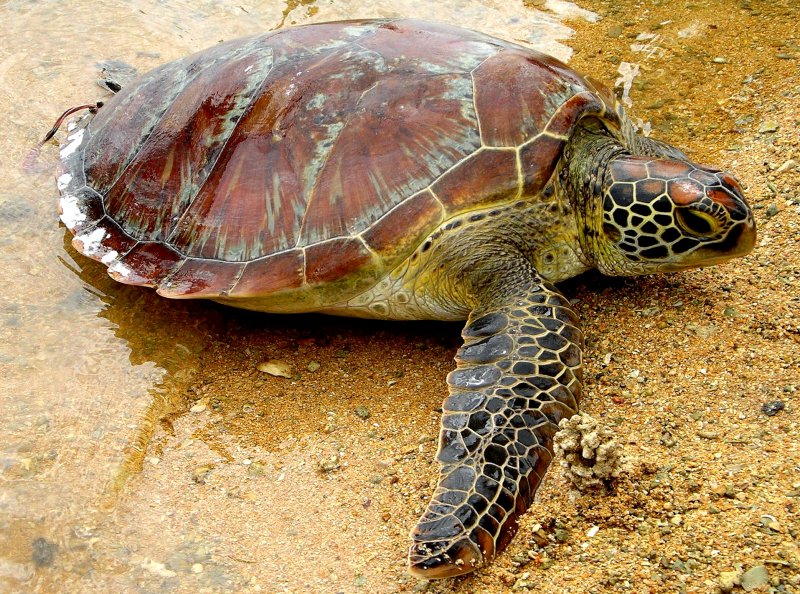
Here is a close-up of the turtle above from Lohivary Village.
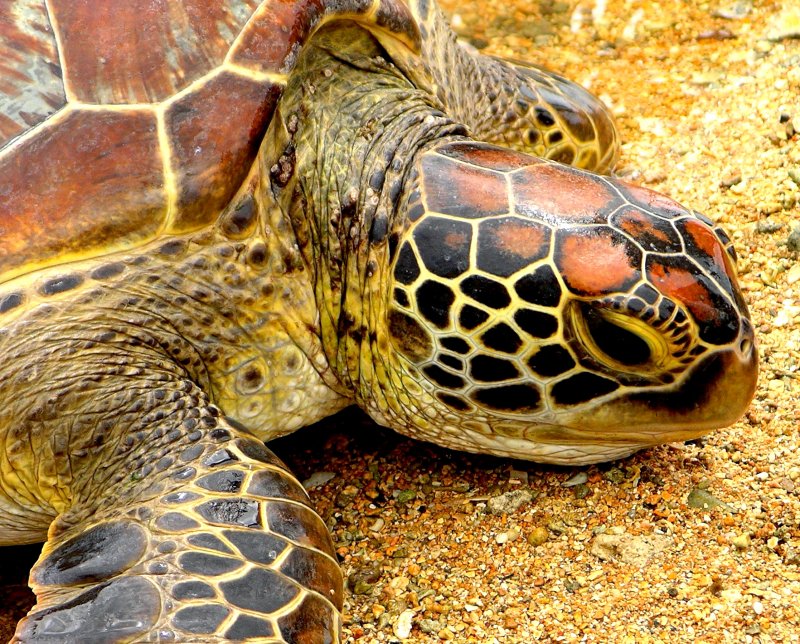
On Nguna, a small island just north of Efate there is a Marine Protected Area which gains finance by sponsoring turtles. So, given an opportunity like that what do you expect of proud grandparents. The snag was that you first had to catch a turtle! Dave went out to a reef around 1Km offshore with four guys in an open boat about an hour after dark. As all five of us, clad in snorkeling gear left the boat, the instructions were, "stick together and flash your torch back and forth if you come across a turtle dozing under a rock on the reef". Of course they all went off in different directions leaving grandad to sort himself out. It took about 20mins to find a nice hawksbill turtle which when we returned to the boat, to our dismay already sported a tag. Getting pretty cold and tired, about 30mins later we found a good sized green sea turtle. Next day we went ashore to the tank he had spent the night in to register and name him Sean Jesinger, before taking him to the water's edge to be released back to the ocean. There were only a couple of little problems, Sean the turtle is female and around 40yrs old! You can check out the Marine Reserve at http://plaza.ufl.edu/lumina.
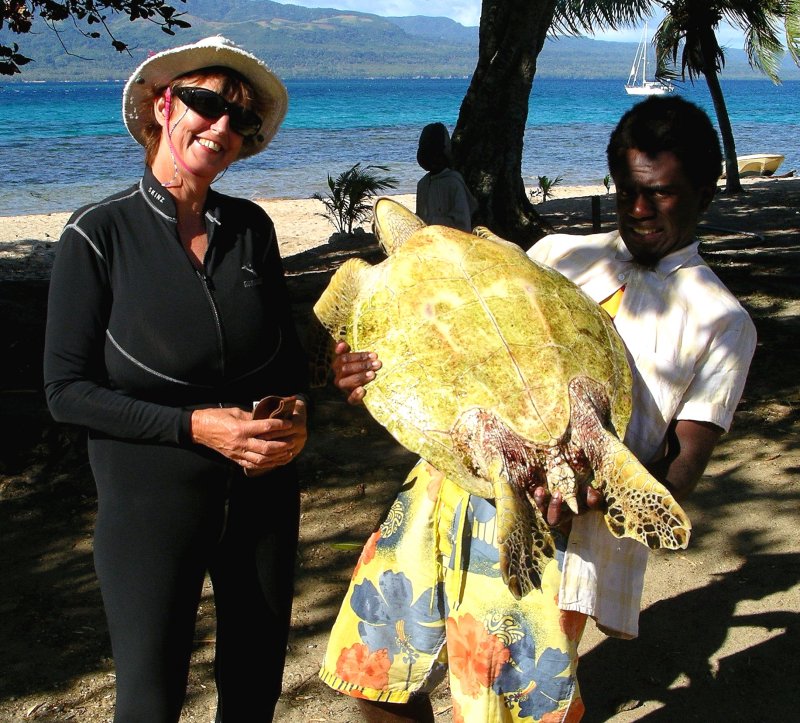
Turtle Sean's sponsorship certificate. After the palavr of capturing him, Grandad was relieved we only had one grandchild at that time.

Below is one of the less common Hawksbill Turtles, seen on a dive at the Thai Similan islands. Because this is a conservation area, the marine life is often much more tolerant of divers. It was here that Dave and diving buddy Alfred spent around fifteen minutes exploring the reefs in close company with a large Green Turtle whilst Di and Rosemary watched from the dive tender above through an observing device (bucket with a clear perspex bottom). We took some good video to remember the event.

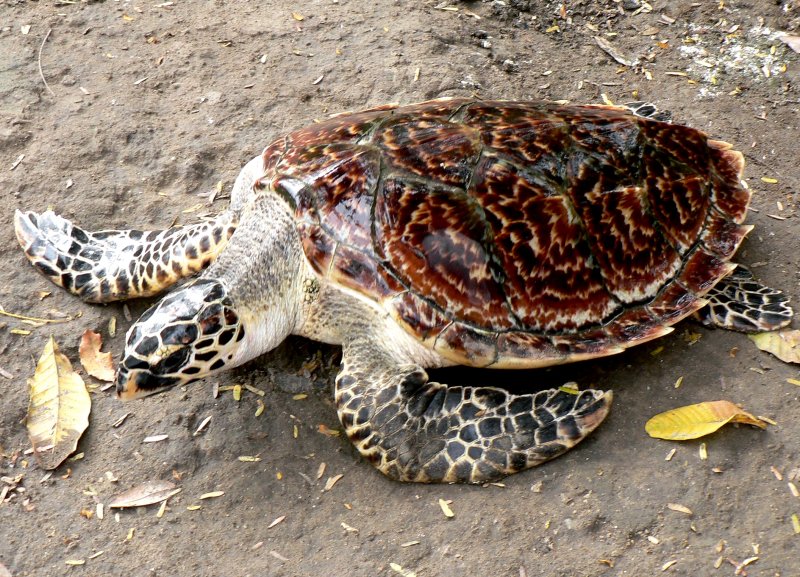
A better view of a Hawksbill on a beach in Indonesia. It had to be a remote beach as through protected worldwide, these charming, nosey creatures are much sought after by locals to supplement their diets which are often short on protein.
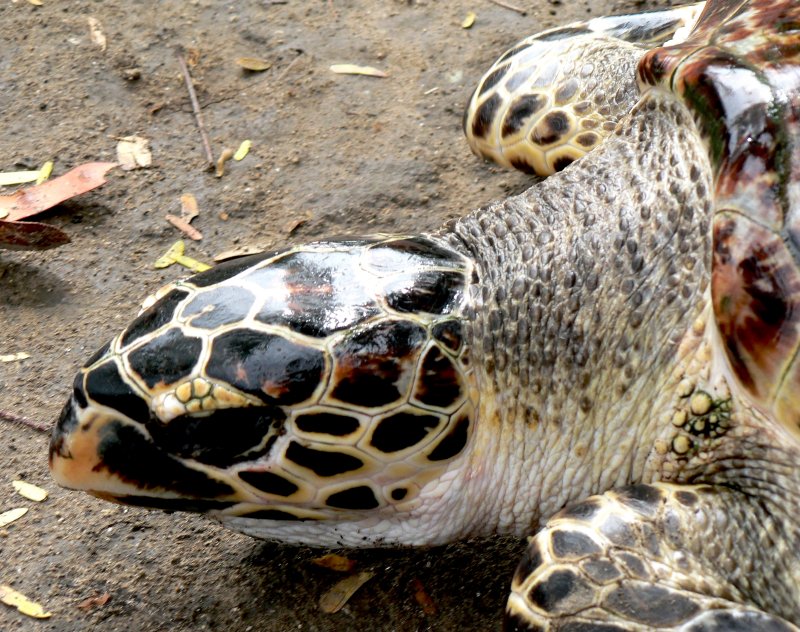
This is definitely the last turtle image and is a close-up of the head of a Hawksbill for comparison of the scales with the Green Sea turtle.
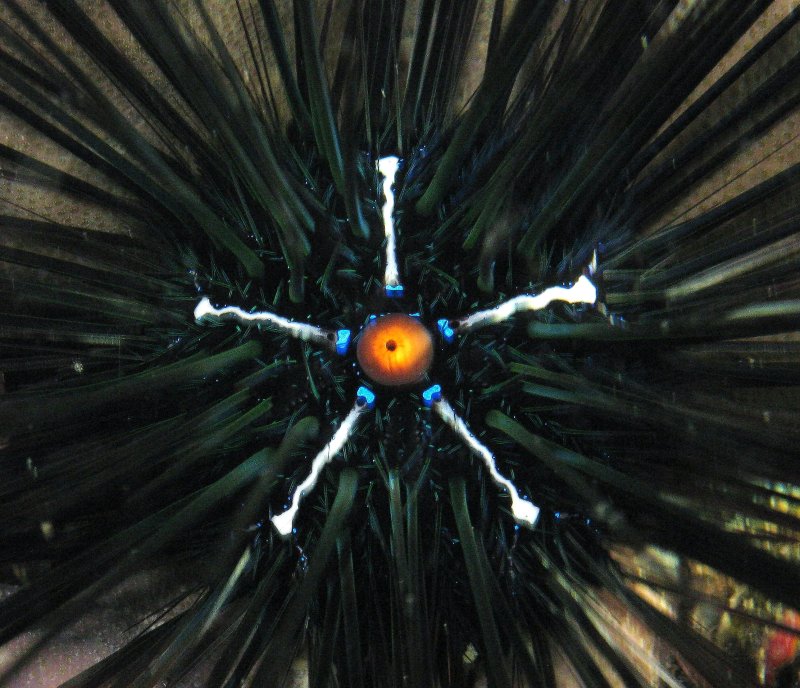
One always needed to be wary of urchins, especially where there is a shallow, uneven rocky bottom. The spines easily penetrate skin and tend to break-off giving many days of pain before they are absorbed. The whole thing is usually around 15-25cm across. The attractive markings on the one below are rarely seen though they do have a top mounted anal orifice with a retractable tube. Urchins are usually nowhere to be seen or alternatively they are there in great preponderance.
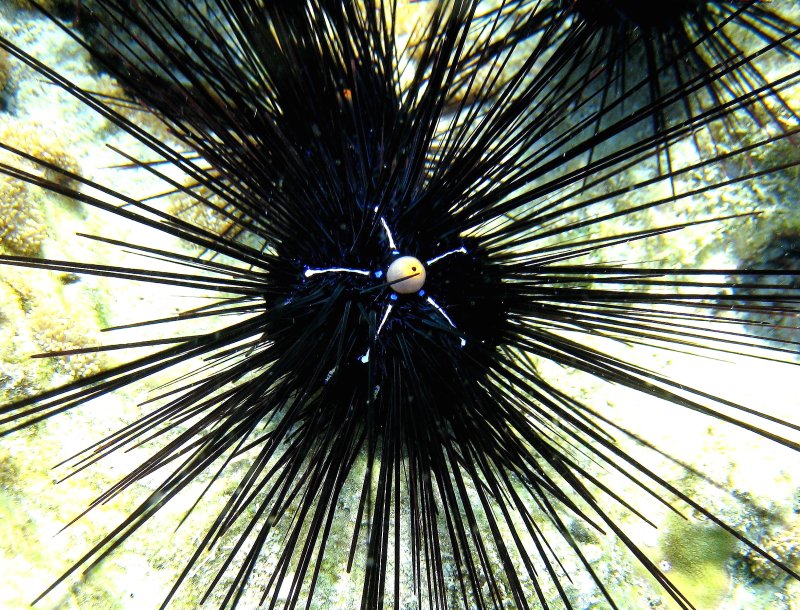
A close-up of these rarely seen markings.
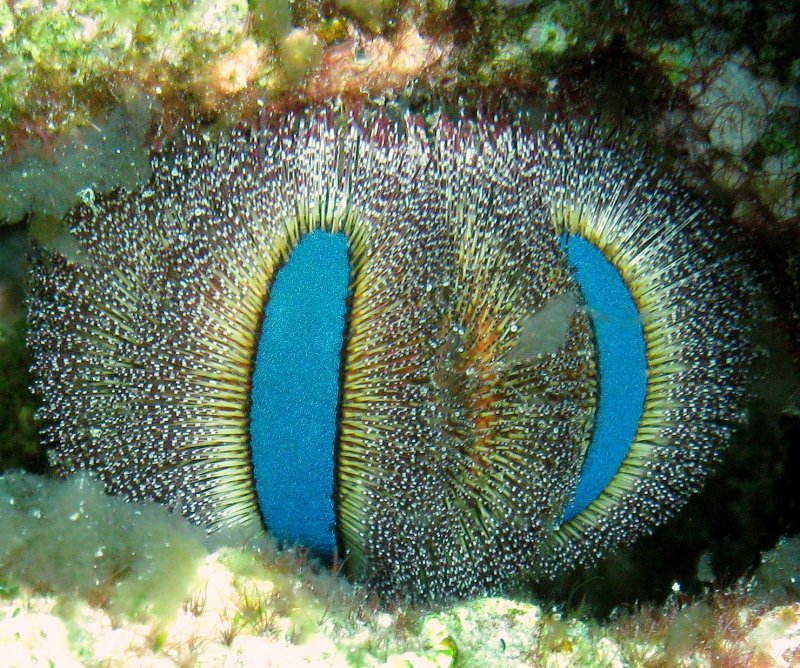
Tripneustes grattila, another form of Urchin seen only rarely.
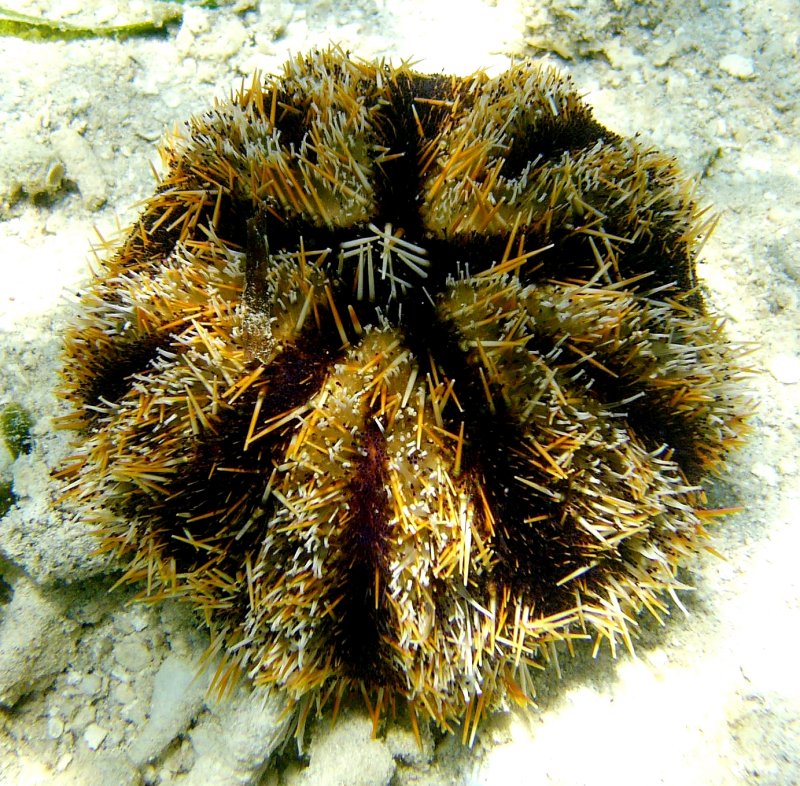
Another version of the Mespilia globulus with some vivid blue markings.
This Echinothrix diadema Urchin has mixed spines and interesting markings.
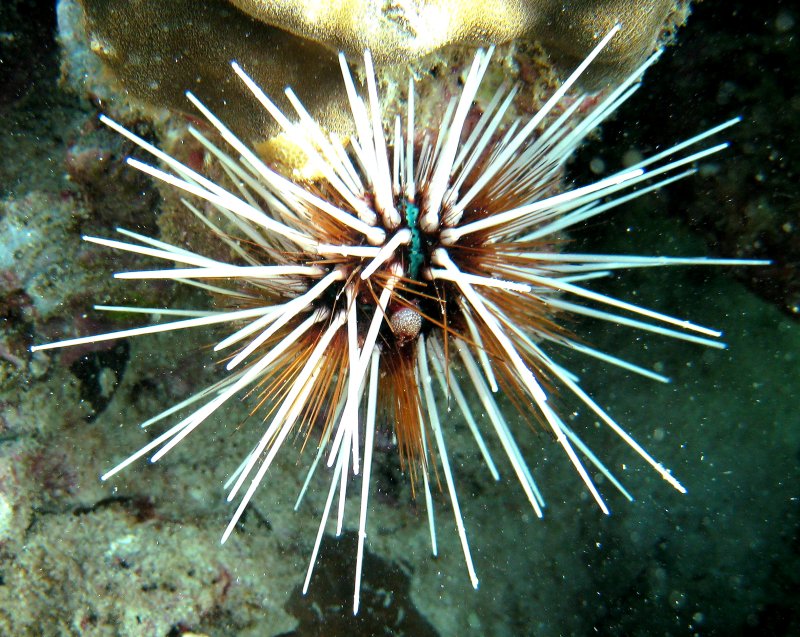
Urchin (Echinothrix diadema), Koh Adang, Butang Islands, Thailand
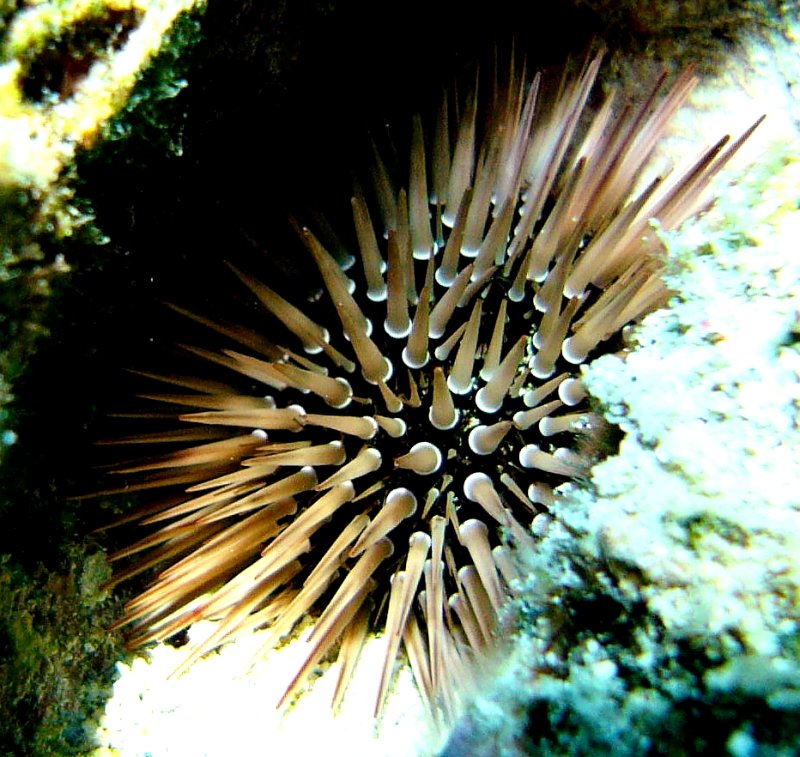
Another dramatic Urchin, the Parasalenia gratiosa.
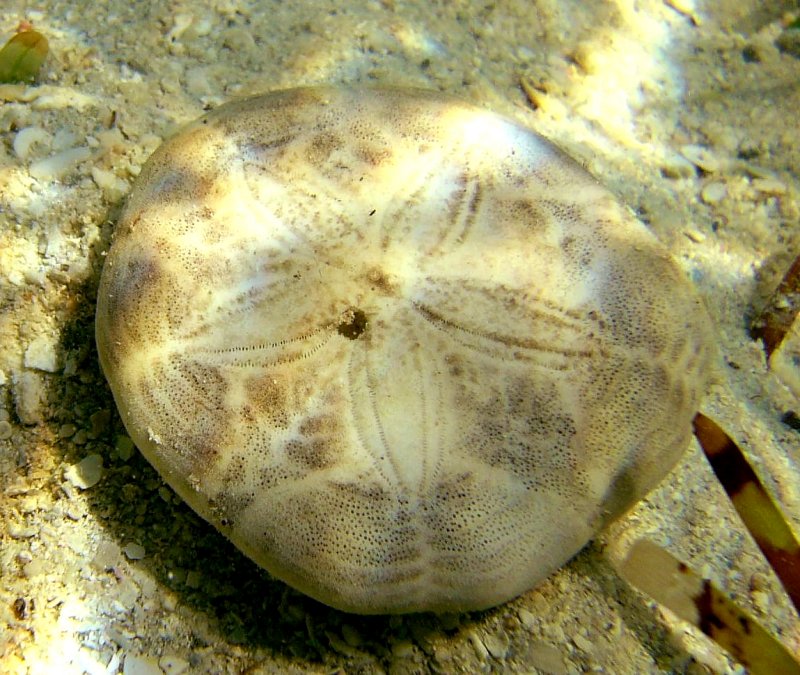
The flattened, oval shell of this urchin carries the five armed starfish 'insignia' and is known as a Sand Dollar.
Now we move on to corals, the creatures whose skeletons form the solid limestone foundation of the reefs of tropical waters. Reefs shelter coastal regions from wave action and are the source of almost all the fish life that is a major source of food. We never cease to be amazed by the shapes of the structures that the basic polyp elements that form corals organise themselves into. An individual polyp comprises a fleshy sack topped with a ring of tentacles around a central mouth opening. Members of a colony are linked by living tissue that enables them to share nutrients. The colouration is derived from an algae incorporated in the structure which also assists in process of nutrient conversion to carbon rich organic compounds.
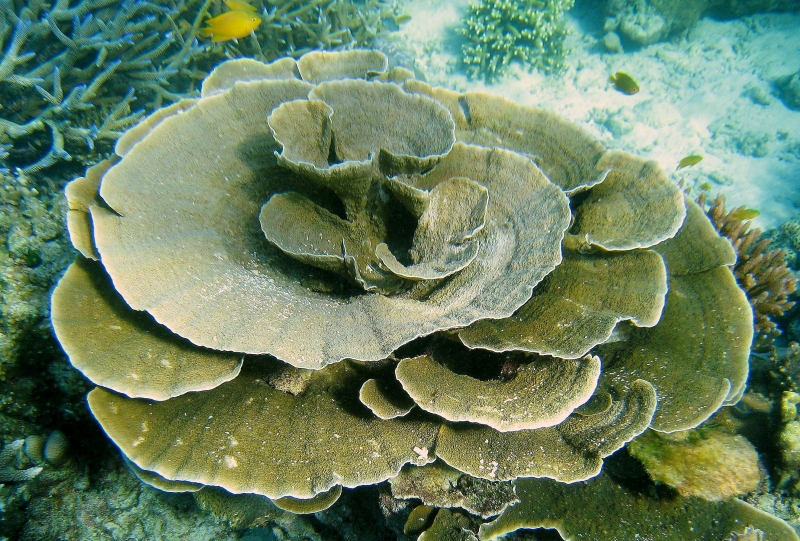
Acroporidae form what is probably the largest of all the families of hard corals. Most species tend to be tree-like, unlike this example. It is often important when photographing corals to take a close up of the structural detail to aid identification.
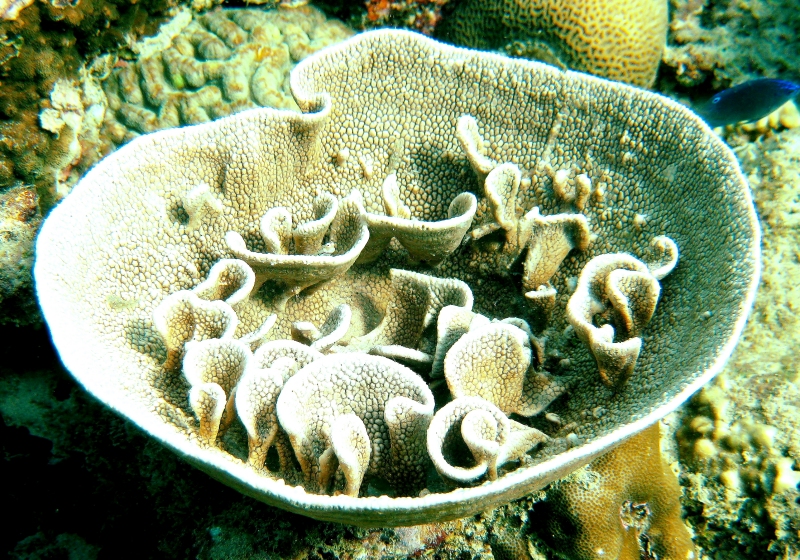
Acroporidae hard coral (Montipora capricornis), Henry Lawrence Island, Andaman Islands, India
A further example of these bowl-like structures, Montipora aequituberculata.
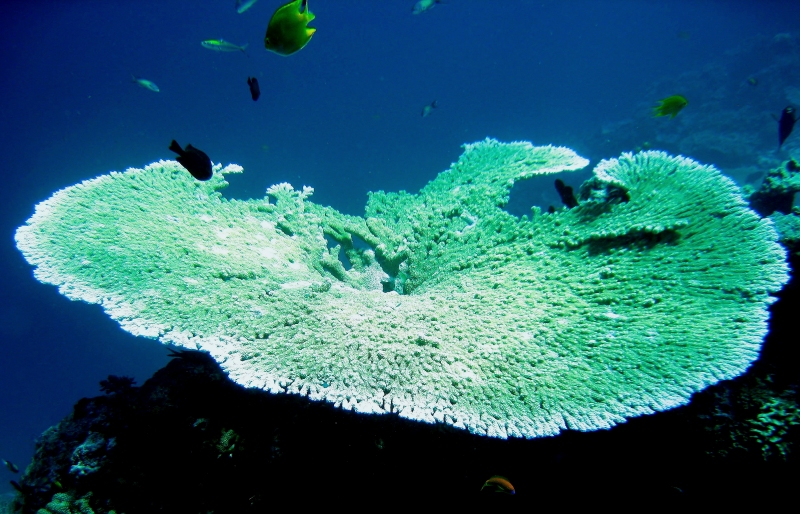
This picture of a clathrata taken off the eastern side of the northern Surin island in Thailand was taken because of its size (around 3.5m in diameter) and the completeness of its multi-layered structure.
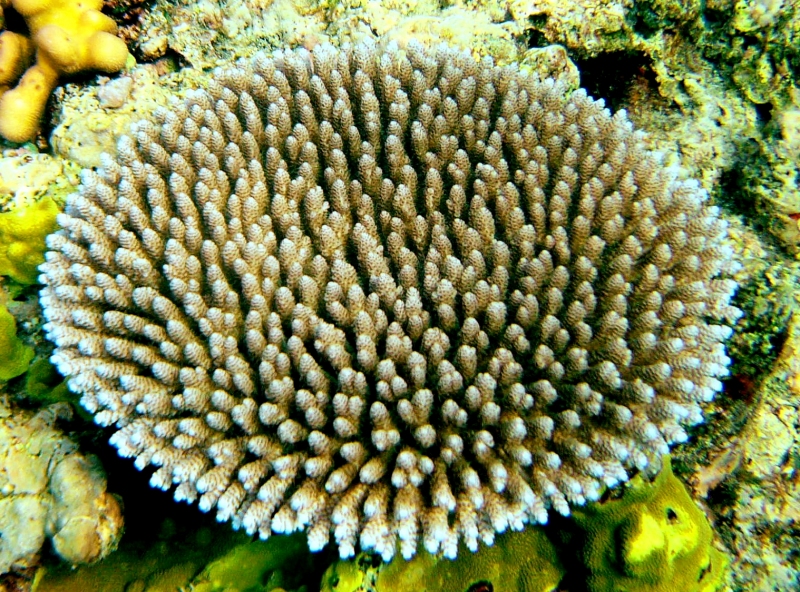
Use of the term digitifera in the Acropora below aptly describes its finger like structure, each digit comprising what appears to be a leaf-clad surface.
A close-up of the leaf-like structure, this time on Acropora danai.
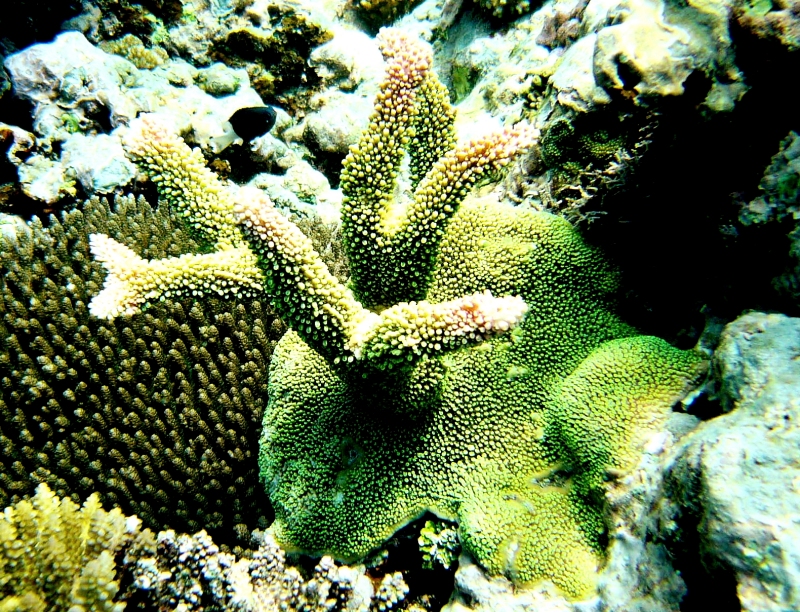
Yet again with more veried shaped limbs on Acropora florida.
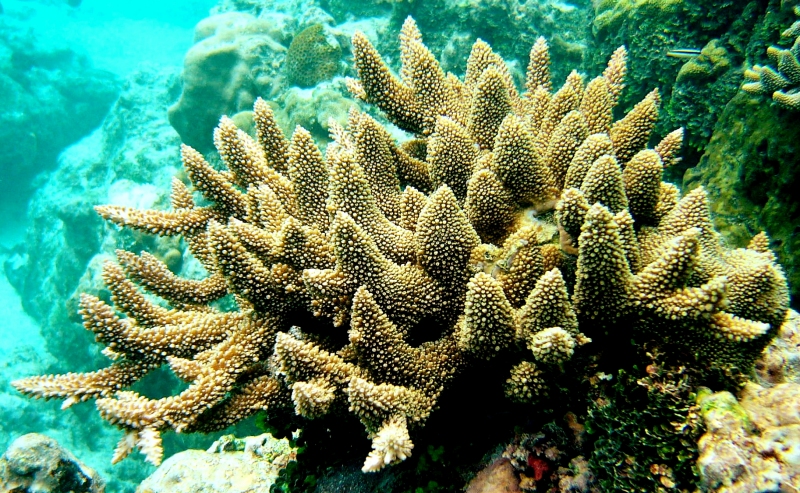
In the case of the Acropora humilis below the 'leaves' are more conformal producing an much smoother surface. Note the sheet-like area at the bottom that attaches the structure to the dead coral base. The colours af these corals are largely determined by the predominant algae specie in the area.
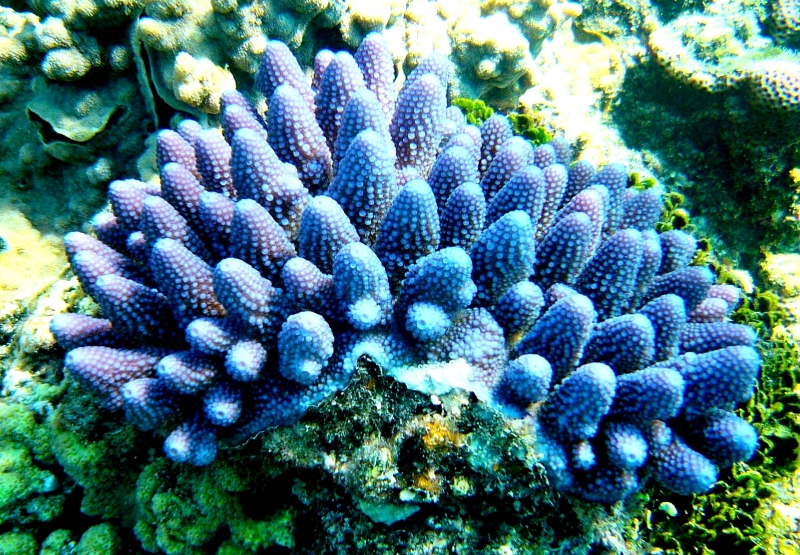
The Acropora millepora below has pronounced 'leaves' and is of white tipped, brownish hue.

The pointy Acropora noblis is common, often appearing in beds many metres in extent.
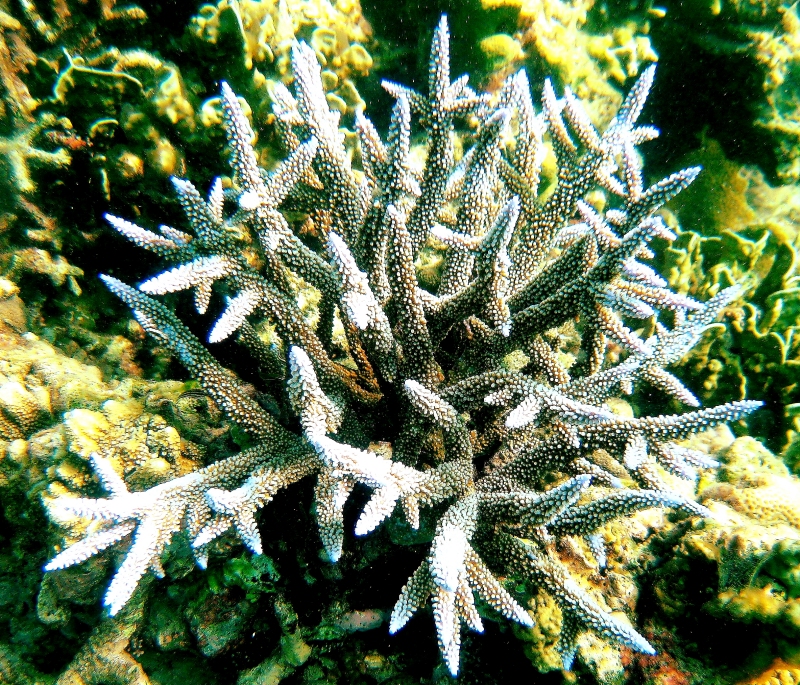
This noblis has large stubby, round topped fingers around 30mm in diameter.
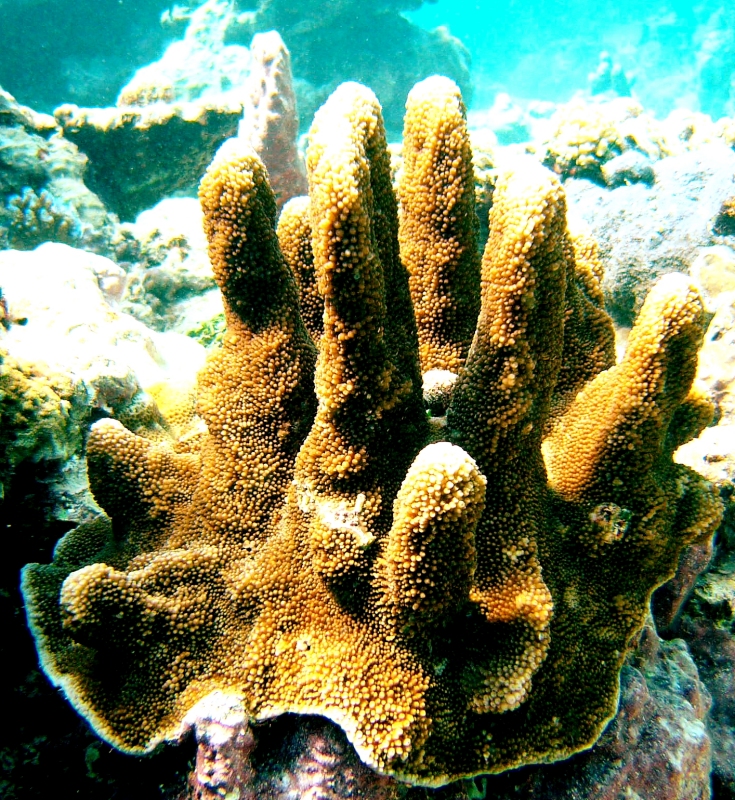
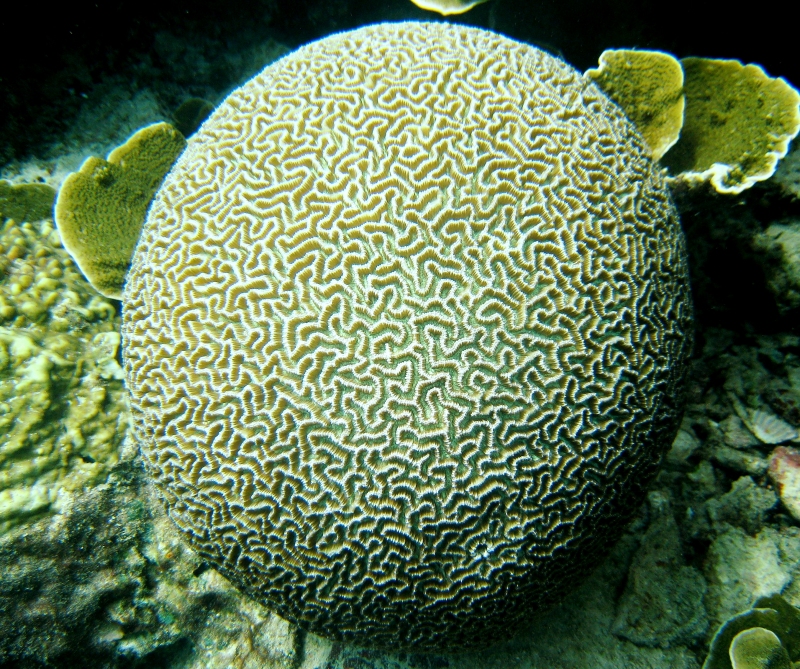
Moving on now to the Faviidae family which are often referred to as 'brain' corals. This one on a small island off Phuket in Thailand was close to a metre in diameter.
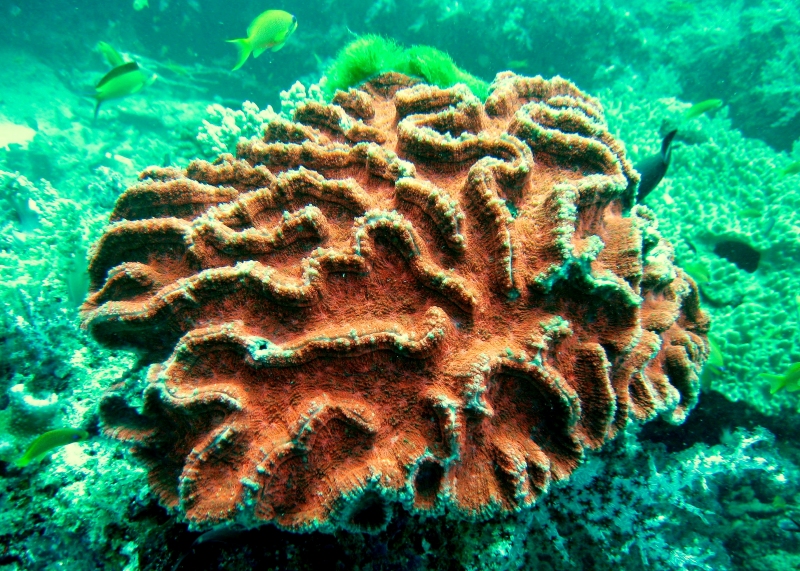
The Faviidae, Platygyra daedalea below is flatter and plate-like with a much courser, random structure coated in red algae.
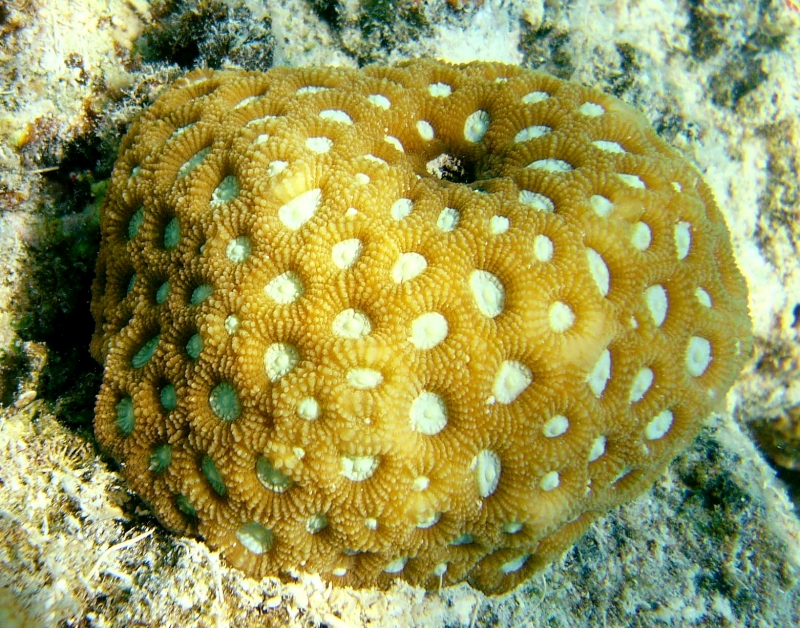
Favites flexuosa below is rounded with a pretty two tone structure.
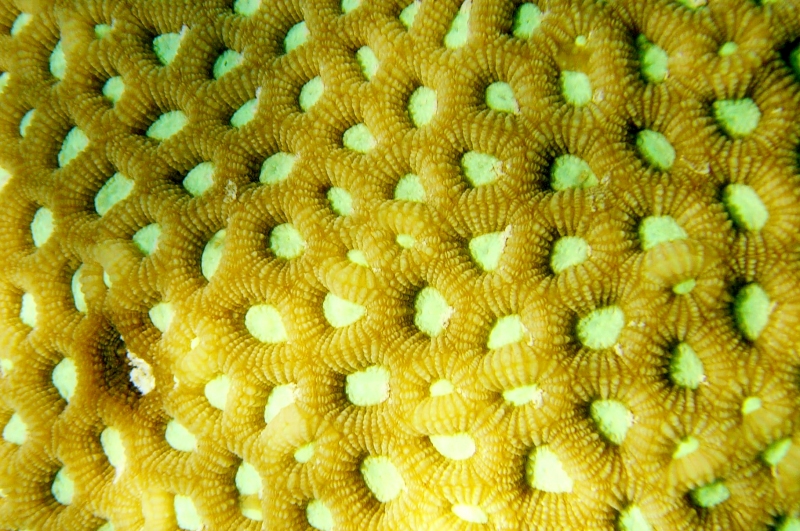
A close-up of Favites flexuosa reveals the regularity of the structure.
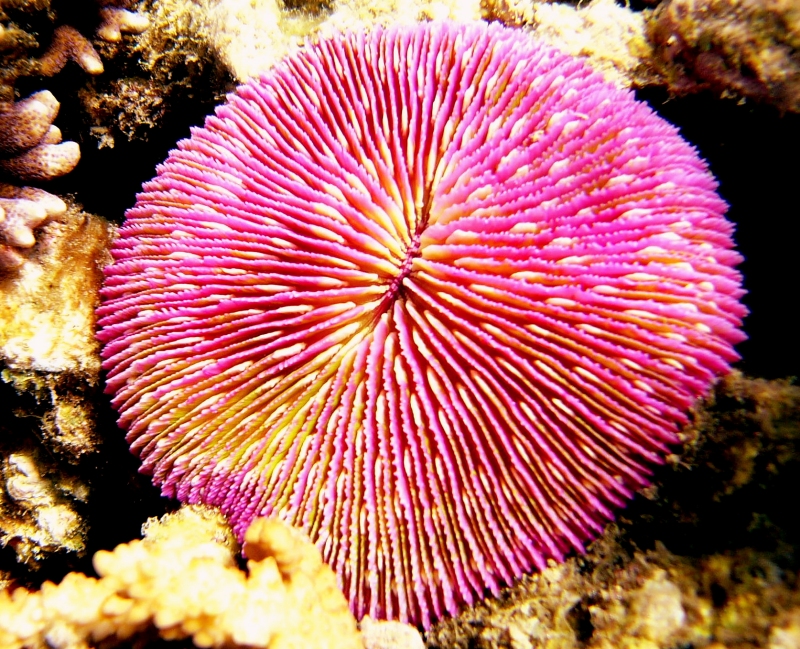
This form of Fungia, named no doubt after their look-alike land based fungi, are relatively common in all tropical waters. They exist as independent items, not connected to rocks or other coral structures.
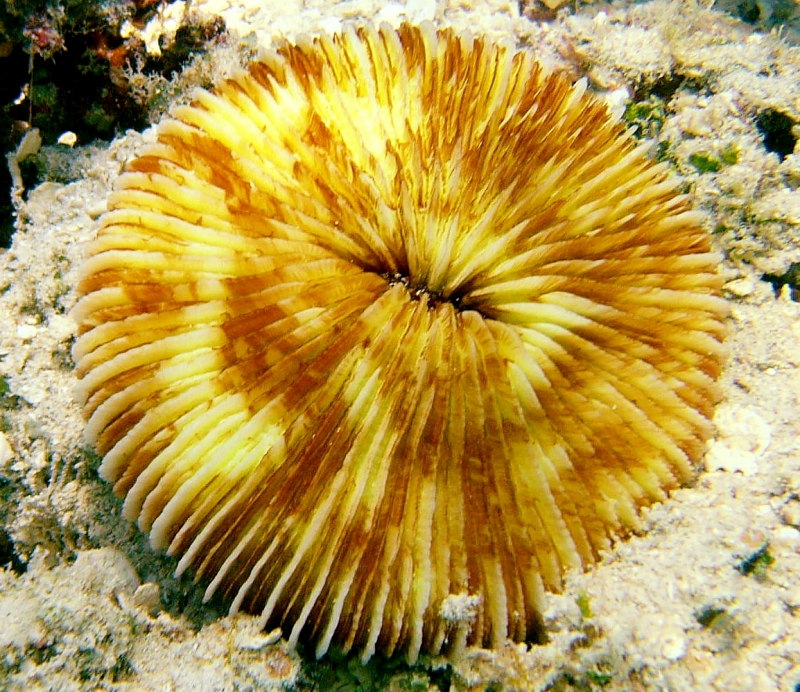
Fungia concinna again but with less serrated fins and of very different hue.
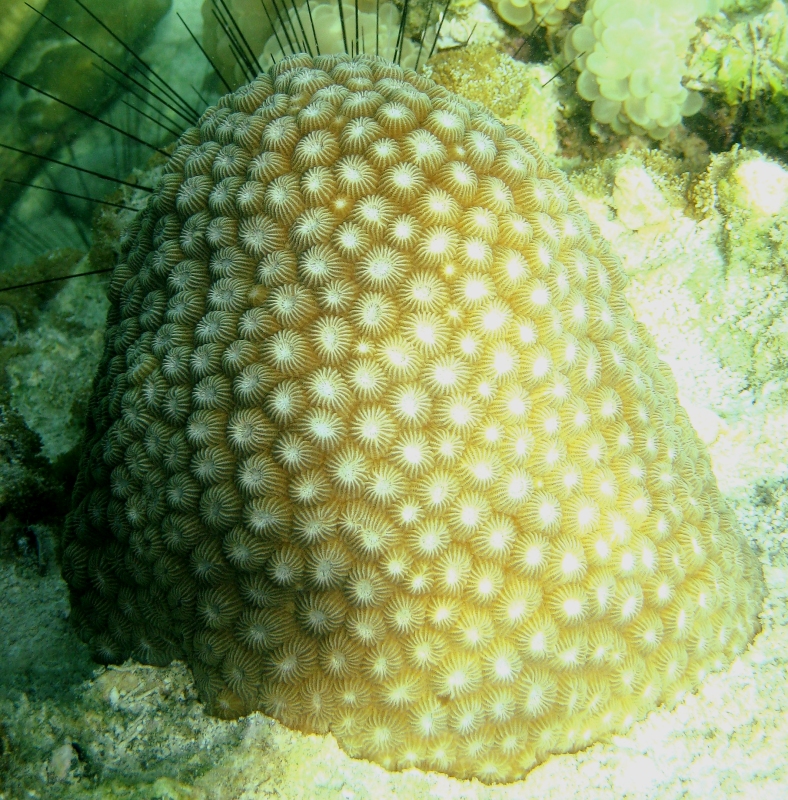
Below, the attractive, regularly patterned spherical coral, Diploastrea heliopora. Note the urchin spines in the background.
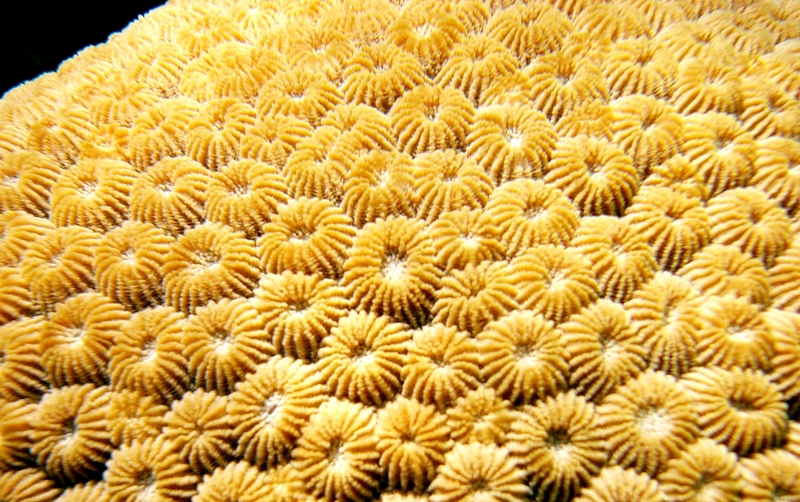
A close-up of a similarly patterned Astreopora myriophthalma.
Another large, brain coral, Platygyra lamellina which has an unusually deep patterned surface.
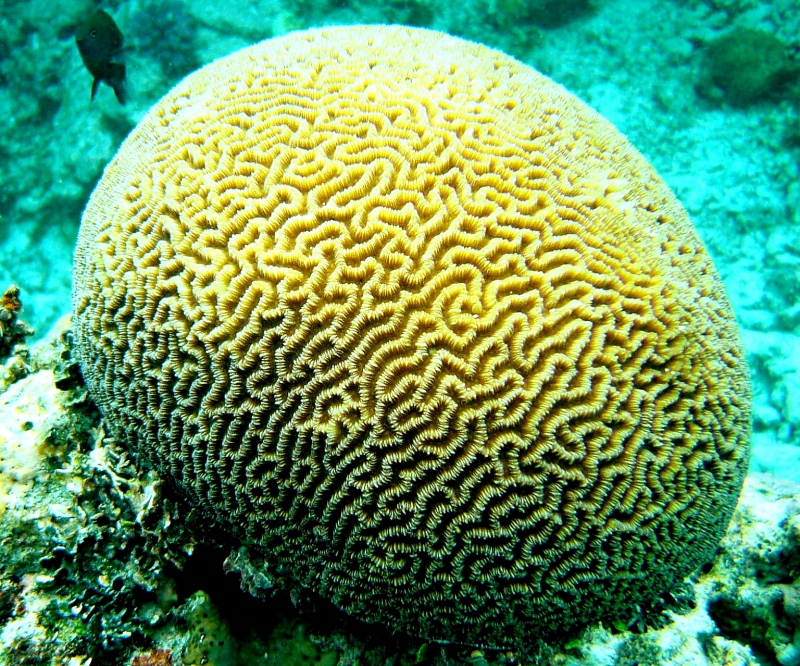
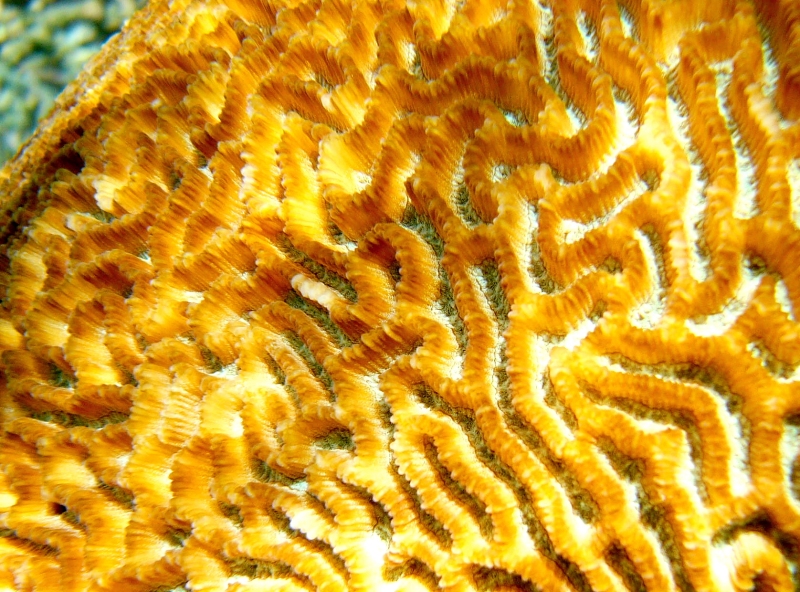
A closer view of this deep valleyed patterning.
This attractively coloured, compact Mussidae hard coral, Lobophyllia hemprichii, has a course rambling structure.

A further image from the East of Eden, dive site in Thailands Similan group, this beautifully regularly shaped Mussidae, often referred to as brain coral.

Yet a further variant, Oulophyllia crispa.

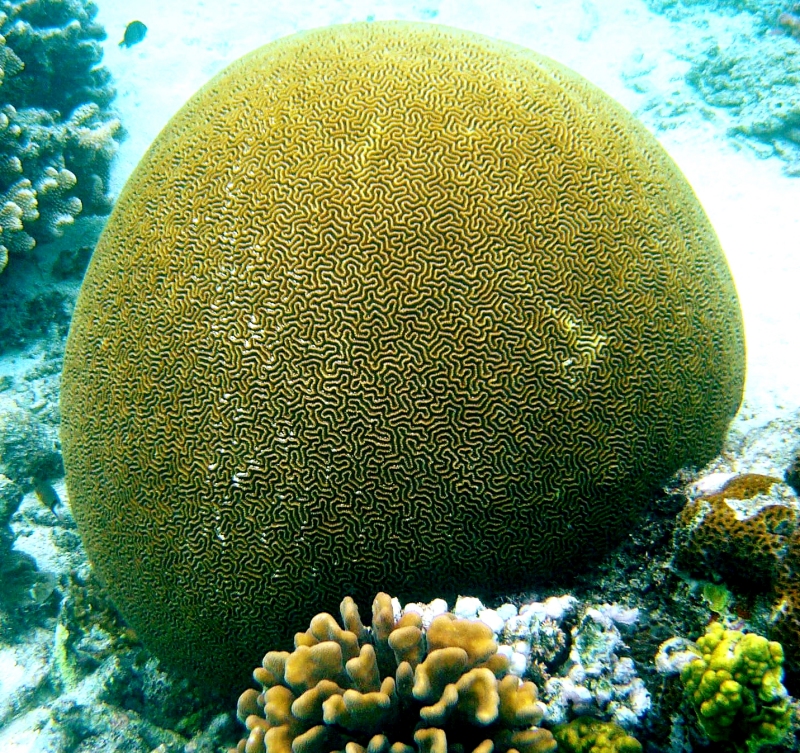
This Platygyra ryukyuensis in Vanuatu was nearly 2m in diameter.
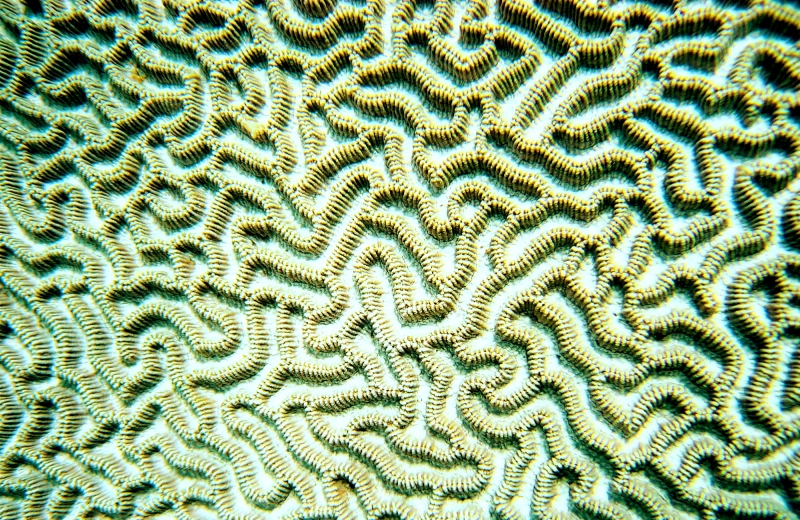
The close view of the Platygyra ryukyuensis above.
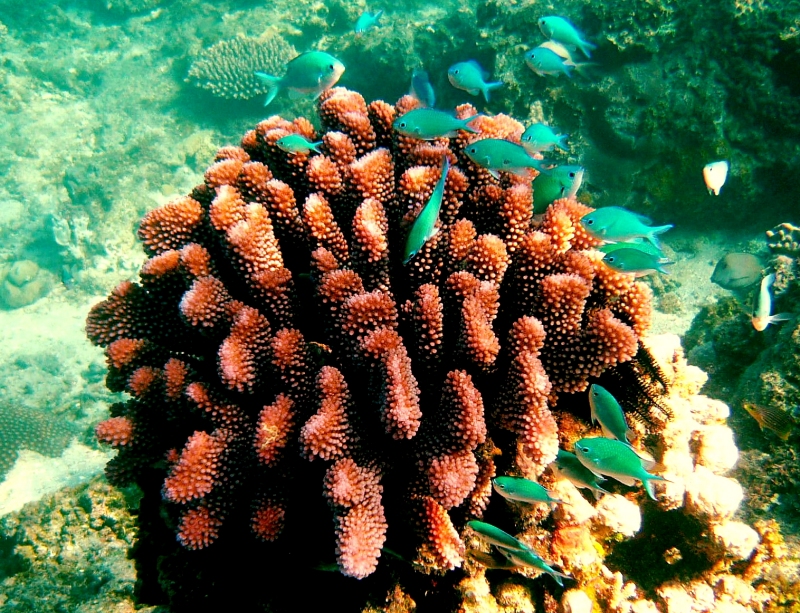
Hard coral ,Pocillopora eydouxi, in the Yasawa Islands of Fiji surrounded by blue chromis from the damselfish family.
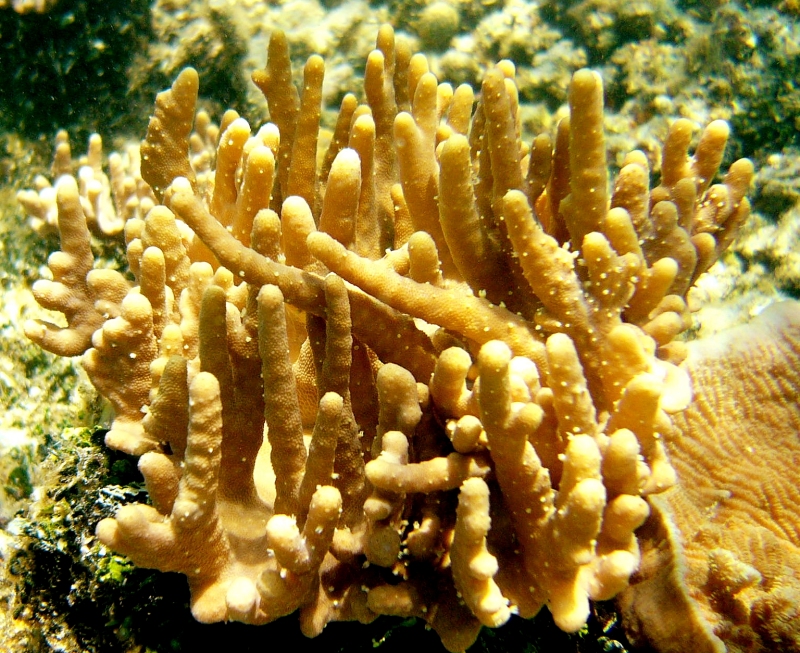
Porites in its various forms is a key building block of many tropical reefs, this latistella is finger-like.
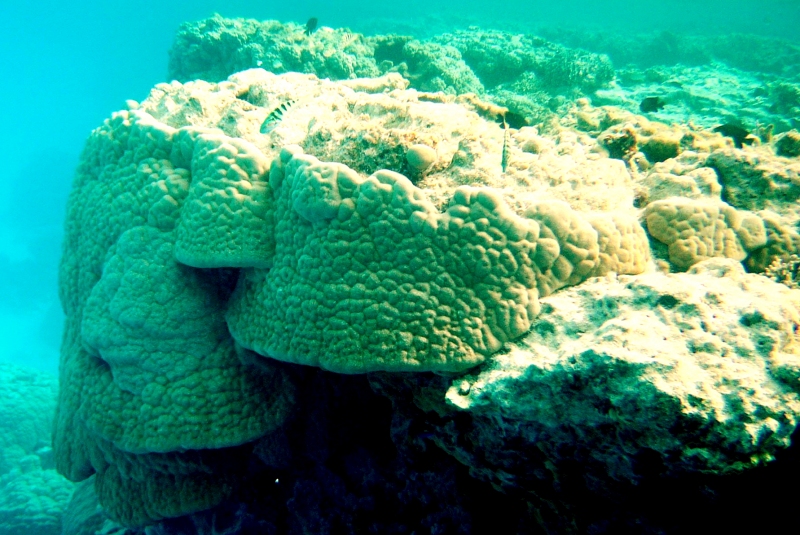
Whereas below is a more typical conglomoration which spreads over around 5m.
This Caryophylliidae looks more like a cluster of eggs rather than a hard coral.

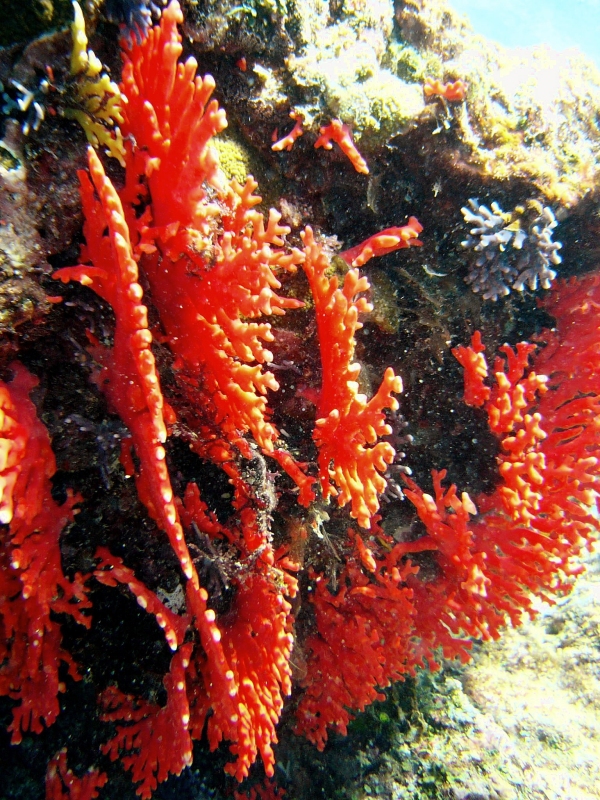
The Lace hard coral, Distichopora violacea, below is rarely seen.
This colourful Trachyphyllia geoffroyi looks as though it has just been extruded from a dispenser.
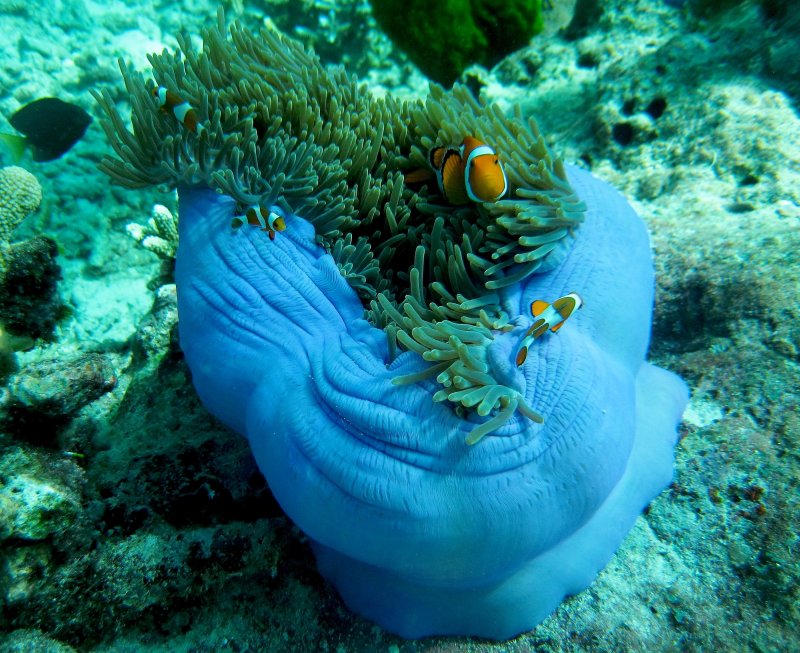
Moving on now to a section of soft corals and anemones which though the latter are not corals, they do have very similar appearance. Sea Anemones come in a wide variety of forms, many hidden within fissures in the reefs. This aptly named Magnificent is definitely our favourite as they are usually home to a happy family of anemone fish like these Falseclowns. We found these whilst traversing the main anchorage at Koh Miang in the Thai Similan group, Dave diving in around 12m and Di above giving cover snorkeling.
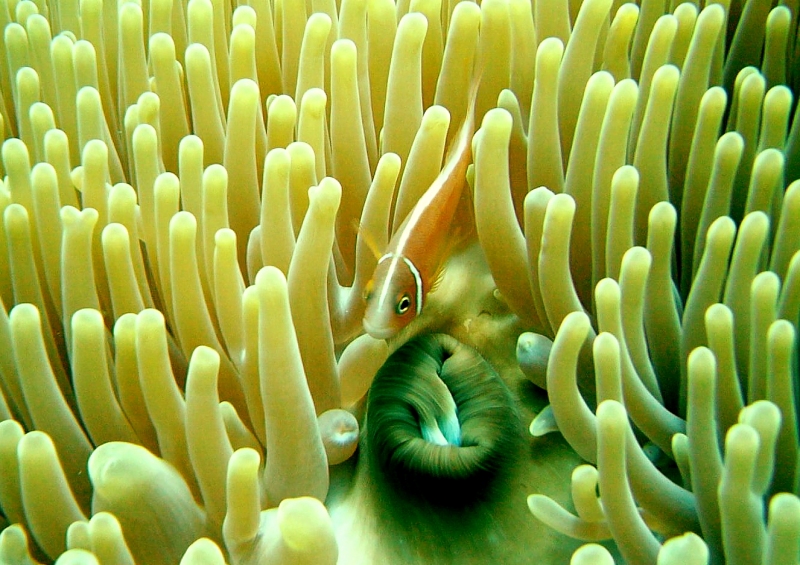
From Indonesia onwards into the Indian Ocean we have found anemones to be much more common than in the Pacific. These long tentacles of a giant sea anemone (Stichodactyla gigantea) are invariably home to a number of the damsel fish family which are known as anemone fish.
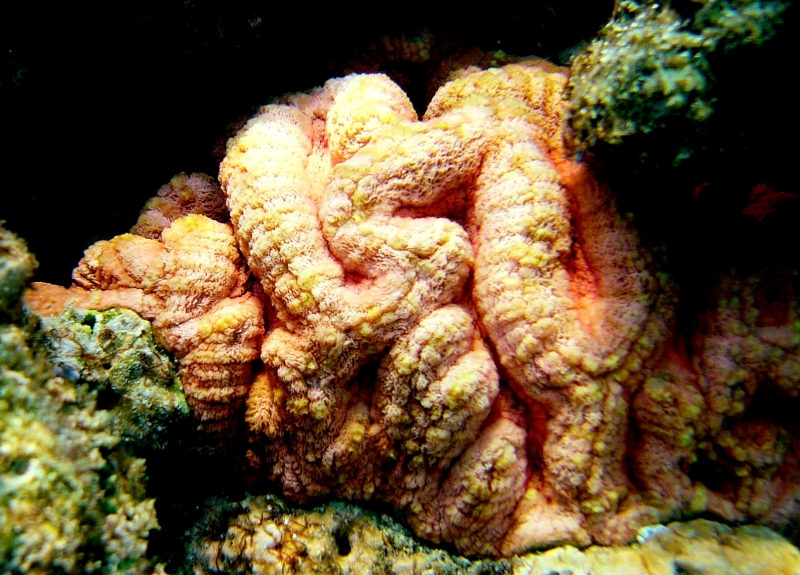
These large (1.5m) Corallimorpharian anemones seen in Fiji are splendid if rare examples.
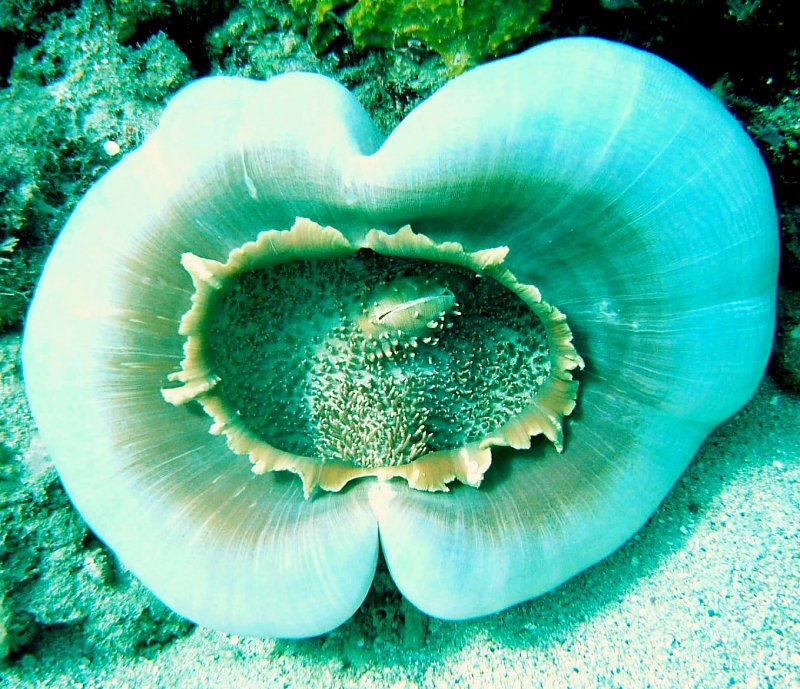
Yet a further example of Corallimorpharian this time without a surrounding skirt in Indonesia.
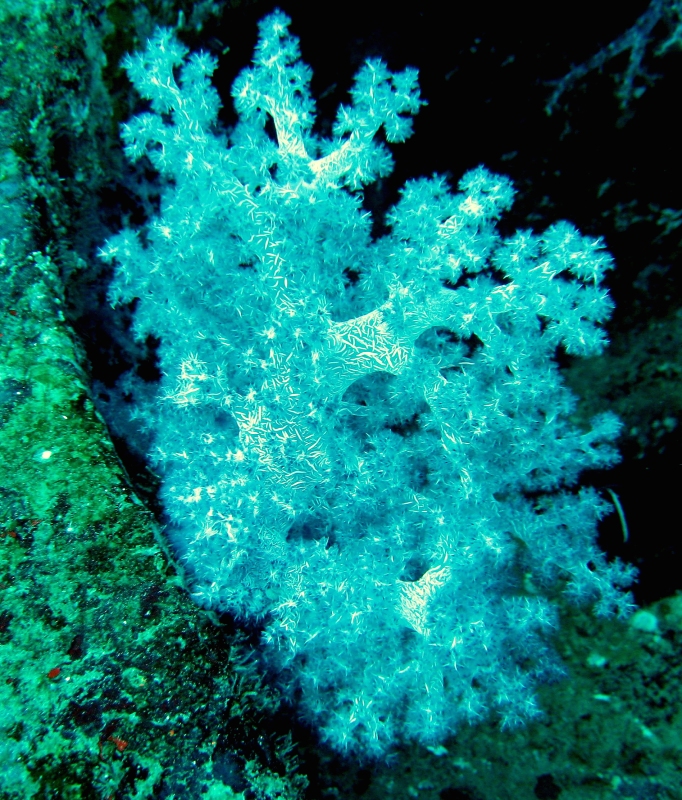
Moving on to the family of soft corals, here is a resplendent Dendronephthya on the wreck of a Thai fishing boat in the Thai Similans.
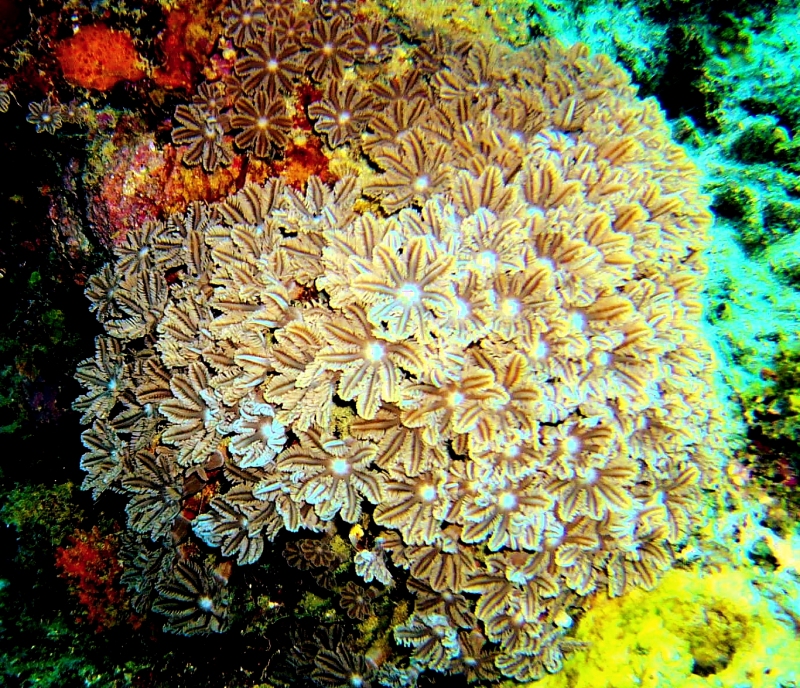
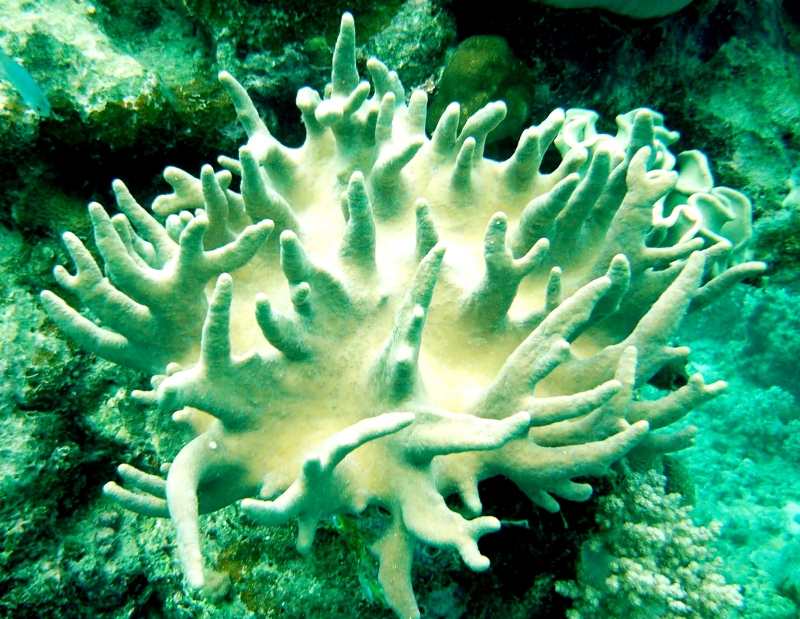
It is truly incredible that these invisibly small polyps join millions upon millions to form a structure such as this Clavularia below, looking just like the flowers we see in a garden.
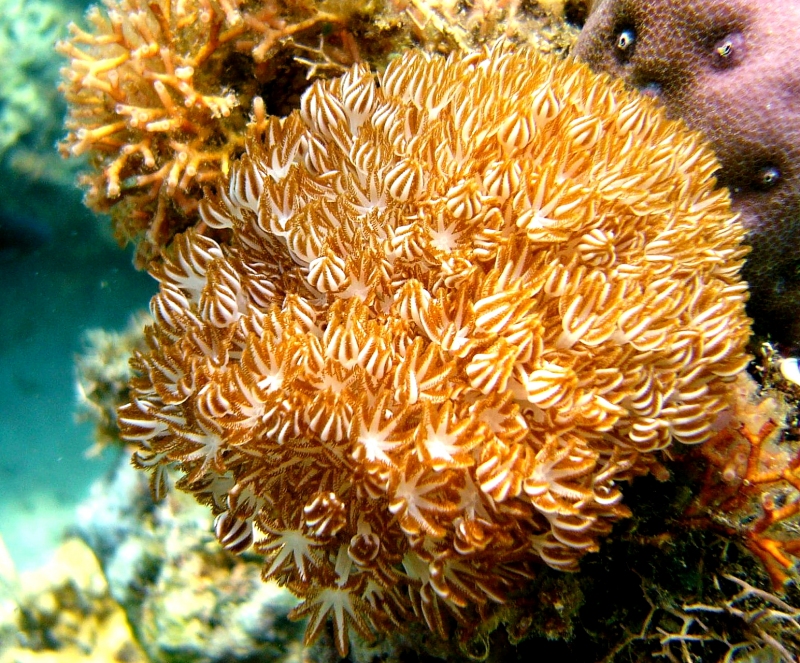
Here is a further flower soft coral, Xenia in Indonesia.
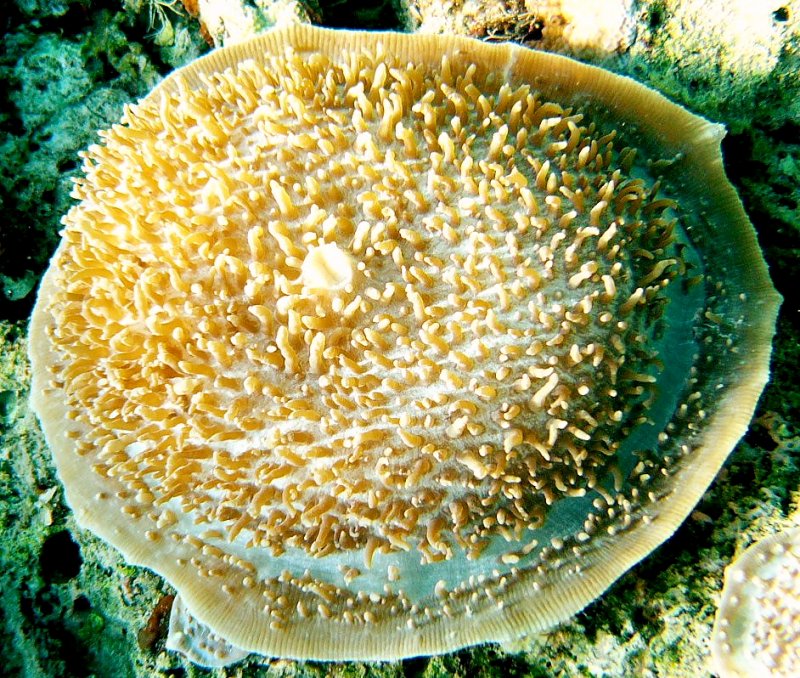
This Goniopora is a further reminder of the diversity of forms that marine polyps adopt and how uncannily they resemble terrestial flowers.

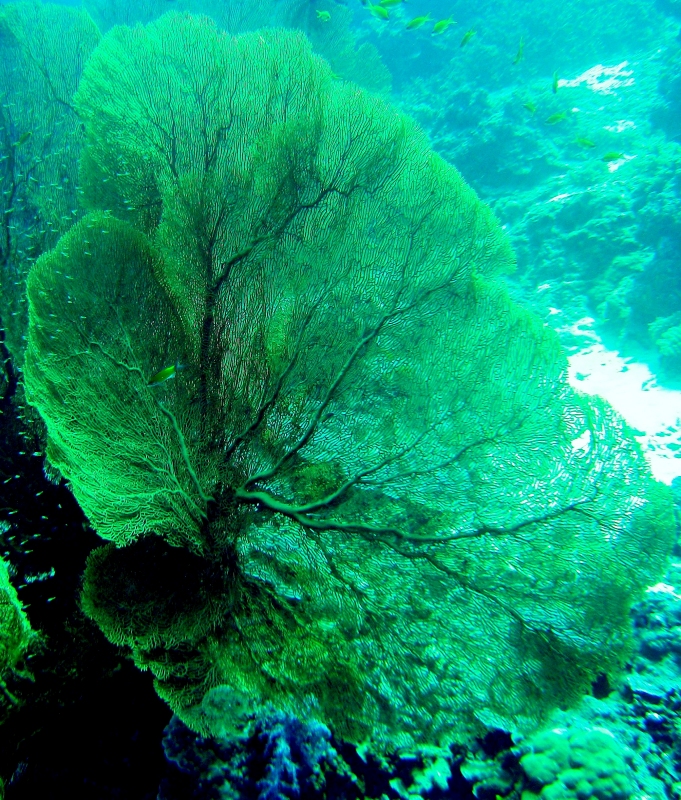
Fans are not common and large ones like this 1.5m high example, even more so. This was one of a couple of big ones on the well known Similan Breakfast Reef site.
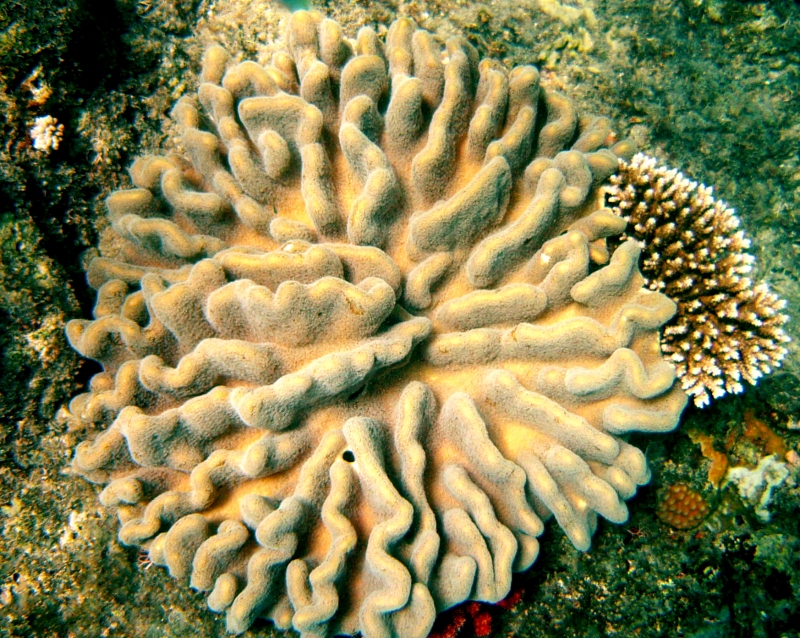
Lobophyton are an important and widespread family of soft corals.
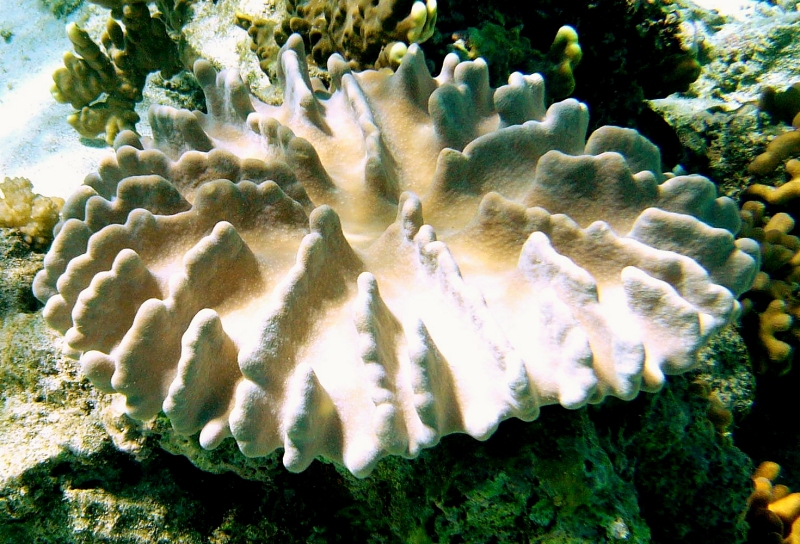
Another Lobophyton variant.
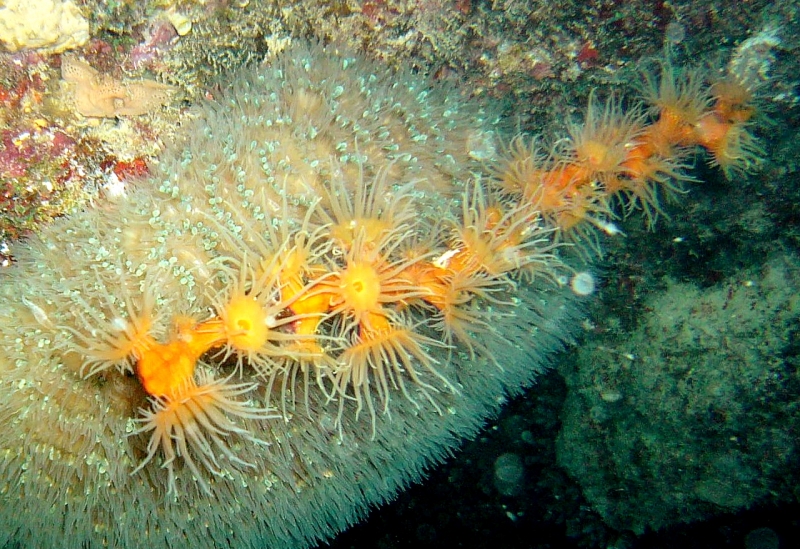
In contrast, Euplexaura verrill is exotic and flower-like.
Early in September 2007 we spent four magical days anchored off the idyllic islet of Sebayor Kecil in a marine park between the larger islands of Flores and Komodo. The variety of species was almost beyond belief, much greater than any other site we have ever visited. The diving was excellent but even better were the drift snorkels we would do through a 1km long pass each morning. This beautiful Sarcophyton was one of many on the route through the pass.

Another variant of the Sarcophyton.
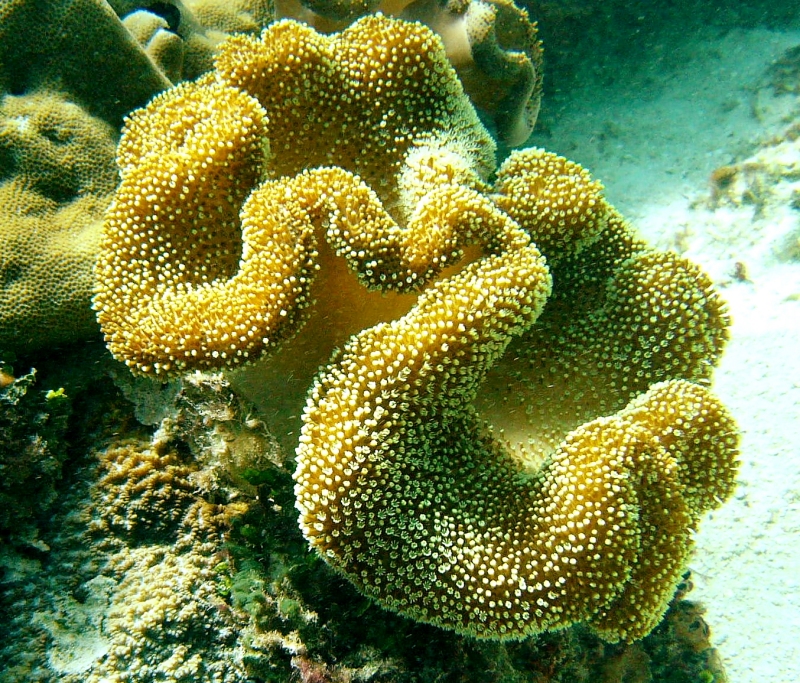
Further Sarcophyton.

Yet another variant from the Australian Great Barrier Reef.
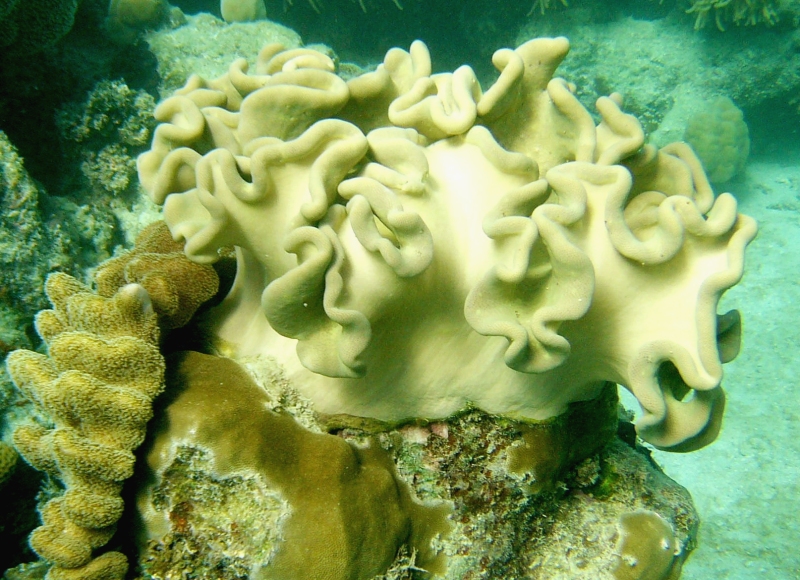
A Mushroom leather soft coral Sarcophyton from Vanuatu.
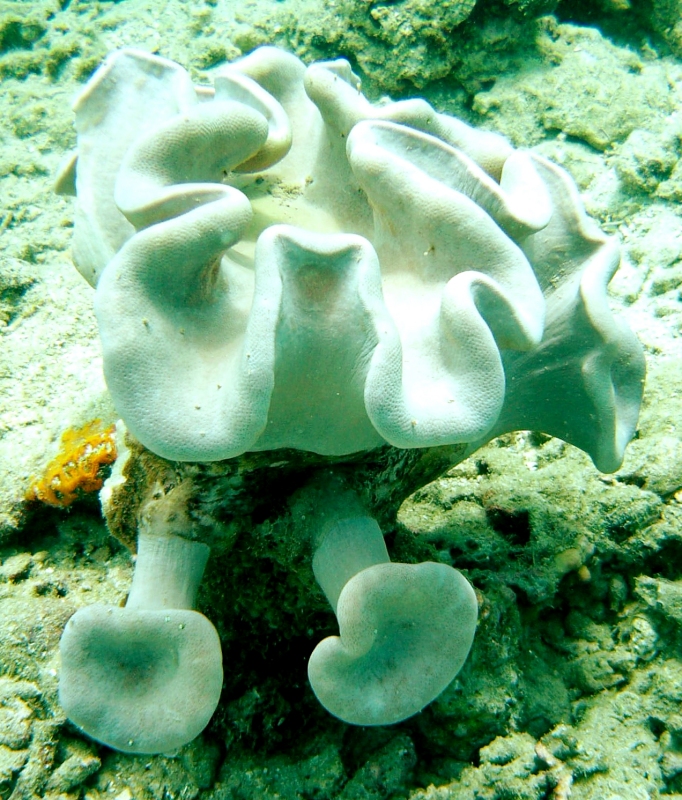
Similar to the Sarcophyton are the Sinularia family.
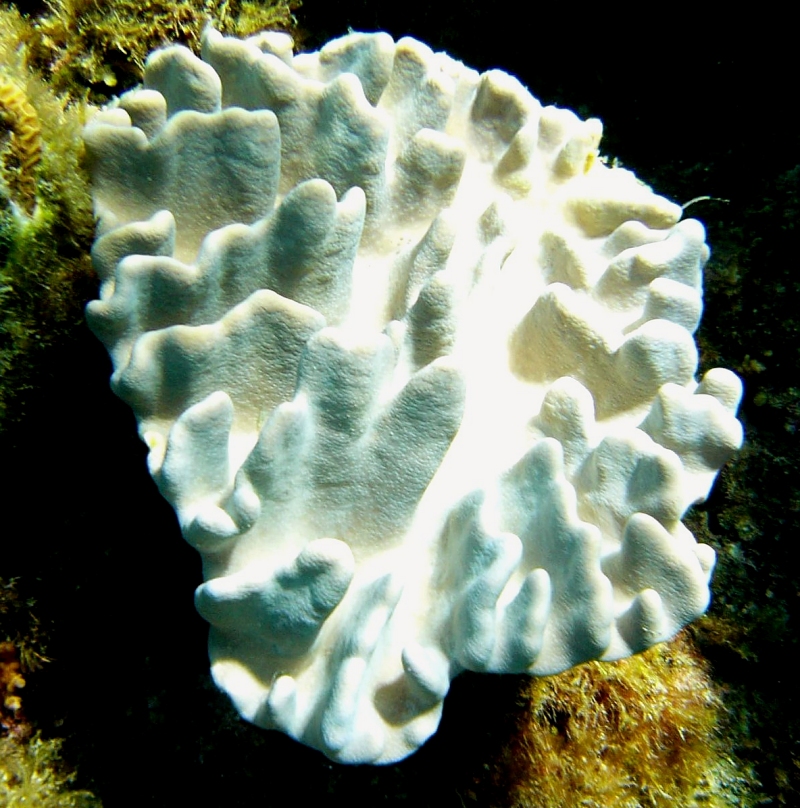
Another Sinularia.
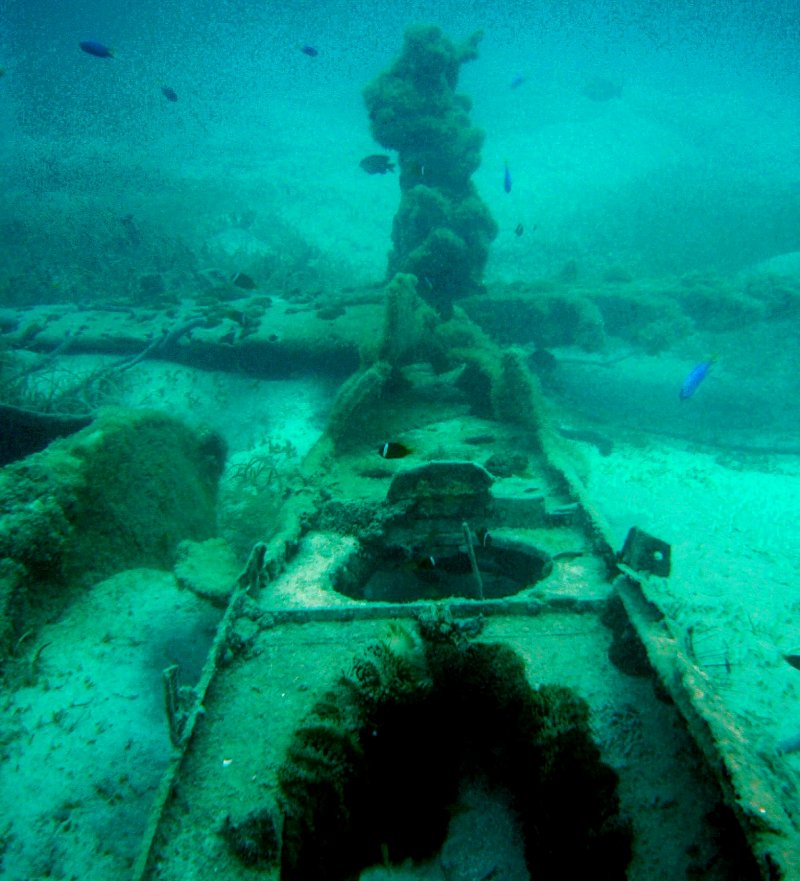
On now to some wrecks starting with the fuselage of a Bell P39 Air Cobra fighter aircraft dating from 1943. It is said that five of these US fighter aircraft deployed to Fiji in WW2 arrived with storage oil in the engines which was not changed, leading to them all being lost, one after the other. This one ditched in a lagoon on the eastern side of the island of Naviti in the Yasawas, Fiji. Fortunately the pilot escaped and was soon picked-up by a flying boat rescue aircraft. We knew of the wreck but even with a reasonably good description of the location in about 5m of water, it was surprisingly difficult to locate. First we found an undamaged propeller blade sticking up vertically out of the just visible hub, a good indicator that the engine had not been developing power as the aircraft touched water. Around 200m away we came across the fuselage. It had been marked in pencil on our second hand chart as a Spitfire which it plainly wasn't. Thanks to sailing friend Wayne, ex-airline pilot and aircraft buff, we reckon we have it right now. The identification came from the V12 Allison engine, mounted just behind the large yoke protecting the pilot. An unusual configuration as most engines were mounted ahead of the crew.
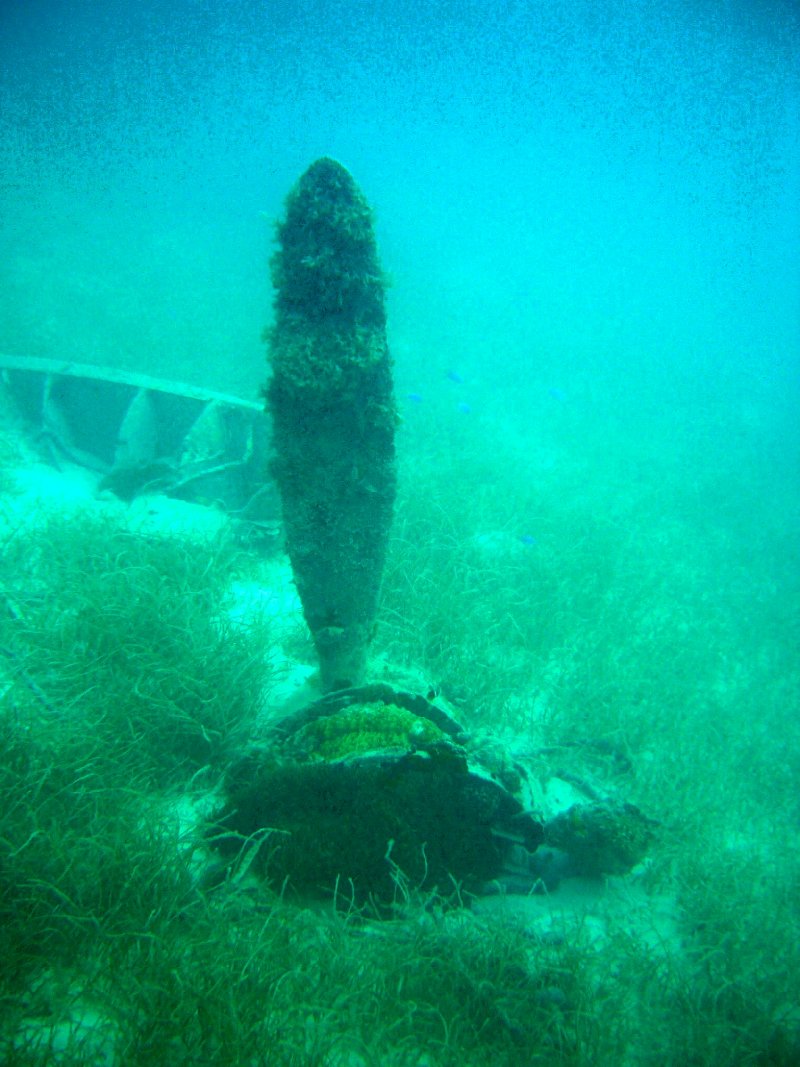
The undamaged propeller of the US, Bell P39 Air Cobra fighter blade sticking up vertically out of the just visible hub, a good indicator that the engine had not been developing power as the aircraft touched water.
The New Hebrides, as Vanuatu was known as in those days, was a major logistics base for the battle of the Coral Sea where the Allies fought to contain the Japanese southerly expansion which had reached the Solomon Islands 650nm to the north. Over one million troops passed through the island of Santo which was also had two bomber and one fighter airstrips.
At 09.35 on the 26th October 1942, the American troop ship President Coolidge hit two 'friendly' mines whilst approaching Luganville harbour on Espirito Santo, Vanuatu and was grounded on the reef by her skipper, Henry Nelson. All but one of the 5,050 military personnel survived and only one member of the crew was lost. This tragic loss was due entirely to the failure of communication between the military command on the island and the commandeered, civilian manned troopship. The vessel took the easiest of three approaches through offlying islands which had been mined. This in spite of her being in signal light communication with a frigate and patrol boat as she approached.
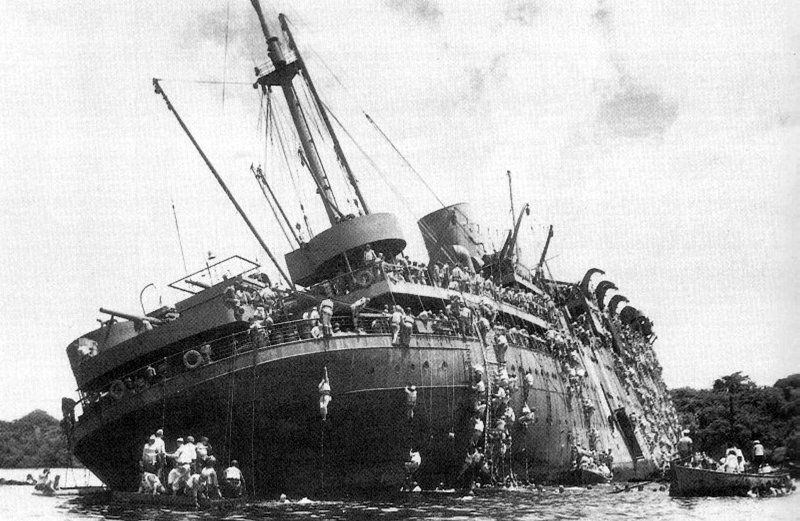
She lies on her port side with the bow 25m and stern 73m below the surface of the water. Technically, it is quite a difficult dive, not only because of the depths involved but also the navigation around such a huge ship lying on its side. Much of the time one is making use of ventilation ducts and the like to avoid areas of damage and danger. After 75 years on the bottom she has not only begun to collapse structurally but also is covered with a thick layer of growth. This can be a show stopper as the area is seismatically very active with ground shaking a common event. Should one be diving within the hull in even a mild quake, the resulting loss of visibility would make escape exceedingly difficult. Not long before Dave had his four dives on the wreck, two Japanese divers had died in these circumstances.
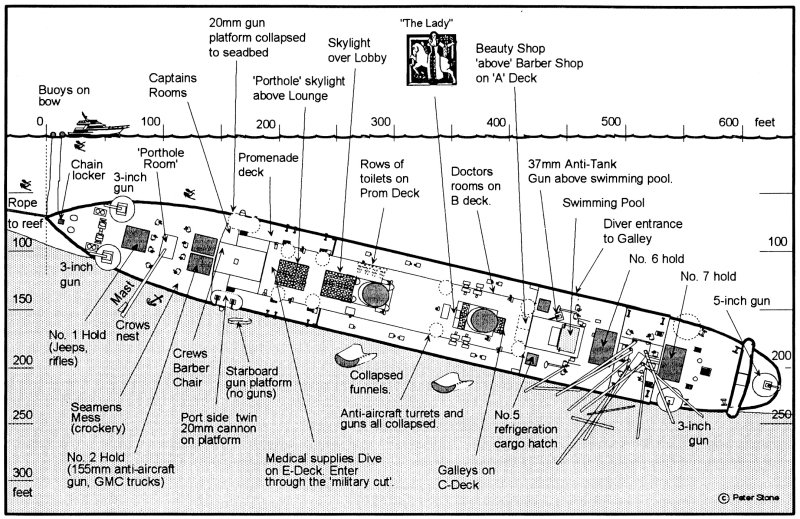
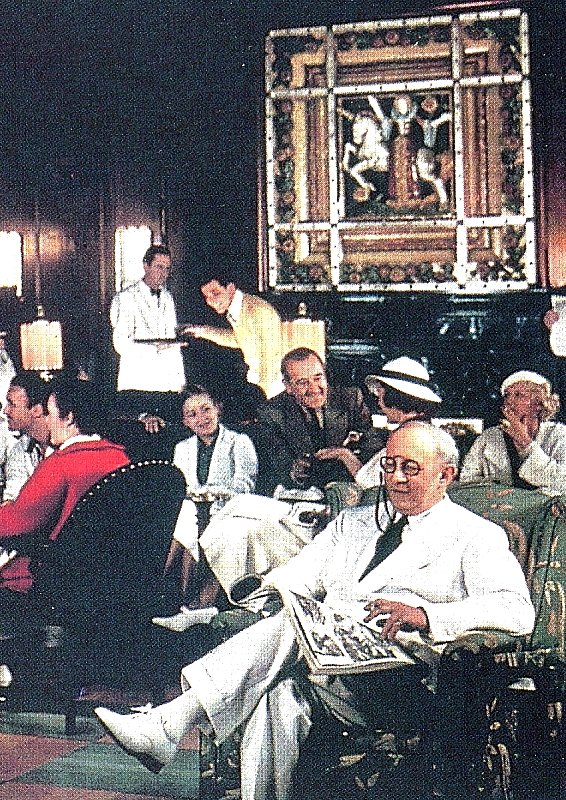
President Coolidge's keel was laid in Norfolk, Virginia on 24th March 1930 which probably explains the exotic relief mounted over the fireplace in the first class smoking lounge, depicting a 'Lady' with a unicorn. It is believed that the lady is Queen Elizabeth I and the unicorn as only a virgin can see these mythical beasts.
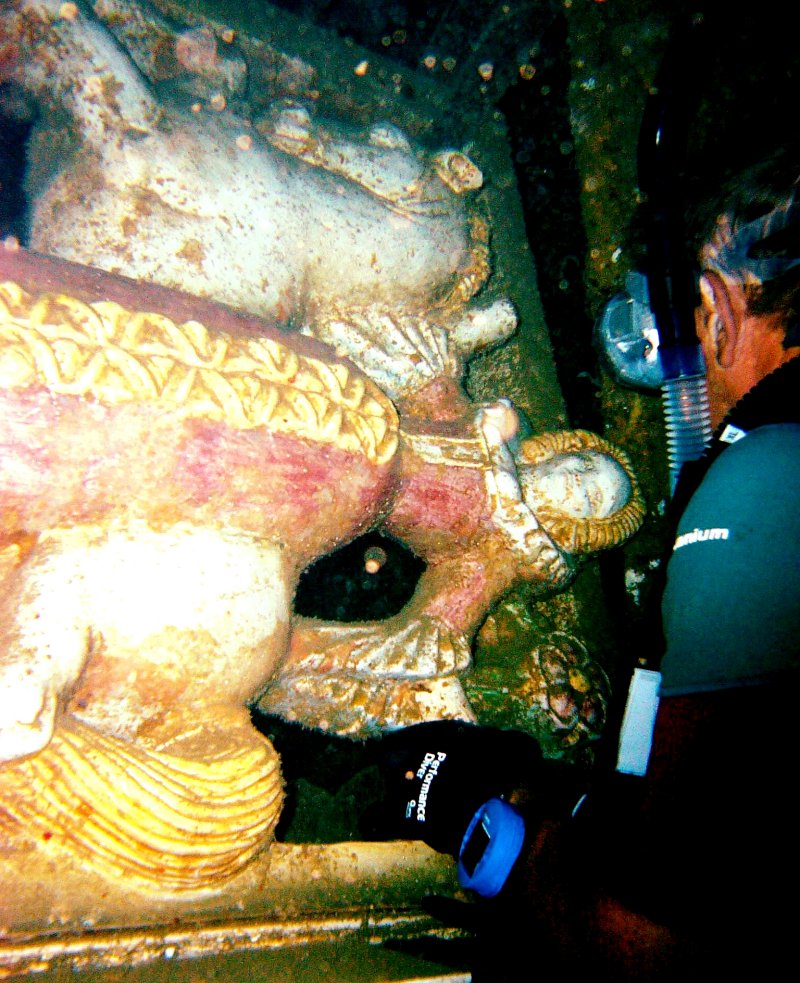
This is a close-up of the relief as we saw it with one of the Queen's arms and the horn of the unicorn missing.

Here we are with the 'Lady' in 50m of water, deep within the bowels of the President Coolidge. It is a tradition for divers to remove their demand valves to give her a kiss (known as 'going down on the Lady').
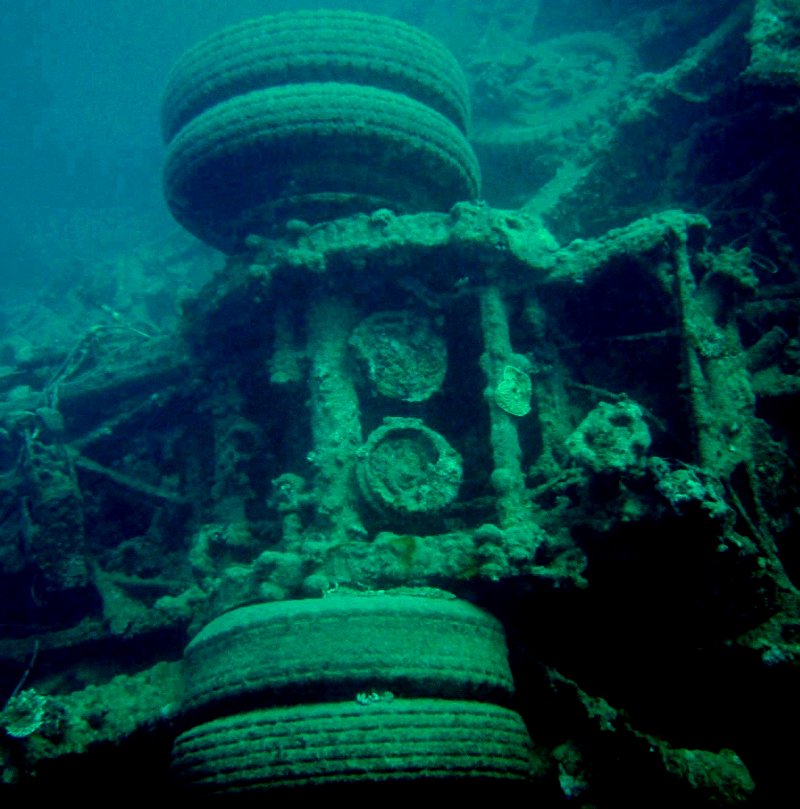
A further famous nearby diving site is known as 'Million Dollar Point' which given the intervening inflation could well justify an upgrade to Billion Dollar. This was where the withdrawing US troops built a ramp out into the reef to bulldoze into the deep thousands of tons of vehicles, building plant, military equipment, armaments and stores. The question as to why some of the construction and transportation equipment was not donated to help develop the islands for the communities who has hosted the US wartime efforts has never been satisfactorily answered. Below an upside-down, tracked bulldozer.
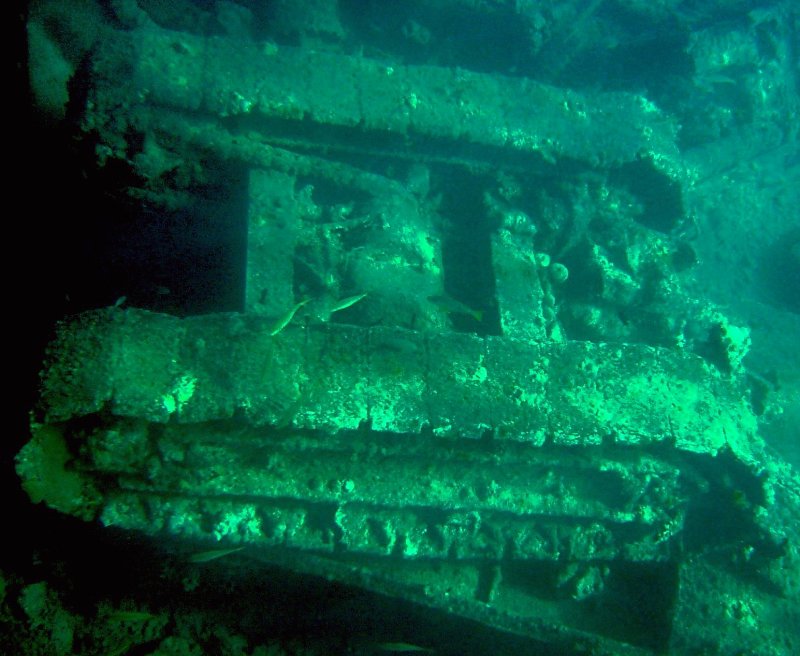
This view of the underside of the rear axle of a truck illustrates an interesting point. Though 72 years of marine growth covers the metallic surfaces, the tyres are virtually free of fouling.
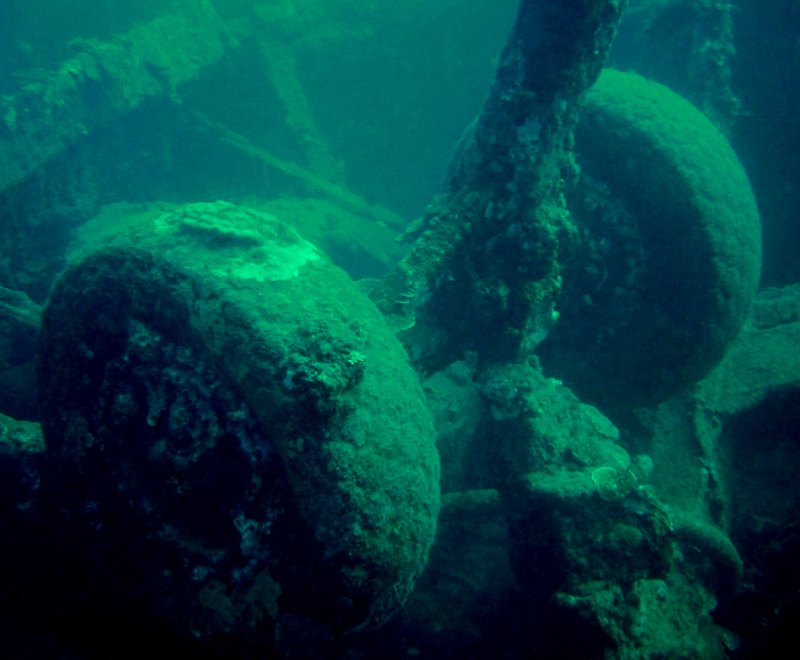
This is the undercarriage of a bomber, again showing minimal fouling. There were also scores of aircraft fuel tanks.
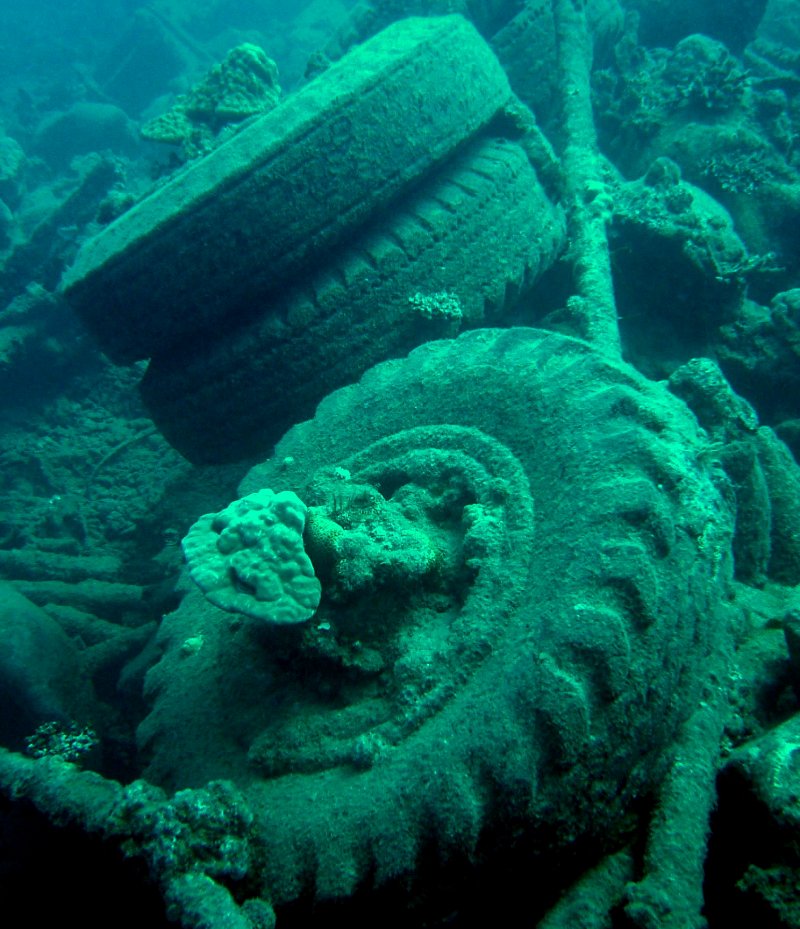
Again, an illustration that the tyres remain lightly or unfouled whilst the wheel hubs are heavily encrusted with marine growth. This encourages the thought that perhaps we should be covering the underside of our boats with vulcanised rubber rather than expensive antifouling which as to be replaced annually. A further advantage would be reduced damage from flotsam and jetsam striking a moving hull or even damage from collisions.
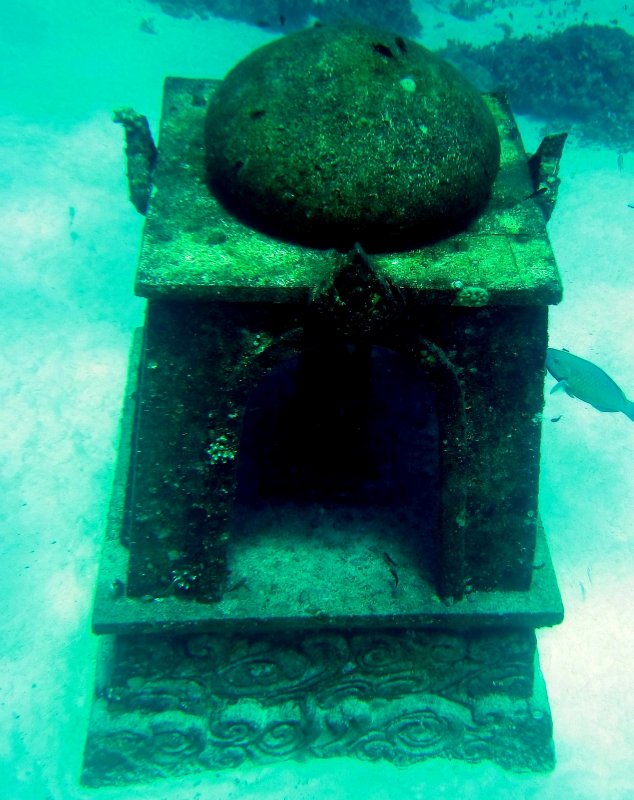
Whilst at anchor to the east of Koh Miang in the Thai Similan Islands we could just discern strange objects through the clear blue waters. A snorkel trip to around 18m revealed nothing other than a cast iron, 3m high, traditional temple complete with vertical, central tablet. Well what else? There was also a prone, full size statue of a naked wench and a row of around five huge fans. These had been sunk to provide features to enliven the excursions of commercial dive boat punters, especially on night dives.
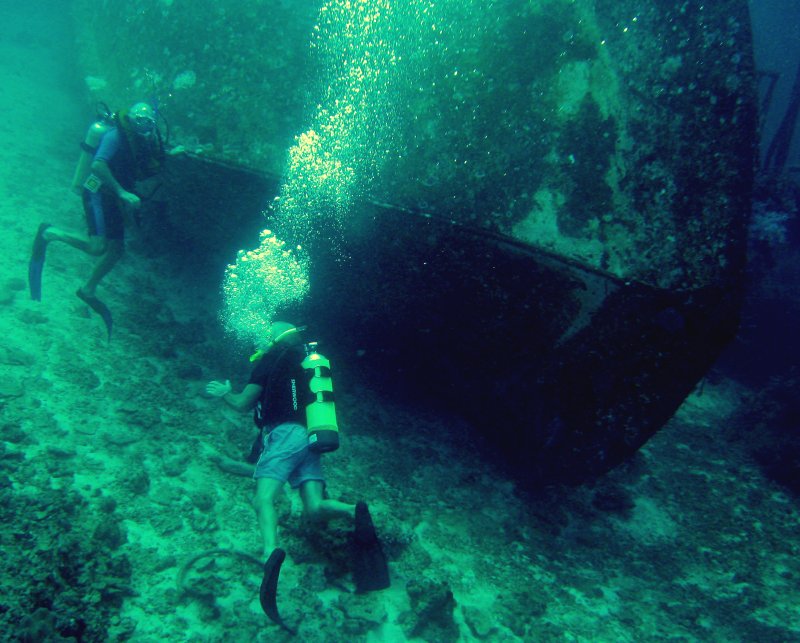
Again in the Similans, only a mile or so from where the last picture was taken, in around 35m of water lies the wreck of a Thai fishing boat. Here with cruising friends Keith and Walter, Dave is exploring the bow before entering the bowels of the boat.
Well done, if you have reached this point, congratualations. It must be time for bed!